
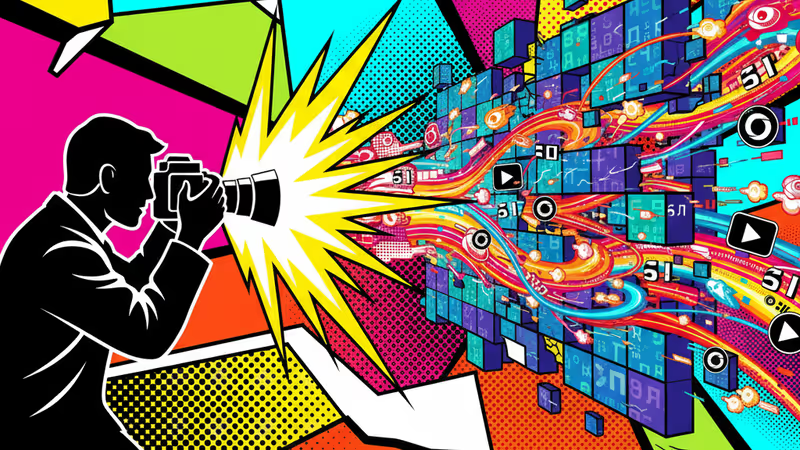
Russia's Human API: How One Photographer Pierces the Digital Iron Curtain
As Russia retreats behind a digital curtain, one photographer's work provides a rare, human API into its complex reality. This is a new form of cultural intelligence.
The Lede: Beyond the Headlines
While executives track sanctions, energy prices, and Kremlin decrees, the most crucial dataset on Russia is often overlooked: its human reality. As the nation becomes increasingly opaque—a 'black box' walled off by political and digital barriers—the work of photographers like Sergey Kolyaskin is no longer just art. It has become a form of essential, high-fidelity cultural intelligence. For leaders making decisions in a volatile global landscape, these images are a ground-truth signal in a high-noise environment, offering a glimpse into the societal mood that quantitative data can never capture.
Why It Matters: The Rising Value of Authenticity
In an era of state-sponsored narratives and the looming threat of AI-generated propaganda, the value of verifiable, on-the-ground documentation is skyrocketing. Kolyaskin’s lens provides a counter-narrative to both the polished, nationalistic story projected by the Kremlin and the often-monolithic stereotypes seen in Western media. This matters for several reasons:
- Risk Analysis: Geopolitical risk is not just about troop movements; it's about societal resilience, discontent, and normalcy. These photos—depicting everything from a solitary figure in a snowstorm to graduates celebrating—are qualitative data points on the Russian zeitgeist.
- Media & Information: As access for foreign journalists becomes more restricted, individual creators within Russia are becoming vital, if unintentional, conduits of information. They are the human APIs into a closed system.
- Brand Strategy: For the few global brands still operating in or monitoring the region, understanding the cultural texture—the blend of melancholy, absurdity, and enduring community—is critical for navigating a complex market.
The Analysis: The 'Surreal-Normal' vs. The State Narrative
Kolyaskin's work occupies a crucial space between two extremes. On one side, you have the highly manicured output of Russian state media, which emphasizes national strength and unity. On the other, you have the Western focus on overt political dissidence or geopolitical maneuvering. Kolyaskin's photography documents the vast, apolitical, and often surreal middle ground where most life happens.
His photos of 'Forgotten Villages' or a lone 'Journey Through The Puddles' speak to a theme of isolation and resilience that is core to the Russian identity but absent from official reports. This isn't journalism; it's a deeper, more ambient form of truth. It reveals the cultural substrate upon which political and economic events unfold. The simultaneous existence of bleak, snowy landscapes and vibrant human connection ('Old Friends', 'Best Friends') captures the fundamental duality of the nation—a resilience born from, and in spite of, hardship.
PRISM Insight: The 'Authenticity Premium' is the New Alpha
We are entering an economic phase where authenticity is a tradable, high-value commodity. As AI floods the digital space with synthetic content, the demand for verified, human-created artifacts will create new markets. This is the 'Authenticity Premium'.
For investors and technologists, this signals a key trend: the future lies in platforms and protocols that can verify and elevate human-centric data. Think beyond NFTs for art. Think of systems that authenticate photojournalism, on-the-ground reporting, and cultural documentation. The ability to prove that an image or story originates from a specific human at a specific time and place will become a critical component of the information economy. Investing in 'Proof of Human' technologies is a long-term bet on the enduring value of reality.
PRISM's Take
Satellite imagery can track a tank, and economic data can measure GDP, but neither can capture the feeling of a St. Petersburg 'White Night' or the quiet stoicism of a mother saying farewell to her son. Sergey Kolyaskin’s work is a powerful reminder that in our quest for data-driven omniscience, we risk losing sight of the human factor that ultimately drives history. The most sophisticated intelligence frameworks of the future will not be those with the most data, but those that can successfully integrate these 'analog' insights into their digital models. Understanding the soul of a nation, in all its weird and wonderful complexity, is the ultimate competitive advantage.
관련 기사
소셜미디어에서 유행하는 'GLP-3'의 정체는? 오젬픽 열풍을 넘어선 웰니스 정보 과잉 시대의 위험과 기회를 PRISM이 심층 분석합니다.
AI가 완벽한 이미지를 생성하는 시대, 왜 우리는 '실패한' 사진에 열광할까요? 진정성과 타이밍의 가치를 통해 콘텐츠의 미래를 분석합니다.

포토샵 없이 스마트폰 2대만으로 현실과 판타지를 결합하는 사진작가. AI 시대에 더욱 빛나는 '아날로그 AR'의 창의성과 미래 콘텐츠 트렌드를 분석합니다.

제니퍼 로렌스가 레오나르도 디카프리오의 연애사를 저격한 순간. 단순한 농담을 넘어 밈, 세대교체, 미디어 전략을 관통하는 심층 분석.