
Pluribus Finale: The Hidden Meaning Behind Rhea Seehorn’s Sci-Fi Novel Choice
Unpacking the deep symbolism behind Carol Sturka's choice of book, Ursula K. Le Guin's 'The Left Hand of Darkness', in the 'Pluribus' Season 1 finale and how it mirrors the show's core themes.
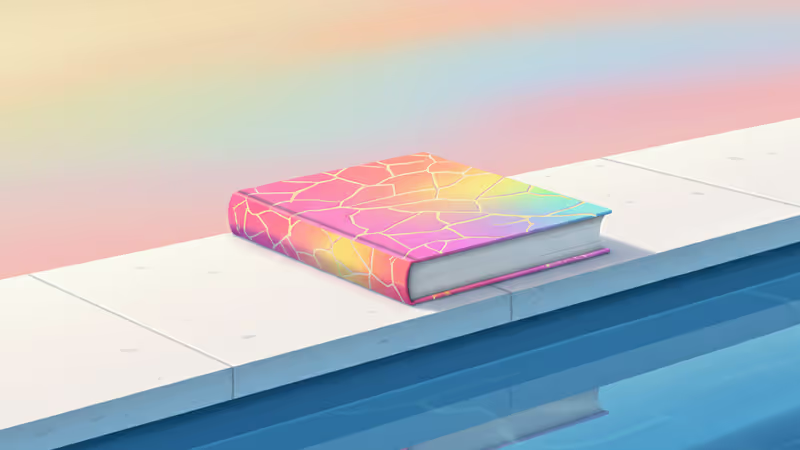
What if a character's poolside reading could unlock the entire meaning of a show? Sci-fi fans took notice when Carol Sturka (Rhea Seehorn) was spotted with a specific book in the Pluribus Season 1 finale. That book was Ursula K. Le Guin's classic, The Left Hand of Darkness, and its inclusion is far more than a simple prop—it's a crucial key to the show's central themes.
A Landmark Sci-Fi Cameo
Published in 1969, The Left Hand of Darkness is set on a frigid alien planet called Gethen, whose inhabitants are ambisexual. Their unique biology has created a society without war. The novel was a literary sensation, becoming only the second book after Frank Herbert's Dune to win both the Hugo and Nebula Awards for Best Novel, cementing its place in the science fiction canon.
A Deliberate and Symbolic Choice
The choice was intentional. In a video interview with Mashable, Rhea Seehorn explained the decision came from discussions with writers Alison Tatlock and Gordon Smith. "We talked about who Carol might read," Seehorn said, noting that Le Guin's literary level seemed like something Carol would admire. While other books like Aldous Huxley's Brave New World were considered, they ultimately settled on a female author.
The Unsettling Parallels Between Show and Novel
The book's resonance goes much deeper. "[It] holds a mirror to and has some parallels with what the audience is watching," Seehorn explained. The novel's protagonist, Genly Ai, is the sole human on Gethen, an envoy from an intergalactic coalition. His isolation among aliens is a powerful parallel to Carol's loneliness as one of the few humans immune to the alien hive mind.
However, there's a crucial difference. Genly's mission is to persuade Gethen to join a larger collective, the Ekumen. Carol, on the other hand, is fighting to stop 'The Joining,' the forcible induction of humanity into a hive mind. This contrast highlights the central conflict of Pluribus: the tension between individuality and the collective, forcing viewers to question what it truly means to belong.
본 콘텐츠는 AI가 원문 기사를 기반으로 요약 및 분석한 것입니다. 정확성을 위해 노력하지만 오류가 있을 수 있으며, 원문 확인을 권장합니다.
관련 기사

2023년 자녀 2명을 살해한 혐의를 받는 미국인 킴벌리 싱글러가 영국에서 도피 생활 끝에 미국으로 송환되었습니다. 살아남은 딸의 결정적인 증언이 사건의 진실을 밝혔습니다.

마돈나, 린다 에반젤리스타 등 할리우드 스타들의 성형수술 여정을 통해 완벽한 외모를 향한 압박과 그로 인한 예상치 못한 결과, 후회, 논란을 분석합니다.
중국 과학자들이 적정량의 돼지기름(라드) 섭취가 체지방 축적과 염증을 줄일 수 있다는 연구 결과를 발표했다. 동물성 지방에 대한 기존 상식을 뒤엎는 발견이다.

미국 시트콤 '더 미들', '프렌즈' 등으로 국내 팬들에게도 친숙한 배우 팻 핀이 3년간의 암 투병 끝에 60세의 나이로 세상을 떠났다.
2023년 자녀 2명을 살해한 혐의를 받는 미국인 킴벌리 싱글러가 영국에서 도피 생활 끝에 미국으로 송환되었습니다. 살아남은 딸의 결정적인 증언이 사건의 진실을 밝혔습니다.
마돈나, 린다 에반젤리스타 등 할리우드 스타들의 성형수술 여정을 통해 완벽한 외모를 향한 압박과 그로 인한 예상치 못한 결과, 후회, 논란을 분석합니다.
중국 과학자들이 적정량의 돼지기름(라드) 섭취가 체지방 축적과 염증을 줄일 수 있다는 연구 결과를 발표했다. 동물성 지방에 대한 기존 상식을 뒤엎는 발견이다.
미국 시트콤 '더 미들', '프렌즈' 등으로 국내 팬들에게도 친숙한 배우 팻 핀이 3년간의 암 투병 끝에 60세의 나이로 세상을 떠났다.