
US Allies' Confidence Crumbles: Poll Shows Trump's America Seen as a 'Negative Force'
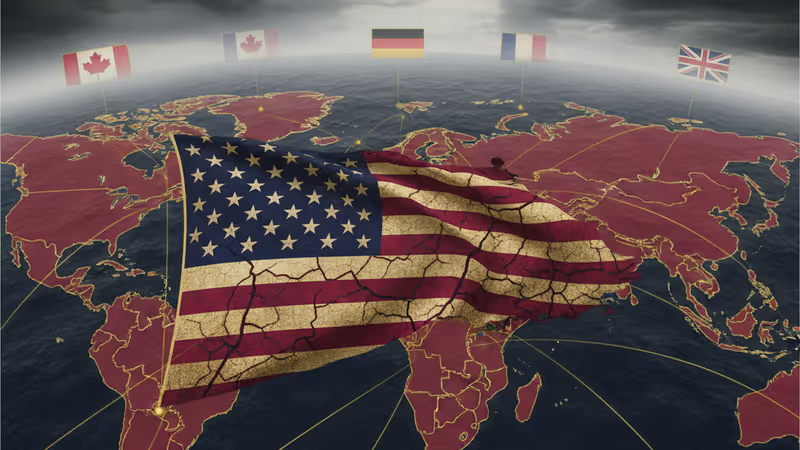
A new POLITICO-Public First poll shows a dramatic shift in perception among key U.S. allies like Canada, Germany, and France, who now view America as an unreliable and negative global force under President Trump.
Unreliable, a source of global problems, and a negative force on the world stage—this is the stark assessment of the United States held by large shares of its closest allies, according to a new international poll. The findings, from POLITICO-Public First polling, reveal the deep impact of President Donald Trump's sweeping foreign policy overhaul on transatlantic and North American relations.
A Transatlantic Trust Deficit in Numbers
The polling data paints a grim picture of America's standing. Pluralities in Germany and France, and a majority of Canadians, now say the U.S. is a negative force globally. In the United Kingdom, views are more mixed, but a significant 35% share that dim assessment.
Furthermore, near-majorities in all four allied nations believe the U.S. tends to create problems for other countries rather than solve them. When asked whether Washington supports or challenges its allies, a majority of Canadians and just under half of respondents in Germany and France say it challenges them. In the U.K., roughly 4 in 10 agree, while more than a third say the U.S. cannot be depended on in a crisis.
Allies Recalibrate Amid Trump's Doctrine
During his first year back in office, Trump has blurred traditional lines of global alliances. He recently described Europe as a “decaying” group of nations in a POLITICO interview, and his sweeping National Security Strategy argued the continent has lost its “national identities and self-confidence.” This skepticism from allied leaders is likely seeping into public sentiment, according to Matthew Kroenig of the Atlantic Council’s Scowcroft Center.
Public opinion in democracies often reflects elite opinion... you do have politicians in these countries expressing skepticism about the United States and about the Trump administration, and that's being reflected in the public opinion polling.
— Matthew Kroenig, Atlantic Council
In response, allied nations are recalibrating their policies.
- Germany: Chancellor Friedrich Merz has secured a historic spending overhaul, unlocking hundreds of billions of euros for defense, driven by wavering U.S. support for Ukraine and questions over Washington's commitment to NATO.
- France: President Emmanuel Macron is using Trump's unpredictability to bolster arguments for greater European strategic autonomy, a long-held French ambition.
- United Kingdom: Prime Minister Keir Starmer is attempting a delicate balancing act—finalizing a U.K.-U.S. trade deal while coordinating a European response on Ukraine, all without angering the White House.
- Canada: Relations have seen the sharpest deterioration amid a punishing trade war. Flavio Volpe of the Automotive Parts Manufacturers' Association noted, "People lost their jobs... and billions of dollars in Canadian capital evaporated."
A Nation Divided: American Perceptions of Its Global Role
In contrast to their allies, Americans view their own country more favorably. Overall, 51% see the U.S. as a positive force globally. However, these numbers mask a deep partisan divide.
According to Public First polling, almost half of voters who backed former Vice President Kamala Harris (47%) say the U.S. is a negative force, compared with just 13% of Trump voters. Conversely, three in four Trump voters (77%) say the U.S. is a positive force.
This shift among Democrats is recent and dramatic. Polling from October of last year found strong majorities of both Democrats (71%) and Republicans (69%) viewing America's historical role positively. One year later, while the Republican figure remains high, the Democrat figure has plummeted to 58%. Seb Wride, head of polling at Public First, notes this means "around 1 in 8 Democrats changing their views on the role the U.S. has played in its entire history, in just one year."
The poll's numbers signal more than diplomatic discontent; they reveal a fundamental erosion of trust in America's role as a global stabilizer. As allies like Germany and France accelerate their push for 'strategic autonomy,' the long-term risk is a more fragmented West, less capable of unified responses to challenges from powers like Russia and China.
본 콘텐츠는 AI가 원문 기사를 기반으로 요약 및 분석한 것입니다. 정확성을 위해 노력하지만 오류가 있을 수 있으며, 원문 확인을 권장합니다.
관련 기사
POLITICO-Public First 여론조사 결과, 트럼프 행정부 출범 이후 캐나다, 독일, 프랑스 등 핵심 동맹국에서 미국을 부정적으로 보는 여론이 급증했습니다. 동맹국들의 독자 노선 모색과 미국 내 분열된 시각을 분석합니다.

우크라이나 전장에서 서방의 첨단 무기 지원 확대와 러시아의 전술 핵무기 훈련 대응이 국제 안보 지형에 미치는 영향을 분석합니다. 지정학적 맥락, 전문가 관점, 투자 시장의 변화를 심층적으로 다룹니다.

트럼프 재선 가능성에 유럽, 아프리카 등 전 세계가 독자 생존 전략을 모색하고 있습니다. 글로벌 지정학의 거대한 전환점과 시장에 미칠 영향을 분석합니다.
블라디미르 푸틴 러시아 대통령이 '존중'을 조건으로 전쟁 종식을 언급했습니다. PRISM이 이 발언의 지정학적 함의와 서방을 향한 메시지를 심층 분석합니다.