

Navigating a Fractured World: Geopolitical Volatility and Systemic Risk
Analyze global instability: from localized violence and geopolitical stalemates to humanitarian crises. Understand systemic risks, business impact, and adaptive strategies.
The Unsettling Symphony of Global Instability
In an increasingly interconnected world, seemingly disparate events—from localized acts of violence to protracted geopolitical conflicts and escalating humanitarian crises—are not isolated incidents but rather interwoven threads in a tapestry of systemic risk. For global executives and strategic planners, these are not just headlines; they are critical indicators of operational fragility, shifting political landscapes, and the profound human cost that can cascade into economic and social disruption.
Why It Matters: Beyond the Headlines
The convergence of these events signals a period of heightened uncertainty, impacting everything from global supply chain resilience and market stability to the ethical considerations of international investment. Understanding these dynamics is paramount for anticipating regulatory changes, navigating geopolitical headwinds, and upholding corporate social responsibility in an era where local instability can quickly ripple across borders.
The Analysis: Fault Lines and Feedback Loops
Recent events underscore a global environment characterized by persistent security threats, unresolved conflicts, and profound human suffering, often exacerbated by political opportunism and deep-seated societal divides.
- Persistent Security Threats: From the tragic knife attack in Taiwan to the call for 'moral courage' after the Bondi shooting, domestic security challenges remain a critical concern, often mirroring broader societal stresses. Internationally, the US aerial bombardment against 'ISIS thugs' in Syria highlights the enduring challenge of non-state actors and the complex, often interventionist, responses of global powers. These incidents collectively contribute to a pervasive sense of insecurity that influences everything from travel advisories to foreign investment decisions.
- Enduring Geopolitical Stalemate: The question of Russia's war on Ukraine finding an end, met with Putin's silence, signifies a strategic stalemate with profound implications for global energy markets, food security, and the international rule of law. This ambiguity suggests a prolonged conflict, embedding geopolitical risk into long-term business planning. Similarly, the heart-wrenching death of a baby due to hypothermia in Gaza casts a stark light on the humanitarian catastrophe unfolding amidst the Israeli-Palestinian conflict, demonstrating how civilian populations bear the brunt of geopolitical tensions. This crisis not only highlights human rights concerns but also fuels regional instability and international diplomatic friction.
- The Politics of Symbolism and Dissent: The decision to add 'Trump-Kennedy Center' to the venue's façade is a potent example of how domestic political symbolism can both reflect and deepen societal polarization, even impacting cultural institutions. Simultaneously, the massive turnout for a Bangladeshi activist's funeral underscores the enduring power of civil society and public dissent in shaping national narratives and challenging political establishments, a force that can drive significant change or provoke state responses.
PRISM Insight: Resilience in a Volatile World
The current geopolitical landscape demands an aggressive focus on predictive analytics and robust risk mitigation strategies. Companies must invest in sophisticated AI-driven tools to anticipate political instability, map supply chain vulnerabilities, and model the impact of humanitarian crises on market sentiment and consumer behavior. Furthermore, the rise of 'humanitarian tech'—from rapid deployment communication networks to data platforms for aid distribution—will become increasingly critical, offering both an investment opportunity and a moral imperative for tech leaders.
PRISM's Take: Adaptive Strategies for a Fragmented Future
The confluence of these global events paints a picture of a world in flux, where traditional geopolitical anchors are shifting. Leaders must adopt an adaptive, empathetic, and data-driven approach. This involves not only understanding the immediate impacts of conflict and crisis but also recognizing the underlying trends of societal fragmentation, humanitarian challenges, and the complex interplay of state and non-state actors. Future-proof strategies will prioritize ethical governance, sustainable investment, and an unwavering commitment to understanding the human element at the heart of every geopolitical storm. Ignoring these signals is not an option; proactive engagement and strategic foresight are the only paths forward.
관련 기사

노스캐롤라이나 럼비 부족이 132년 만에 완전한 연방 인정을 받았습니다. 이 역사적인 결정의 배경, 글로벌 지정학적 함의, 그리고 경제 및 기술적 파급효과를 PRISM이 심층 분석합니다.
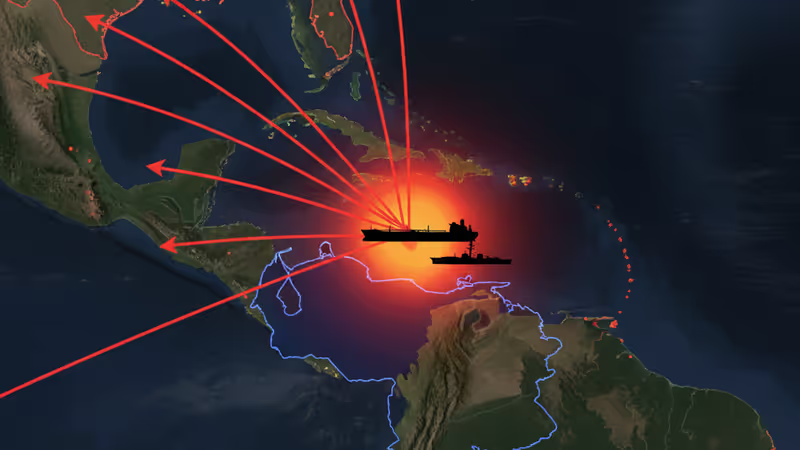
미국의 베네수엘라 유조선 나포가 카리브해 지정학적 긴장을 격화시키며 국제 해상법에 대한 논쟁을 촉발했습니다. PRISM이 이 사건의 배경, 파장, 그리고 미래 해상 감시 및 물류 기술에 미칠 영향을 분석합니다.
우크라이나 전선 격화 속 미국의 3자 회담 제안, 지정학적 함의와 전장 기술, 에너지 안보 및 국제 금융 시스템에 미칠 영향을 PRISM이 심층 분석합니다.
미국과 러시아 특사단이 마이애미에서 우크라이나 전쟁 종식 논의를 재개했습니다. 진전과 이견이 교차하는 가운데, 이 대화가 글로벌 지정학에 미칠 영향을 분석합니다.