
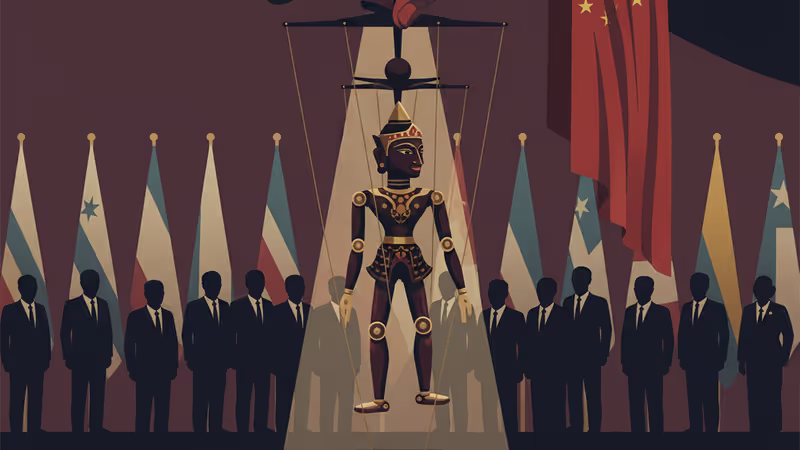
China's Gambit: Why Myanmar's Junta Is Finally Holding Its Long-Promised Election
Nearly five years after its coup, Myanmar's military is holding an election. Driven by Chinese pressure and a battlefield turnaround, the vote is designed not to restore democracy but to consolidate military rule under a civilian guise.
Nearly five years after seizing power in a coup inFebruary 2021, Senior GeneralMin Aung Hlaing is following through on his pledge to hold an election. After a brutal civil war that has killed tens of thousands, nobody expects the vote to be free or fair. The country's most popular political party, theNLD, is banned from competing. So why now? The answer lies in a combination of overwhelming pressure fromChina and a dramatic reversal of fortune on the battlefield.
A Return from the Brink
Just over a year ago, the military regime seemed to be in terminal decline. InOctober 2023, a powerful coalition of ethnic armed groups known as theThree Brotherhood Alliance launched a stunning offensive, capturing major towns and military bases. Images of seized tanks and hundreds of surrendering regime soldiers flooded social media, fueling a belief that the dictatorship was on the verge of collapse.
Fearing that a victorious pro-democracy movement would be too close to the West,China intervened to an unprecedented degree. According to reports,Beijing pressured the Alliance groups on its border to sign a ceasefire, closing border crossings they rely on for supplies and forcing them to return key territories to junta control. ByDecember 2024, Chinese officials were overseeing a ceremony where the major northern city of Lashio was handed back to the regime without a fight. This intervention saved the junta from collapse.
An Election by Design, Not by Choice
Owing its survival toChina, the junta is now under intense pressure to satisfy its benefactor’s demand for an election. With the military back in a dominant position,Min Aung Hlaing also feels politically secure enough to stage a carefully managed vote. It’s less a political transition and more “a procedural exercise to consolidate military rule behind a thin civilian veneer,” says Richard Horsey, senior Myanmar advisor for the International Crisis Group.
The election's structure is engineered to guarantee military control. Voting will be cancelled in nearlyhalf of townships. Paradoxically, this strengthens the military's hand. Under the 2008 constitution, the military directly appoints25% of parliamentary seats. As analyst Min Zaw Oo notes, with fewer elected seats in play, this appointed bloc will constitute a significantly larger percentage of the total, giving the junta an even tighter grip on power.
The timing also serves to undermine the oppositionNUG. The NUG's mandate stems from the2020 election, which is now set to expire. Having already lost relevance due toChina's hostility and its inability to command the loyalty of all anti-junta forces, the NUG is being further politically and militarily isolated.
This election isn't a step toward resolution but the formalization of a new, China-influenced reality in Myanmar. It aims to sideline Western-leaning democratic forces for good and create a managed, authoritarian state that secures Beijing's strategic interests. The key question is no longer if the junta will fall, but how power will be shared among pro-military elites under China's watchful eye.
본 콘텐츠는 AI가 원문 기사를 기반으로 요약 및 분석한 것입니다. 정확성을 위해 노력하지만 오류가 있을 수 있으며, 원문 확인을 권장합니다.
관련 기사
미얀마 군부가 2021년 쿠데타 이후 약 5년 만에 총선을 강행한다. 중국의 압력과 전세 역전이 배경으로, 민주 진영이 배제된 채 군부 통치를 공고히 하려는 의도가 깔려있다.

이스라엘의 '가자 영구 주둔' 선언부터 러시아의 우크라이나 공습까지, 전 세계적으로 강경 발언과 비타협적 태도가 확산하며 외교적 해법의 공간이 축소되고 있다.

미국 CBS 뉴스가 트럼프 행정부의 이민자 추방과 연관된 엘살바도르 교도소 고발 보도를 방영 직전 취소해 '정치적 검열' 논란에 휩싸였다. 모기업의 인수합병을 앞두고 행정부 압력에 굴복했다는 비판이 거세다.

미국 무역대표부(USTR)가 중국의 반도체 정책을 '불공정하고 차별적'이라 공식 판정하고, 18개월 후 인상되는 '0% 유예 관세' 조치를 발표했다. 이는 미중 기술 패권 경쟁의 새로운 압박 카드로 분석된다.