
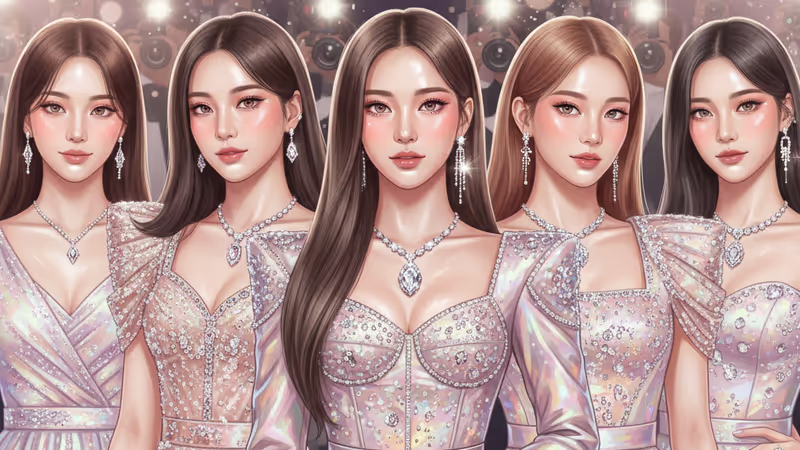
MMA 2025 Red Carpet: Decoding the Billion-Dollar Brand Strategies Behind the Looks
The MMA 2025 red carpet isn't just fashion. It's a battleground for brand deals, tech innovation, and K-Pop's global economic influence. PRISM analyzes.
The Lede: Beyond the Velvet Rope
The Melon Music Awards 2025 red carpet is not a fashion parade; it's a real-time display of multi-billion dollar economic strategy. For the C-suite executive, this is not about celebrity gossip. It is a critical case study in brand architecture, global market penetration, and the calculated deployment of cultural soft power. The choice of a tuxedo or gown is a move on a global chessboard, with implications for luxury goods markets, entertainment stock valuations, and the future of fan engagement technology.
Why It Matters: The New Currency of Culture
What happens on the red carpet has immediate and significant second-order effects. A single, well-placed look does more than generate social media buzz; it functions as a strategic asset with quantifiable ROI:
- Market Creation: When a top-tier idol wears an emerging Korean designer, it can trigger global distribution inquiries overnight, effectively creating a new market for that brand.
- Ambassadorship as Equity: These are not simple endorsements. They are long-term partnerships that directly influence luxury brand stock prices. A successful red carpet appearance by a brand ambassador like IDID's members for global fashion houses is a direct signal of market resonance to investors.
- IP Fortification: For entertainment agencies, the red carpet is a showcase of their management prowess. The curated looks reinforce a group's specific 'concept' or intellectual property, strengthening their global brand and downstream revenue opportunities from tours to merchandise.
The Analysis: From Uniformity to Individuality Inc.
Two decades ago, K-Pop red carpets were defined by coordinated, often domestically-sourced, group outfits designed to emphasize collective identity. The MMA 2025 carpet marks the final stage of a seismic shift. The dominant trend is now the ‘Group as a House of Brands,’ where each member is a distinct profit center with their own global luxury ambassadorship.
This evolution reflects the maturation of the K-Pop industry from a music exporter to a sophisticated manager of global talent IP. We've moved from the era of SM Entertainment’s synchronized aesthetics to HYBE's model of leveraging superstar individuality. This creates a competitive dynamic not just between entertainment companies, but between the French, Italian, and American luxury conglomerates like LVMH and Kering, who now see Seoul as a primary battleground for capturing the next generation of consumers. The fact that a rookie group chose a sustainable Seoul-based designer this year is a counter-maneuver, a signal of nationalistic 'cool' and a potential threat to the dominance of established European houses.
PRISM Insight: The Red Carpet as a Data Goldmine
The real story isn't just the fabric; it's the data stack behind it. The most advanced labels and agencies are no longer guessing at impact. They are deploying AI-powered analytics to measure the 'Red Carpet ROI' in real-time:
- Earned Media Value (EMV): Sophisticated platforms are scraping millions of social media posts, articles, and fan comments to assign a dollar value to every second an idol is on camera wearing their brand.
- Sentiment & Trend Analysis: AI tools are analyzing the emotional response to outfits, identifying breakout trends that will inform next season's collections and marketing campaigns.
- The Next Frontier - Phygital Assets: We are seeing the first experiments with digital-only accessories, visible via AR filters on red carpet broadcasts. This is a clear investment signal for companies operating at the intersection of Web3, fashion, and fandom. The virtual twin of an idol's outfit, sold as an NFT for a metaverse, is the next logical—and highly lucrative—step.
PRISM's Take: The K-Pop Conglomerate is a Fashion-Tech Hybrid
The Melon Music Awards 2025 red carpet solidifies a fundamental truth: the K-Pop industry has transcended entertainment. It is now a highly efficient engine for global commerce and a testbed for the future of marketing. The most powerful agencies are now operating as hybrid tech/media/fashion conglomerates, with the red carpet serving as their quarterly shareholder presentation. Ignore the flashbulbs and watch the brand choices. They are a more accurate predictor of future market movements and consumer trends than any traditional industry report. The key takeaway is that an idol's outfit is no longer just a statement; it's a balance sheet.
관련 기사

NCT WISH 료의 MMA 2025 불참 소식. 신인 아이돌의 건강 관리 시스템과 K팝 산업의 지속 가능성에 대한 심층 분석을 확인하세요.
MMA 2025 레드카펫 패션을 심층 분석합니다. 단순한 스타일을 넘어 K팝 산업의 미래 전략, 브랜드 파워, 기술 트렌드를 읽어보세요.

2023년 신곡 없이 '올해의 가수' 1위에 오른 지드래곤. K팝 전문가들이 그를 선택한 이유와 이것이 업계의 미래에 시사하는 바를 심층 분석합니다.

263만 유튜버 나름TV의 K팝 아이돌 학폭 폭로 사건을 심층 분석합니다. 크리에이터 경제와 팬덤 문화가 충돌하며 K팝 산업의 검증 시스템에 중대한 질문을 던집니다.