
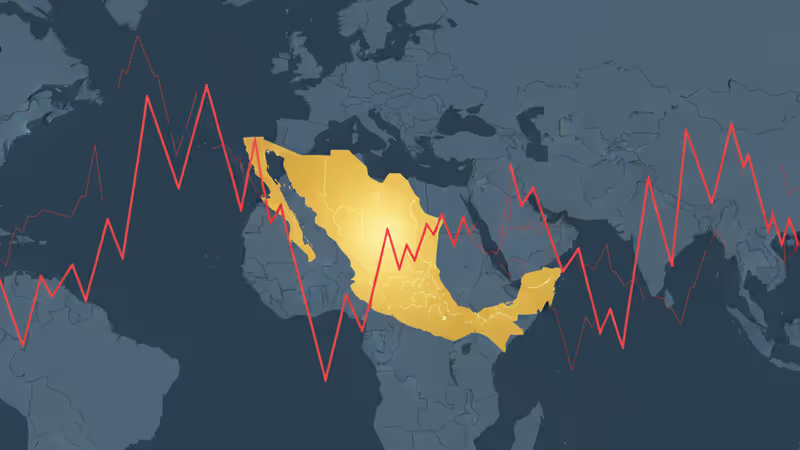
Mexico's Supermajority Shock: Sheinbaum's Mandate vs. Market Meltdown
Mexico's historic election gave Claudia Sheinbaum a powerful mandate, but spooked markets. Our analysis of the geopolitical risk for investors and nearshoring.
The Lede: A Landslide Mandate Meets a Wall of Worry
Mexico just delivered a historic landslide victory to President-elect Claudia Sheinbaum and her Morena party, handing them a potential congressional “supermajority.” For investors and global executives, this isn't just a political headline; it's a flashing red light on the dashboard. The subsequent market crash—with the peso and stock market plummeting—signals a fundamental clash between a powerful democratic mandate and the institutional stability required for global business. The core question now facing every company with exposure to Latin America's second-largest economy is stark: Will Mexico double down on the populist policies that spook investors, or will pragmatism prevail?
Why It Matters: The Nearshoring Dream at a Crossroads
The market panic goes far beyond currency fluctuations. At stake is the entire “nearshoring” thesis that has positioned Mexico as the primary beneficiary of US-China supply chain diversification. Billions in planned investments are predicated on a stable, predictable legal and regulatory framework. The prospect of a supermajority able to unilaterally amend the constitution raises critical risks:
- Institutional Erosion: The most controversial proposed reform—allowing popular election of Supreme Court justices—is seen by investors as a direct assault on judicial independence. This threatens the impartial rule of law, the bedrock of contract enforcement and investment protection.
- Regulatory Upheaval: Plans to dismantle autonomous regulators in sectors like energy and telecommunications could unwind years of market liberalization, reintroducing state interventionism and jeopardizing private and foreign capital.
- USMCA Jitters: With a mandatory review of the US-Mexico-Canada Agreement (USMCA) looming in 2026, any move that undermines investor protections or creates an uneven playing field could create significant friction with Washington, regardless of who occupies the White House.
The Analysis: The Ghost of AMLO's Unfinished Agenda
This market reaction isn't about Sheinbaum herself—a scientist with a reputation for being more data-driven than her populist predecessor, Andrés Manuel López Obrador (AMLO). Instead, the market is pricing in the risk that she will be forced, or politically inclined, to execute AMLO's most radical, unfulfilled ambitions. For six years, a divided congress acted as a crucial check on his power, blocking these very constitutional changes. The election has potentially removed that barrier.
Sheinbaum's administration now faces a classic emerging market dilemma. On one hand, she has an undeniable mandate from over 35 million voters to deepen the “Fourth Transformation”—a political project focused on social programs and state power. On the other, the sharp, immediate rebuke from global markets demonstrates the economic constraints she operates under. Her initial moves, such as retaining the current finance minister and promising central bank autonomy, are classic signals designed to calm nerves. However, her simultaneous push for a “broad survey” on judicial reform is seen by skeptics as political theater—a way to legitimize a predetermined outcome rather than a genuine consultation.
PRISM Insight: The September Cliff
For investors and policymakers, the calendar is now critical. The new Congress takes office on September 1st, a full month before Sheinbaum's inauguration on October 1st. This creates a dangerous lame-duck window where the new, Morena-dominated legislature could theoretically pass controversial reforms with the political backing of the outgoing President AMLO, presenting Sheinbaum with a fait accompli.
The key metric to watch is not just Sheinbaum's rhetoric, but the composition of her cabinet and the final seat count in Congress. If hardliners secure key economic and energy posts, it will signal a tilt towards ideology over pragmatism. Conversely, if technocrats are empowered, it may suggest an internal understanding of the need to maintain market confidence. The nearshoring investment boom is fueled by capital that is both massive and mobile; if the perception of political risk solidifies, that capital will find new homes in Southeast Asia or other Latin American nations.
PRISM's Take: A High-Stakes Balancing Act
President-elect Sheinbaum is navigating a political minefield. She must appease the populist base that gave her an overwhelming victory while simultaneously reassuring the global capital markets that Mexico needs for growth and stability. The market's visceral reaction was a warning shot, reminding the incoming government that even the strongest mandate is subject to economic gravity.
The dream of Mexico as the undisputed hub of 21st-century nearshoring hinges on institutional certainty. The first and most important test of the Sheinbaum era will be her handling of these constitutional reforms. Her choice is clear: either consolidate political power at the expense of institutional checks and balances, risking a flight of capital and confidence, or moderate her agenda to preserve the very framework that has made Mexico an investment magnet. The future of North American economic integration hangs in the balance.
관련 기사

시드니 본다이 비치 테러는 단순한 비극을 넘어, 글로벌 분쟁이 호주의 다문화 사회에 미치는 영향을 드러냅니다. PRISM이 그 지정학적 함의를 심층 분석합니다.

교황의 수원교구 보좌주교 임명은 단순 인사가 아니다. '한국의 실리콘밸리'에서 가톨릭교회의 미래 역할에 대한 바티칸의 전략적 포석을 분석한다.

임란 칸 전 파키스탄 총리에게 추가 징역형이 선고되었습니다. 단순한 부패 사건을 넘어, 총선을 앞둔 군부의 정치 개입과 지정학적 미래를 분석합니다.

중국 난징 GPS 마비 사태는 단순 기술 문제를 넘어, 미중 기술 패권 경쟁과 회색지대 전쟁의 현실을 보여줍니다. 지정학적 함의와 미래 PNT 기술을 분석합니다.