
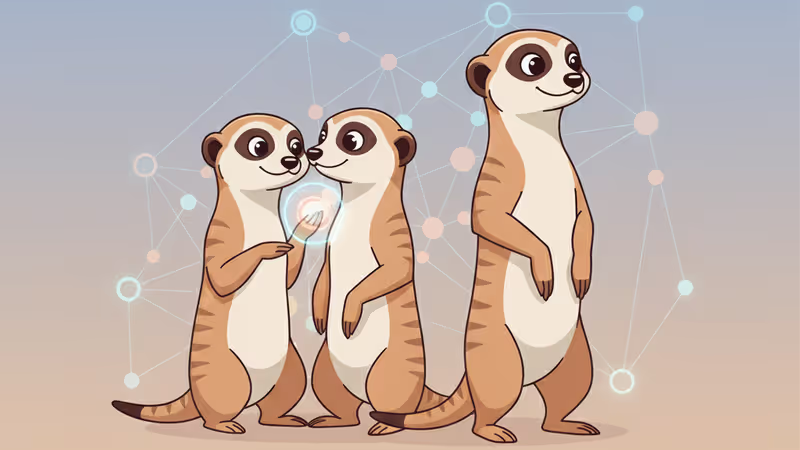
Kalahari's Unsung CEOs: Meerkat Lessons in Distributed Intelligence and Adaptive Teams
Discover how meerkat survival strategies in the Kalahari offer profound lessons for business leaders on distributed intelligence, team agility, and resilience in a dynamic world.
The Kalahari Blueprint for Modern Business Agility
Forget the latest Silicon Valley startup manifesto. Sometimes, the most profound insights into operational resilience and team cohesion come from the most unexpected places. Take the humble meerkat. While a wildlife photographer's close encounters might seem like mere entertainment, PRISM sees a potent metaphor for the challenges and strategies defining today's volatile business landscape.
In a world where threats emerge from every direction – be it market disruption, cyberattacks, or supply chain vulnerabilities – the meerkat's finely tuned system of distributed vigilance, communal support, and rapid adaptation offers a blueprint. For any executive grappling with how to build an organization that is both robust and agile, the Kalahari provides a masterclass.
Why It Matters: Beyond the C-Suite, Into the Wild
The core lesson from these 'desert fluffballs' isn't about their cuteness; it's about their survival strategy. Their behavior—from a sentry perched atop a human head, scanning for predators, to a dozen pups snuggling for warmth—illustrates critical principles for modern organizations:
- Distributed Intelligence: No single meerkat is solely responsible for security. Every member contributes to a collective awareness. This mirrors the need for pervasive threat intelligence and decentralized decision-making in enterprises, where every employee is a potential sensor in the organizational nervous system.
- Adaptive Vigilance: The 'shoulder scout' and 'double vigilance' aren't static roles; they adapt to immediate needs. In business, this translates to dynamic risk management, real-time market sensing, and the ability to pivot strategies based on immediate feedback, rather than rigid, annual plans.
- Community Cohesion: The 'group sunbath' and 'cuddling' reinforce social bonds, which are vital for trust and swift coordinated action. High-performing teams, especially in remote or hybrid models, require intentional efforts to build psychological safety and shared purpose, fostering an 'all for one' mentality when facing external pressures.
- Resourceful Agility: A meerkat making a 'dinner dash' with a scorpion exemplifies opportunistic resourcefulness. In competitive markets, companies must be agile in identifying and seizing opportunities, often with limited resources, turning potential threats (like a venomous scorpion) into sustenance.
The Analysis: From Hierarchy to Hyper-Collaborative Networks
Historically, many corporate structures operated like solitary predators, or at best, small, insular packs. Decision-making was centralized, information flowed vertically, and vigilance was confined to specific departments. This 'single sentinel' approach is increasingly fragile in the face of complex, interconnected threats.
The meerkat model, however, represents a highly evolved, hyper-collaborative network. Their survival depends on constant communication, shared responsibility, and a seamless blend of individual action within a collective strategy. This directly challenges traditional top-down hierarchies, advocating for flatter, more autonomous team structures where leadership is often distributed and context-dependent. Competitive dynamics today are less about brute force and more about the speed of information processing, the resilience of internal networks, and the collective capacity to adapt.
PRISM Insight: Investing in the Next Generation of Organizational AI
For investors and tech leaders, the meerkat provides a compelling analogy for the future of organizational design and enabling technologies. We are seeing a surge in platforms and methodologies that mimic this distributed intelligence:
- AI for Anomaly Detection: Systems that continuously monitor vast datasets for subtle indicators of threats or opportunities, acting as digital sentinels.
- Decentralized Autonomous Organizations (DAOs): Emerging structures exploring truly distributed decision-making and governance.
- Agile & DevOps Methodologies: Emphasizing cross-functional teams, rapid iteration, and continuous feedback loops—a human-driven form of adaptive vigilance.
- Collaboration & Knowledge Management Tools: Essential for fostering the 'cuddling' and 'clan' dynamics necessary for a cohesive, informed workforce.
Investing in technologies and cultural shifts that empower every 'meerkat' in the organization to be a sensor, a contributor, and a protector is no longer optional; it's foundational for future growth and resilience.
PRISM's Take: Cultivating Your Corporate Kalahari
The raw, unfiltered reality of the Kalahari Desert reveals a powerful truth: survival and prosperity in harsh environments hinge on collective intelligence, unwavering vigilance, and robust community bonds. For global enterprises, the message is clear: foster a culture where every team member is empowered to be a lookout, where information flows freely, and where collaboration is the instinctual response to any challenge. Building a corporate 'Kalahari' means embracing distributed intelligence and nurturing adaptive teams. This isn't just a strategy for survival; it's the pathway to undisputed market leadership.
관련 기사

테일러 스위프트와 트래비스 켈시 커플이 스포츠와 팝 문화를 융합하며 창출하는 전례 없는 문화적, 경제적 파급력을 분석합니다. 팬덤 경제와 미래 마케팅 전략에 미치는 영향을 PRISM이 심층 조명합니다.
할리우드 거장 롭 라이너 가족의 비극은 중독 치료의 현주소를 조명합니다. 닉 라이너 사건을 통해 중독 치료의 비용, 효과성, 시스템 한계, 그리고 미래 기술의 역할을 분석합니다.
제임스 카메론 감독이 '아바타: 불과 재'에서 가장 아끼는 장면으로 '에로틱한 마약 환각' 시퀀스를 꼽으며, 판도라 서사의 어둡고 심층적인 진화를 예고했습니다.

2019 국제 풍경 사진전은 기술과 예술의 결합, 포스트 프로덕션의 자유, AI 시대 창작자의 역할 변화를 보여주며 미래 비주얼 콘텐츠의 방향을 제시합니다.