
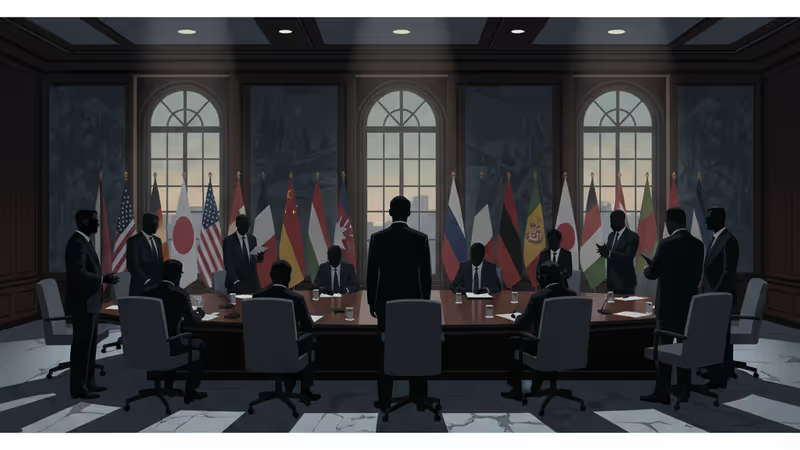
Global Geopolitical Fractures: Gaza, Ukraine, and the Unraveling Threads of Stability
Analyze geopolitical fault lines from Gaza's humanitarian crisis to Ukraine's war, exploring global stability, polarization, and impacts on business and policy.
The Lede
In an increasingly interconnected world, seemingly localized crises are rapidly morphing into systemic risks, demanding urgent attention from global leaders and business executives alike. From the escalating humanitarian catastrophe in Gaza to the protracted stalemate in Ukraine, and the profound political polarization witnessed globally, the underlying currents signal a fragile international order. For a busy executive, these aren't just headlines; they represent tangible threats to supply chains, investment stability, and the very fabric of global commerce.
Why It Matters
The implications extend far beyond immediate conflict zones. Protracted geopolitical instability erodes investor confidence, necessitates costly supply chain diversification, and diverts vast resources towards humanitarian aid and security measures. The deepening humanitarian crisis in Gaza, underscored by the tragic death of an infant due to hypothermia and the plight of hunger strikers, strains international aid mechanisms and challenges global norms on human rights. Simultaneously, the indefinite continuation of the Russia-Ukraine conflict perpetuates energy market volatility and prompts strategic reassessments of defense spending and alliances, directly impacting defense industries, energy markets, and international trade flows. Domestically, the enduring political divisions in key global players signal potential inconsistencies in foreign policy and global leadership, adding another layer of uncertainty for multinational corporations.
The Analysis
Gaza: A Humanitarian Crisis with Global Ripples
The escalating humanitarian crisis in Gaza, marked by widespread displacement, lack of essential services, and the tragic loss of civilian lives, including infants, represents a critical flashpoint in Middle Eastern geopolitics. The plight of pro-Palestinian hunger strikers in detention further underscores the deep-seated human rights concerns and legal complexities of the conflict. This situation not only fuels regional instability but also tests the limits of international humanitarian law and the efficacy of global diplomatic efforts. From Washington's perspective, navigating this crisis involves balancing strategic alliances, humanitarian obligations, and domestic political pressures, often leading to a perceived diplomatic tightrope walk that satisfies few. The broader implications for regional security architectures are profound, risking a wider conflagration and disrupting critical shipping lanes.
Ukraine: A Protracted Conflict Reshaping Europe
In Eastern Europe, the absence of an explicit end game for Russia's war on Ukraine, as indicated by recent Kremlin statements, points towards a protracted conflict. This scenario has far-reaching consequences: it solidifies a new geopolitical divide, accelerates NATO's eastward expansion, and continues to disrupt global energy and food markets. European nations are grappling with long-term defense commitments and refugee crises, while the global south faces sustained economic pressures from commodity price volatility. The competitive dynamic here is one of attrition, with Russia seeking to outlast Western support, and the West aiming to sustain Ukraine's defensive capabilities while avoiding direct escalation. The implications for the future of European security, global power balances, and the role of international sanctions regimes are immense.
Global Political Currents: Polarization and Dissent
Beyond these overt conflicts, global political currents show increasing fragmentation. The mass turnout at a Bangladeshi activist's funeral highlights the potent force of public dissent and social unrest in developing nations, a common thread observed across various geographies. Such internal pressures can destabilize governments and impact regional trade and investment flows. Even in established democracies, intense political polarization, exemplified by domestic cultural disputes, can subtly erode governmental capacity for coherent foreign policy, leading to inconsistent global engagement and a perception of declining leadership capacity on the world stage. While seemingly localized, an isolated knife attack in Taiwan, a vital technological hub, serves as a stark reminder of the underlying societal stresses that can manifest even in economically advanced regions. Given Taiwan's critical role in global supply chains and its delicate geopolitical position, any internal instability, however localized, is watched closely for broader implications.
PRISM Insight
These evolving geopolitical landscapes present both challenges and opportunities for the tech and investment sectors. The heightened need for robust cybersecurity, advanced surveillance, and secure communication technologies in conflict zones is undeniable. Investment in humanitarian logistics and crisis management technologies, leveraging AI and drone capabilities for rapid response and resource allocation, is set to surge. Furthermore, as nations reassess supply chain vulnerabilities, expect accelerated investment in resilient manufacturing, nearshoring, and automation, utilizing advanced robotics and IoT. The demand for sophisticated geopolitical risk analysis platforms, powered by big data and predictive analytics, will also grow exponentially, helping firms navigate an increasingly complex global environment. Finally, the humanitarian crises underscore the urgent need for innovative solutions in sustainable energy and food production in conflict-affected areas.
PRISM's Take
The confluence of protracted conflicts, humanitarian emergencies, and deepening political divides paints a picture of a global order in flux. The traditional mechanisms of diplomacy and multilateral cooperation are being severely tested, requiring renewed commitment and innovative approaches. For businesses and policymakers, the imperative is clear: develop agile strategies that account for systemic risks, prioritize ethical considerations in global operations, and foster resilient, diversified networks. The future demands not just technological prowess but also a profound understanding of geopolitical dynamics and their human cost. Navigating this era will require foresight, adaptability, and a commitment to long-term stability over short-term gains, recognizing that global security is inextricably linked to global prosperity.
관련 기사
일본이 30년 만에 맞이한 정책 대전환의 시대를 분석합니다. 금리 인상, 의료 개혁, 외교 확장 등 일본의 국내외 전략 재편이 글로벌 시장과 지정학에 미칠 영향을 PRISM이 심층 분석합니다.
레바논이 리타니강 이남 헤즈볼라 무장해제를 완료하며 중동 평화의 중요한 전환점에 섰습니다. 이스라엘의 불신과 헤즈볼라의 저항 속에서 지역 안정화의 미래를 분석합니다.

미 법무부의 엡스타인 파일 공개 지연 및 광범위한 수정이 정부 투명성에 대한 논란을 재점화했습니다. 이번 사건의 글로벌 영향과 디지털 시대의 투명성 과제를 PRISM이 분석합니다.
격동하는 글로벌 지정학의 주요 쟁점들을 심층 분석합니다. 미국 외교 정책 변화, 지역 분쟁, 이념적 동향이 세계 경제와 무역에 미치는 영향을 전망합니다.