

Gaza Ceasefire's Future Hangs in Balance as Mediators Reconvene Amid Renewed Attacks
In-depth analysis of the Gaza ceasefire review by US, Egypt, Qatar, and Turkiye. Examining the fragile peace, geopolitical implications, and investment opportunities in reconstruction and resilience tech.
The Fragile Equilibrium of the Gaza Ceasefire
As senior envoys from the United States, Egypt, Qatar, and Turkiye convened in Miami to review the first phase of the Gaza ceasefire, the precarious nature of the agreement was starkly underscored by renewed Israeli strikes and escalating Palestinian casualties. This high-level diplomatic push, led by US President Donald Trump’s special envoy Steve Witkoff, signals a critical juncture for the region, demanding the attention of global executives tracking international stability and geopolitical shifts.
Why This Matters to Global Leadership
The stability of the Middle East, particularly the Israeli-Palestinian conflict, reverberates far beyond its borders, influencing global energy markets, supply chain resilience, and international investment flows. A sustained ceasefire would unlock significant reconstruction opportunities and potentially re-route diplomatic resources towards other pressing global challenges. Conversely, a breakdown risks broader regional escalation, threatening critical maritime trade routes like the Suez Canal and Red Sea, driving up insurance premiums, and injecting volatility into global commodity prices. For multinational corporations and policy makers, this mandates a reassessment of regional risk profiles, diversification of critical supply chains, and hedging strategies against potential market disruptions.
The Geopolitical Chessboard: A Multi-faceted Analysis
The review of the ceasefire, which commenced on October 10 and has yielded some progress in humanitarian aid delivery, captive returns, and partial force withdrawals, is nonetheless overshadowed by significant implementation hurdles. The US-led initiative, framed around President Trump’s ambitious '20-point peace plan,' faces the enduring challenge of transforming initial de-escalation into a lasting political resolution. The ongoing violence, which has claimed hundreds of lives since the truce began, highlights the deep mistrust and divergent objectives of the parties involved.
Key Dynamics at Play:
- US Leadership in a Shifting Landscape: The United States, through its special envoy, is actively working to enforce commitments, reflecting a strategic imperative to restore regional stability and project influence. The emphasis on the '20-point plan' suggests a commitment to a specific, potentially hard-line, framework for peace, challenging previous diplomatic paradigms.
- Regional Mediators' Complex Roles: Egypt and Qatar, alongside Turkiye, play indispensable, albeit often competing, roles. Egypt leverages its border with Gaza and historical ties, while Qatar maintains unique channels to Hamas. Turkiye, under President Erdoğan, continues to solidify its position as a significant regional power and a vocal advocate for the Palestinian cause, often diverging from traditional Western diplomatic stances. Their collective involvement underscores the multilateral and increasingly fragmented nature of conflict resolution in the modern era.
- The Hamas Disarmament Dilemma: Central to the second phase of the agreement is the call for the disarmament of Hamas and the establishment of an interim authority. While Hamas has publicly reaffirmed its commitment to the ceasefire despite perceived Israeli violations, its disarmament remains a fundamental sticking point. Any transitional administration's legitimacy and capacity to govern Gaza effectively without Hamas's consent or cooperation are highly questionable, raising concerns about power vacuums and future instability.
- Israel's Security Imperatives: Israel's continued military actions, even within a ceasefire framework, reflect its deeply entrenched security concerns. The withdrawal of forces and the nature of the international stabilization force are critical negotiations, directly impacting Israel's perceived security perimeter. Domestic political pressures, as hinted by calls for an October 7 inquiry, also weigh heavily on its strategic decisions, making compromise internally challenging.
The proposed international stabilization force, a critical component of the second phase, faces significant logistical and political challenges. Secretary of State Marco Rubio's call for troop contributions highlights the need for a robust, multi-national presence, yet securing commitments from nations wary of entanglement in a volatile region will be a complex diplomatic feat, potentially delaying implementation.
PRISM Insight: Tech, Reconstruction, and Resilience Investment
The future trajectory of the Gaza ceasefire presents a dual-pronged outlook for investors and innovators. Should the truce hold and transition into a more stable political arrangement, the region will present enormous opportunities in reconstruction tech, sustainable infrastructure, and digital transformation. Investments in resilient energy systems, advanced water purification, smart city planning for rapid rebuilding, and AI-driven logistics for humanitarian aid delivery will be paramount. Companies specializing in satellite intelligence for compliance verification, real-time conflict monitoring, and secure communication platforms for emergent governance structures stand to gain. Conversely, continued instability will drive increased investment into defense technologies, robust cybersecurity solutions for critical infrastructure, and advanced surveillance systems, underscoring the demand for innovation in conflict-zone resilience and security.
PRISM's Take: A Crucible for Geopolitical Resolve
The ongoing review of the Gaza ceasefire is more than a diplomatic meeting; it's a critical stress test of global geopolitical resolve and the efficacy of multilateral mediation. The path to a lasting peace is fraught with historical grievances, deeply entrenched security concerns, and competing political agendas. The success of President Trump's '20-point peace plan' will depend not just on initial compliance, but on the international community's sustained commitment to creating a viable, legitimate governance structure for Gaza and ensuring enforceable security guarantees for all parties. Failure would not only condemn the region to further suffering but would also send a chilling message about the limits of international diplomacy, potentially fostering greater instability across the broader Middle East and impacting global economic interconnectedness for years to come. The stakes could not be higher for regional stability and global trade.
관련 기사

노스캐롤라이나 럼비 부족이 132년 만에 완전한 연방 인정을 받았습니다. 이 역사적인 결정의 배경, 글로벌 지정학적 함의, 그리고 경제 및 기술적 파급효과를 PRISM이 심층 분석합니다.
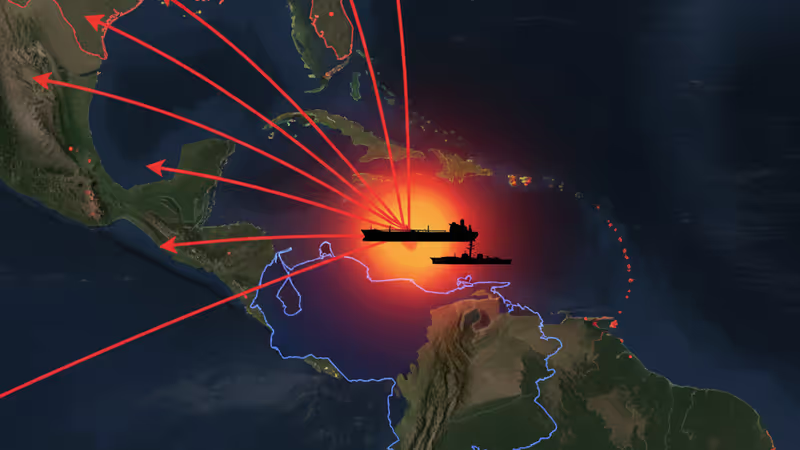
미국의 베네수엘라 유조선 나포가 카리브해 지정학적 긴장을 격화시키며 국제 해상법에 대한 논쟁을 촉발했습니다. PRISM이 이 사건의 배경, 파장, 그리고 미래 해상 감시 및 물류 기술에 미칠 영향을 분석합니다.
우크라이나 전선 격화 속 미국의 3자 회담 제안, 지정학적 함의와 전장 기술, 에너지 안보 및 국제 금융 시스템에 미칠 영향을 PRISM이 심층 분석합니다.
미국과 러시아 특사단이 마이애미에서 우크라이나 전쟁 종식 논의를 재개했습니다. 진전과 이견이 교차하는 가운데, 이 대화가 글로벌 지정학에 미칠 영향을 분석합니다.