

G-Dragon’s Ghost Reign: Why K-Pop's Inactive King Was Just Crowned Its Most Influential Figure
Industry execs voted an inactive G-Dragon as K-Pop's top singer. Our analysis reveals why this isn't nostalgia, but a strategic bet on the future of artist IP.
The Lede: A CEO-Level Briefing
While the K-Pop charts and global headlines are dominated by 4th-generation juggernauts, a recent survey reveals a profound disconnect between public metrics and private sentiment. Korean entertainment executives—the industry's architects—voted G-Dragon, an artist who hasn't released a solo album since 2017, as the most influential singer of the year. This isn't a nostalgic hat-tip; it's a critical strategic signal about where the industry sees future value: in paradigm-shifting, artist-driven Intellectual Property (IP), not just scalable, system-produced acts.
Why It Matters: The Ripple Effect
This vote by industry insiders transcends a simple popularity contest. It’s a declaration of what the market is missing and what it craves. For an industry currently defined by hyper-optimized production, rapid-fire comebacks, and platform-driven virality, the elevation of G-Dragon signifies a deep-seated hunger for a different kind of value.
- Redefining "Influence": The vote decouples influence from recent sales figures and streaming numbers. It re-anchors the concept to enduring cultural impact, brand power, and the ability to dictate trends in music, fashion, and art—even from the sidelines.
- Market Anticipation as a Force: Executives are not rewarding past performance; they are pricing in future disruption. The vote is a proxy for the monumental anticipation surrounding G-Dragon's comeback, signaling to investors that his return is viewed as a market-moving event on par with a major corporate IPO.
- Pressure on the New Guard: This implicitly challenges the current generation of superstars. The message is clear: chart dominance is temporary, but becoming a generational icon—a "G-Dragon"—is the ultimate benchmark for success and long-term enterprise value.
The Analysis: The Blueprint vs. The Machine
To understand this phenomenon, one must recognize G-Dragon's role as the original archetype for the modern K-Pop multi-hyphenate. Before it was standard, he was the producer-idol, the songwriter-performer, and the fashion-muse-turned-mogul. He established the blueprint for artist-centric creativity within the idol system. For 20 years, I've watched the industry evolve; G-Dragon was an inflection point, proving that a singular, authentic artistic vision could become a billion-dollar brand.
The current K-Pop landscape, particularly the models perfected by giants like HYBE, prioritizes scalable, repeatable systems. It's an efficient machine for producing global hits and highly polished groups. However, the executives' vote for G-Dragon reveals a nostalgia for, and a strategic belief in, the power of the singular genius—the system-disruptor whose value cannot be replicated on an assembly line. They aren't just looking for the next hit song; they are desperately searching for the next cultural reset.
PRISM Insight: The Future of Artist IP
The key takeaway for investors and tech futurists lies in viewing G-Dragon not as a musician, but as a fully-stackable IP. His value isn't just in song royalties; it's in his aesthetic, his brand collaborations (Nike), and his digital identity. His recent signing with Galaxy Corporation, an AI and metaverse company, is the most telling move yet. This isn't a traditional record deal. It's a technology partnership aimed at deploying the G-Dragon IP across new platforms.
Expect to see this strategy become the new gold standard for legacy artists: leveraging a potent, established brand identity into Web3, AI-driven creative projects, and virtual economies. The industry is signaling a shift from manufacturing artists to managing legacy IP as a technology asset.
PRISM's Take: A Vote for the Future, Not the Past
The Korean music industry's vote for G-Dragon is the most insightful data point of the year. It's a collective admission that while the current K-Pop machine is more profitable and globally dominant than ever, it may be lacking the very spark of disruptive, unpredictable artistry that defined its golden eras. The establishment isn't looking backward. They are making a forward-looking bet that the next wave of growth will come not from optimizing the current formula, but from an artist who can break it entirely. The industry didn't vote for the king who is, but for the king they believe will be again, and whose return promises to redefine the kingdom itself.
관련 기사
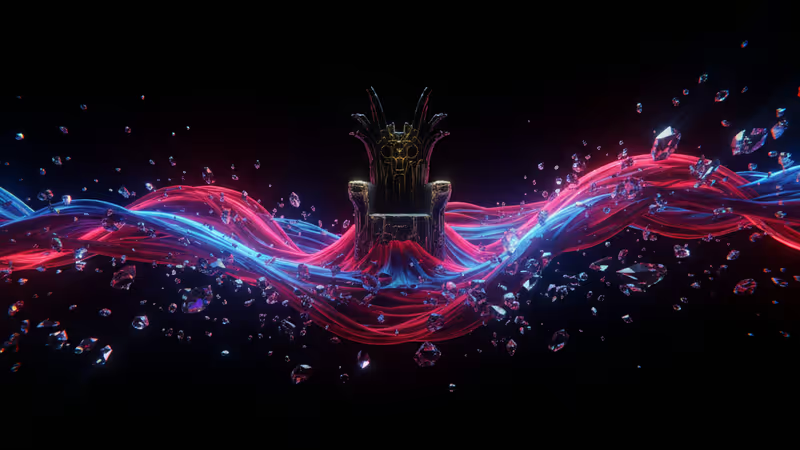
앨범 없이 '올해의 가수'가 된 G-Dragon. 그의 수상은 K팝 산업이 아티스트 IP와 기술의 융합이라는 새로운 미래를 향하고 있음을 보여주는 결정적 증거입니다.
2023년 신곡 없이 '올해의 가수' 1위에 오른 지드래곤. K팝 전문가들이 그를 선택한 이유와 이것이 업계의 미래에 시사하는 바를 심층 분석합니다.

263만 유튜버 나름TV의 K팝 아이돌 학폭 폭로 사건을 심층 분석합니다. 크리에이터 경제와 팬덤 문화가 충돌하며 K팝 산업의 검증 시스템에 중대한 질문을 던집니다.
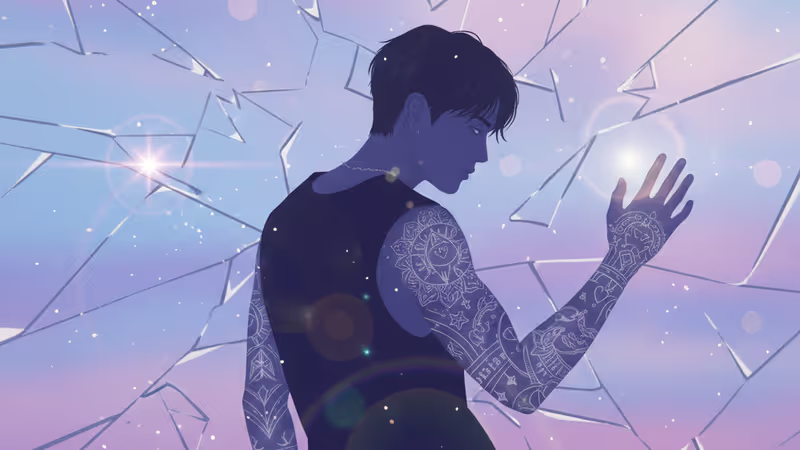
BTS 정국의 타투 논란 심층 분석. K팝 아이돌의 자기표현과 팬덤의 소유권 의식 사이의 충돌이 우리에게 시사하는 바를 알아봅니다.