
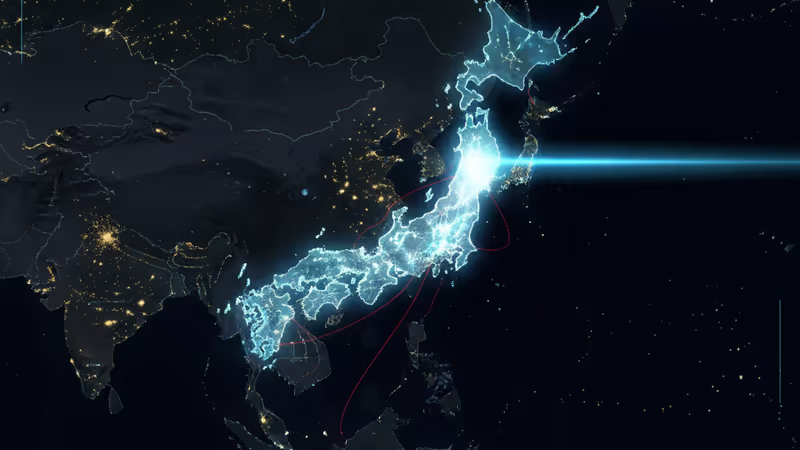
Japan's Nuclear Taboo Cracks: A Geopolitical Reckoning in Asia
An influential Japanese lawmaker is calling for a debate on the nation's non-nuclear principles, signaling a seismic shift in Asia's geopolitical landscape.
The Lede: Beyond the Headlines
A senior figure in Japan’s ruling party has called for a national debate on the country's sacrosanct "non-nuclear principles," a cornerstone of its post-war identity. For global executives and strategists, this is more than a domestic policy shift; it's a seismic tremor signaling a fundamental reassessment of security in the Indo-Pacific. A nation defined by its unique status as the only victim of nuclear weapons is now being forced to confront the unthinkable, with profound implications for regional stability, the global non-proliferation regime, and the future of the U.S. alliance system.
Why It Matters: The Ripple Effect
The explicit questioning of Japan’s non-nuclear stance by Itsunori Onodera, a former Defense Minister and head of the LDP's security council, moves a fringe idea into the political mainstream. This isn't just talk; it's a direct response to a deteriorating security environment. The key drivers are threefold: an increasingly assertive China with a rapidly expanding nuclear arsenal, a belligerently nuclear North Korea, and the stark lesson from Ukraine—that security assurances can fail in the face of aggression.
- Regional Arms Race: Any move by Japan towards nuclearization, even just hosting U.S. weapons, would likely compel South Korea to reconsider its own nuclear ambitions, potentially triggering a dangerous proliferation cascade in one of the world's most economically vital regions.
- U.S. Alliance Under Strain: For Washington, this is a double-edged sword. While a more robustly defended Japan is welcome, a domestically-produced Japanese deterrent would reduce U.S. influence and shatter the global Non-Proliferation Treaty (NPT), which the U.S. has championed for decades. The U.S. State Department’s gentle reminder of Japan's “global leadership” in non-proliferation was a clear, if diplomatic, warning shot.
- Global Norms Eroded: If Japan—the ultimate symbol of nuclear abolition—concludes that only nuclear weapons can guarantee its security, it sends a devastating message to other nations: non-proliferation is a failed experiment.
The Analysis: A Pacifist Identity Confronts a New Reality
Japan's post-war security has rested on two pillars: the pacifist Article 9 of its constitution and the U.S. "nuclear umbrella." The Three Non-Nuclear Principles—prohibiting the possession, production, or introduction of nuclear arms—are the ultimate expression of this identity, born from the ashes of Hiroshima and Nagasaki. For over 70 years, this consensus has been politically untouchable.
However, the strategic landscape has changed irrevocably. Onodera's argument that it is "politically irresponsible" to blindly rely on the U.S. without even debating the issue reflects a growing anxiety within Tokyo's security establishment. The debate is being forced by a hawkish wing of the ruling Liberal Democratic Party (LDP), which includes influential figures like Economic Security Minister Sanae Takaichi. They argue that the U.S. security guarantee, while still strong, cannot be taken for granted in perpetuity, especially given recent American political volatility.
This discussion is now a central, if contentious, part of the LDP’s ongoing revision of Japan's key national security documents. While the majority of the Japanese public remains staunchly anti-nuclear, the Overton window of acceptable political discourse is undeniably shifting. The core tension is between Japan's deeply ingrained pacifist identity and the brutal logic of nuclear deterrence in an increasingly dangerous neighborhood.
PRISM Insight: Defense Tech and Nuclear Latency
The immediate investment implication is not in nuclear warheads, but in the advanced conventional and next-generation technology required to bridge the deterrence gap. Expect accelerated Japanese investment in hypersonic missile development, space-based surveillance assets, cyber warfare capabilities, and advanced missile defense systems. This signals a bull market for Japan’s domestic defense industry (e.g., Mitsubishi Heavy Industries, Kawasaki Heavy Industries) and their international partners (e.g., Lockheed Martin, BAE Systems).
Furthermore, Japan is a 'virtual' nuclear state. It possesses one of the world's most advanced civilian nuclear energy programs, with a significant stockpile of plutonium and the technical expertise to weaponize it within months, not years. This "nuclear latency" is a critical, unspoken element of its strategic posture. The current debate will intensify scrutiny of Japan's dual-use nuclear technology and the security of its civilian facilities.
PRISM's Take: The Taboo is Broken
Full-scale nuclear armament for Japan remains a remote possibility, fraught with immense domestic political hurdles and the certainty of international backlash. However, the significance of this moment cannot be overstated: the taboo has been broken. Openly debating nuclear options is now a legitimate political act in Tokyo.
The most plausible near-term outcome is not a Japanese bomb, but a formal move towards a 'nuclear sharing' arrangement with the U.S., similar to that of several NATO countries. This could involve modifying the third principle—prohibiting the 'introduction' of nuclear weapons—to allow U.S. nuclear assets on Japanese territory or vessels in an emergency. This would be a monumental policy shift, strengthening deterrence against China and North Korea while keeping Japan within the U.S. alliance structure.
The world is now watching the revision of Japan's national security documents. The precise wording will provide the clearest signal yet of whether Tokyo is preparing for a new, more assertive, and potentially nuclear-tinged role in the 21st century. The post-war era of Japanese security policy is officially over; what comes next is now being openly debated.
관련 기사
2025년 12월 셋째 주 세계의 결정적 순간들. 가자지구와 홍콩의 슬픔, 브뤼셀과 미니애폴리스의 저항, 그리고 남수단과 스톤헨지의 공동체까지, 사진으로 기록된 한 주간의 글로벌 뉴스.

호주 본다이 비치 총격 추모식에서 앤서니 알바니 총리가 야유를 받았다. 이는 최근 급증하는 반유대주의에 대한 유대인 공동체의 분노와 정부 불신이 표출된 것으로, 정부는 대책 마련에 나섰다.

2025년 12월 21일, 호주가 본다이 비치에서 발생한 총기난사 사건 희생자 15명을 기리기 위해 '공식 성찰의 날'을 가졌다. 사건 발생 일주일 만에 이루어진 국가적 추모다.

남아프리카공화국 요하네스버그에서 대규모 총기 난사 사건이 발생, 당국이 용의자 추적에 나섰다. 이번 사건은 남아공의 고질적인 폭력 범죄와 치안 문제를 다시 수면 위로 끌어올렸다.