
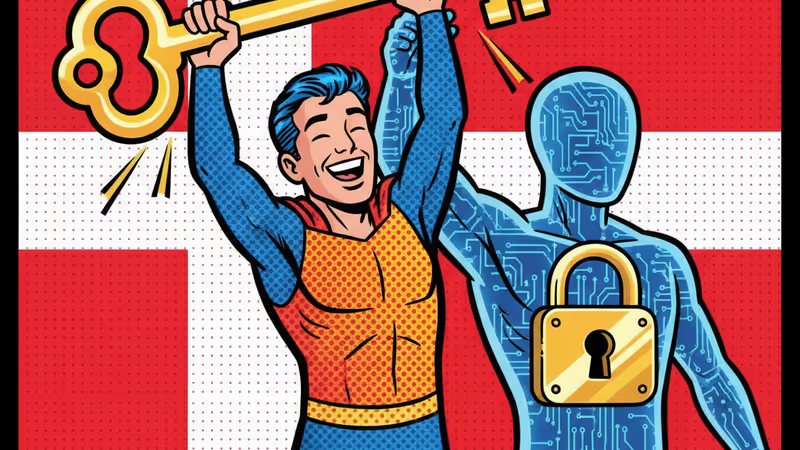
Denmark's Radical AI Law: Why Your Digital Twin Is About to Become Your Property
Denmark's proposed law gives citizens ownership of their digital likeness. PRISM analyzes why this is a global warning for the AI industry and a new era for data rights.
The Lede: A Legal Shot Across the Bow of Generative AI
While the world debates AI ethics in abstract terms, Denmark is moving to codify a revolution. A proposed law would grant citizens full, explicit ownership rights over their own likeness—their face, voice, and biometric data. For any C-suite executive overseeing AI strategy, this isn't a niche European policy; it's the first tremor of a seismic shift that could fracture the foundational business model of the entire generative AI industry, which has been built on the principle of treating public data as a free resource.
Why It Matters: The End of the Data Free-for-All
The implications extend far beyond preventing deepfakes. This Danish proposal fundamentally reframes our digital identity from a liability to be protected (the GDPR model) into an asset to be owned and controlled. This creates immediate, high-stakes consequences for global business:
- The Compliance Nightmare: AI models trained on vast, unconsented internet scrapes—which is to say, nearly all major models today—could be rendered illegal for use on or by Danish citizens. This sets a precedent that could be replicated globally, creating a patchwork of legal liabilities for tech giants and enterprises alike.
- The Birth of a New Market: If your likeness is property, it can be licensed. This could spawn a new industry of 'digital identity brokers' or 'likeness rights agencies,' akin to Getty Images for faces and voices. Individuals could monetize their digital twins, and companies would need to navigate a new, complex rights-management ecosystem.
- Redefining "Public" Data: The law directly challenges the long-held assumption that data posted in a public square (like social media) is fair game for commercial use. This forces a critical re-evaluation of data pipelines and training methodologies for every company in the AI space.
The Analysis: From Privacy Protection to Digital Property
To understand the gravity of this move, we must see it as the next evolutionary step after GDPR. GDPR was about data privacy—controlling who holds and processes your information. The Danish proposal is about digital sovereignty—granting you the property deed to your own identity. It elevates a person's likeness to the same legal status as their home or their car.
This creates a fascinating competitive dynamic. Large incumbents like Google, Meta, and OpenAI, whose models are built on the old paradigm, face an existential threat. Their competitive advantage—massive, scraped datasets—becomes a massive legal liability. Conversely, this opens the door for a new wave of startups focused on ethically sourced, fully-licensed, or synthetic data. The competitive moat of the future may not be the size of the dataset, but the integrity of its sourcing.
PRISM Insight: The Rise of the 'Consent-as-a-Service' Stack
The investment thesis is clear: the regulatory tide is turning against data scraping. The smart capital will flow towards the enabling technologies for this new era of digital ownership. We anticipate explosive growth in several key areas:
- Consent Management Platforms: Advanced systems that can track and manage granular, dynamic consent for the use of biometric data in AI models will become mission-critical infrastructure.
- Synthetic Data Generation: As the legal risks of using real-world data grow, high-fidelity synthetic data will shift from a niche tool to a core enterprise necessity for model training.
- On-Device and Federated Learning: Technologies that allow models to be trained on decentralized data without it ever leaving a user's device will see a massive surge in adoption, as they neatly sidestep many of these data ownership issues.
PRISM's Take: The Great Re-Pricing of Personal Data
Denmark's proposal is not an outlier; it's a postcard from the future. We are witnessing the beginning of the end of the 'move fast and break things' era of AI development. The fundamental input for this technological revolution—human data, faces, and voices—is about to be re-priced from nearly zero to a figure reflecting its true value. For decades, corporations have been the sole beneficiaries of the value generated by personal data. This legislation signals the start of a historic transfer of power, giving individuals a direct economic stake in the AI economy. Companies that prepare for this new reality of digital ownership will thrive; those still operating under the old rules are building their empires on sand.
관련 기사
사상 첫 틱톡 어워즈의 혼란은 단순한 실수가 아니었다. Z세대의 문화, 미디어 권력의 이동, 그리고 새로운 플랫폼 제국의 탄생을 심층 분석한다.
90년대 직장인 스트레스 해소용으로 출시된 '지바 재버'. 이 기괴한 장난감이 오늘날 우리에게 말해주는 것은 무엇일까요? 문화적 변천사를 분석합니다.
N번방보다 더 악랄한 불법 영상 공유 사이트가 등장했습니다. 게임화, 암호화폐 등 진화한 범죄 수법과 기술 트렌드를 심층 분석하고 사회적 의미를 진단합니다.

세 번째로 발견된 성간 천체 3I/ATLAS는 단순한 혜성이 아닙니다. 우리 태양계보다 오래된 이 '우주 타임캡슐'이 인류의 우주 탐사 기술과 미래에 어떤 의미를 갖는지 분석합니다.