
Decoding Putin's 'No More Wars' Vow: A Diplomatic Trojan Horse
Analysis of Vladimir Putin's 'no more wars' vow. This is not a peace offer, but a strategic move to fracture Western unity and redefine victory on his terms.
The Lede: Beyond the Headlines
Russian President Vladimir Putin's recent declaration of “no more wars” if the West respects Russia’s interests is not a peace offering; it's a masterclass in strategic communication. For global executives and policymakers, this isn't a signal of de-escalation. It's a calculated maneuver to exploit 'Ukraine fatigue,' fracture Western alliances, and redefine the terms of victory on the global stage. This is a stress test for international resolve, with Putin betting that the West’s attention span is shorter than his strategic patience.
Why It Matters: The Second-Order Effects
Putin’s statement, delivered during a marathon televised event, is designed to resonate far beyond the Kremlin walls. Its primary targets are Western populations and political factions growing weary of the war's economic and political costs.
- Political Fragmentation: The message provides ammunition for isolationist and populist movements in the U.S. and Europe, complicating efforts to maintain unified support for Ukraine. It frames continued aid not as a defense of sovereignty, but as a stubborn refusal to grant Russia “respect.”
- Geopolitical Realignment: For nations in the Global South, this narrative reinforces the idea that the conflict is a great power struggle instigated by NATO expansion, not an act of Russian aggression. This solidifies diplomatic and economic ties that circumvent Western sanctions.
- Military Reality Check: The rhetoric was immediately contradicted by a deadly missile strike on Odesa. This classic Kremlin tactic—saying one thing while doing another—underscores the true policy: peace is only possible on Russia’s terms, which include the annexation of Ukrainian territory, a non-negotiable for Kyiv and its allies.
The Analysis: The 'Respect' Doctrine and Historical Framing
To understand this move, we must decode Putin’s core grievance: the alleged betrayal over NATO's eastward expansion. This narrative, though historically contested (even former Soviet leader Mikhail Gorbachev denied such a promise was made), is the foundational myth of Russia’s foreign policy. It allows Putin to frame a war of aggression as a defensive necessity.
What Putin means by “respect” is not diplomatic courtesy; it is the West's formal acceptance of a Russian sphere of influence. This is a demand to rewind the clock to a 19th-century model of great power politics, where larger nations dictate the fates of smaller ones. It is fundamentally incompatible with the post-Cold War international order built on the principle of national sovereignty.
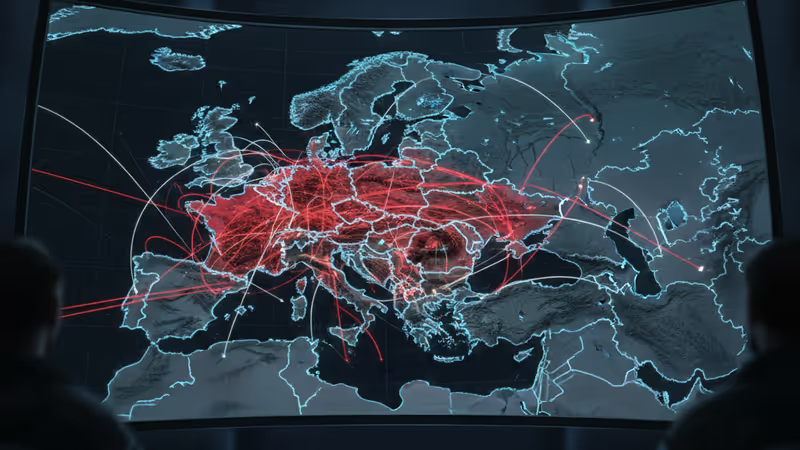
The choreographed “Direct Line” event itself was a piece of political theater, complete with a map showing occupied Ukrainian regions as integral parts of Russia. This visual cue was more revealing than any spoken word. The message is clear: the territorial gains are permanent, and any future negotiation must begin from this new reality. Putin isn't offering to end a war; he is declaring the first phase of his objectives complete and challenging the world to accept it.
PRISM Insight: The Protracted Conflict Tech Thesis
Putin's strategy signals a long-term, simmering conflict, not a near-term resolution. This has clear implications for technology and investment. The sustained tension acts as a powerful catalyst for innovation in specific sectors, moving far beyond traditional defense.
- Autonomous Systems: The war has become the world's largest laboratory for drone warfare. Expect accelerated investment in counter-drone systems, AI-powered swarming technology, and autonomous battlefield logistics.
- The OSINT-Industrial Complex: Putin's statement is an act of information warfare. This fuels demand for commercial satellite imagery, AI-driven sentiment analysis, and sophisticated open-source intelligence (OSINT) platforms to counter state-sponsored disinformation in real time. The ability to verify facts on the ground is now a critical strategic asset.
- Resilience Tech: The ongoing threat to infrastructure, from energy grids to internet cables, will drive public and private investment in cybersecurity for critical systems, decentralized communication networks, and hardened supply chain logistics.
PRISM's Take: Read the Actions, Not the Lips
Vladimir Putin’s conditional offer of peace is a diplomatic Trojan horse. It contains not an olive branch, but a set of non-negotiable demands dressed in the language of reason. By framing himself as a reluctant warrior forced into action by Western perfidy, he aims to shift the onus for the war's continuation onto Kyiv and its partners.
For leaders in business and government, the takeaway is unequivocal: prepare for a protracted strategic competition. The Kremlin's objectives have not changed, only its tactics for achieving them. The true test will not be in parsing Putin's words, but in maintaining the strategic focus and allied cohesion required to counter his actions on the ground and in the global information space.
관련 기사
블라디미르 푸틴 러시아 대통령이 '존중'을 조건으로 전쟁 종식을 언급했습니다. PRISM이 이 발언의 지정학적 함의와 서방을 향한 메시지를 심층 분석합니다.
미국의 수단 휴전 압박은 단순한 인도주의적 개입이 아니다. 홍해 안보, 강대국 경쟁, 신기술이 얽힌 지정학적 체스 게임의 전모를 분석한다.

2년간의 전쟁 끝에 가자지구에서 크리스마스 행사가 재개됐습니다. 이는 단순한 축제를 넘어, 깨지기 쉬운 평화와 지정학적 안정성의 향방을 가늠하는 중요한 신호입니다.
미 공화당 서열 3위 엘리스 스터파닉의 충격적인 정계 은퇴. 트럼프 시대 공화당의 미래와 정치적 양극화가 미치는 영향에 대한 심층 분석.