
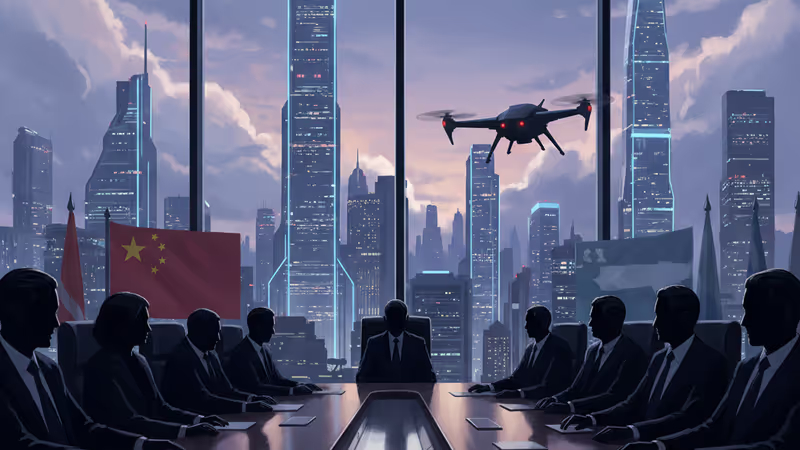
China's Sky-High Dilemma: Rogue Drones Test Beijing's 'Low-Altitude Economy' Ambitions
Rogue drones flying at airliner altitudes in China create a high-stakes test for Beijing. Will it crack down or innovate its way to a safe low-altitude economy?
The Lede: A High-Altitude Stress Test for Beijing's Tech Strategy
Viral videos of consumer drones flying alongside commercial airliners at 8,000 meters are more than just a public safety scare; they are a flashing red light on the dashboard of China's entire tech-driven economic strategy. For executives in the aviation, logistics, and technology sectors, this 'black flying' phenomenon is a critical stress test of Beijing's ability to govern the very innovation it champions. The core conflict is stark: can a state that prioritizes top-down control effectively manage the disruptive, decentralized nature of a technology it has designated as a pillar of future growth?
Why It Matters: The Ripple Effects of Rogue Flights
The immediate risk of a catastrophic mid-air collision is clear, but the second-order effects are where the real strategic implications lie. This incident provides Beijing with the political justification for a swift, decisive response that will reshape the industry landscape.
- Regulatory Whiplash: The most likely outcome is a severe regulatory crackdown. Expect stricter licensing, harsher penalties, and potentially even temporary flight bans in sensitive economic zones. This could chill investment and slow innovation in the nascent 'low-altitude economy,' which encompasses everything from drone delivery to urban air mobility (UAM).
- The Rise of 'Reg-Tech': The crisis will accelerate the mandatory adoption of advanced oversight technologies. This will catalyze a boom in the Unmanned Traffic Management (UTM) sector, including remote identification (Remote ID), sophisticated geofencing, and network-based tracking systems. The crisis effectively creates a massive, state-mandated market for drone 'reg-tech'.
- Global Industry Impact: As the world's dominant drone manufacturer, China-based DJI will face immense pressure to implement foolproof hardware and software altitude limiters. This incident will influence global drone safety standards, pushing regulators worldwide to address the 'rogue operator' problem more aggressively.
The Analysis: A Classic Tale of 'Release and Control'
This episode is a textbook example of a recurring dynamic in China's political economy: the tension between fang (releasing, loosening) and shou (controlling, tightening). Beijing has officially designated the low-altitude economy as a “strategic emerging industry,” unleashing a torrent of capital and entrepreneurial energy. Yet, the state's regulatory and enforcement capabilities are lagging dangerously behind the technological curve.
Unlike the more deliberative, and often slower, regulatory processes of the FAA in the United States or EASA in Europe, China’s top-down industrial policy creates a 'gold rush' environment. The problem is that the tools of state control—licensing, flight plan approvals—are being bypassed by off-the-shelf technology and, in some cases, forged documents. The fact that the issue was forced into the open by a social media blogger on Douyin, rather than by state aviation authorities, highlights a critical vulnerability in Beijing’s governance model. It reveals that in some high-tech domains, a networked citizenry can be a more effective watchdog than the state itself.
PRISM Insight: The Inevitable Mandate for a 'Digital Sky'
Beyond a simple crackdown, the strategic response will be to build a comprehensive digital infrastructure for low-altitude airspace. This is where the primary investment opportunity lies. The 'black flying' incidents provide the political impetus to fast-track the development and deployment of a national-level UTM system. Think of it as building the digital highways, traffic lights, and license plate system for the sky, all at once.
This will create a new class of government-sanctioned technology champions specializing in drone surveillance, data fusion, and command-and-control platforms. For global tech firms, the price of admission to China's low-altitude economy will be full compliance and integration with this state-monitored network. The technology developed here will likely become a new export category for China, offered to other nations looking to manage their own drone traffic.
PRISM's Take: A Defining Moment for China's Tech Governance
These illegal high-altitude flights are not merely the actions of reckless individuals; they are a symptom of a system under strain. The state's ambition has outpaced its ability to enforce its own rules. Beijing now faces a critical choice. A purely restrictive response would stifle a multi-billion dollar industry and signal that control trumps innovation when the two conflict. A more sophisticated approach—one that pairs strict enforcement with massive investment in digital oversight infrastructure—would demonstrate an ability to govern the complex realities of a 21st-century technology leader.
For the rest of the world, this is a crucial case study. How China resolves this dilemma will set a powerful precedent for how state-led economies manage disruptive technologies. The future of drone logistics, urban air taxis, and automated aerial services globally will be influenced by the regulatory and technological solutions forged in the skies over Guangdong and Hunan.
관련 기사

트럼프 전 대통령이 뉴욕 주지사 경선에서 브루스 블레이크먼을 지지하며 공화당 내부 역학 관계와 'MAGA'의 미래 전략에 대한 심층 분석을 제공합니다.

글로벌 지정학적 긴장, 인도주의 위기, 사회적 불안정 속에서 인간 안보의 미래를 분석합니다. PRISM이 제시하는 이 상호 연결된 세계의 도전과 기술, 투자의 관계.

미국 외교 정책에 대한 글로벌 비판과 진보적 목소리의 부상이 국제 관계의 새로운 지형도를 그립니다. 베네수엘라, 아이티, 팔레스타인 이슈를 중심으로 분석합니다.

제프리 엡스타인 파일 공개, 새 정보 부재로 투명성 논란 가열. 유력 인사 연루 의혹과 사법 시스템의 신뢰 문제 분석.