
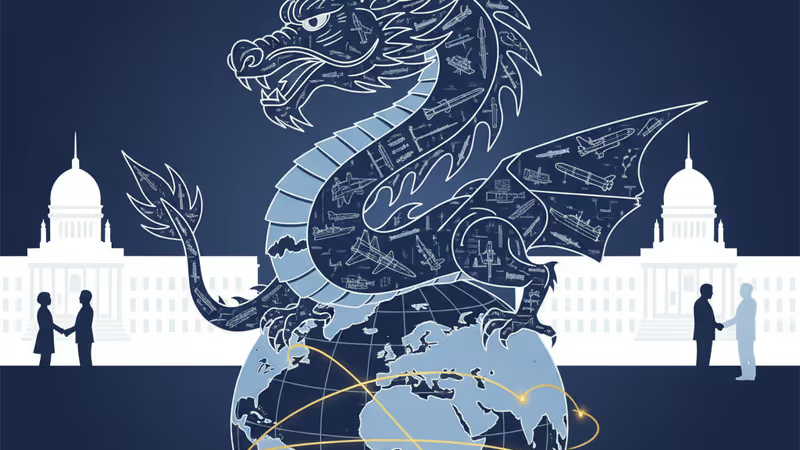
China's Paper Dragon: Why the PLA's High-Tech Arsenal May Be a Hollow Threat
China's high-tech military build-up is impressive, but deep flaws in experience, training, and doctrine may render its advanced arsenal a 'paper dragon'.
The Lede
As headlines in 2025 trumpet China’s latest military hardware—from sixth-generation fighters to mysterious sub-aquatic drones—it's easy to get lost in the spectacle of a rising superpower. But for global leaders and investors, fixating on the hardware is a strategic error. The real story isn’t about the People's Liberation Army's (PLA) new toys; it's about the deep, systemic vulnerabilities in its operational software—its people, its doctrine, and its combat experience. This 'software gap' is the most critical and least-understood variable in the 21st-century's defining geopolitical contest.
Why It Matters
The PLA's modernization is more than a regional arms race; it's a global shockwave with profound second-order effects. The perception of its growing strength, real or not, is already reshaping strategic calculus worldwide:
- Recalibrating Global Risk: A more technologically advanced PLA directly elevates the risk profile for conflicts in critical economic zones, particularly the Taiwan Strait and the South China Sea. Any miscalculation could instantly sever global supply chains for everything from semiconductors to shipping.
- Fueling a New Kind of Arms Race: This isn't a Cold War-style numbers game. China's focus on AI, autonomous systems, and space-based assets forces a qualitative, high-tech response from the US and its allies (like Japan, Australia, and India). This accelerates a global competition for dominance in dual-use technologies that will define both future economies and future battlefields.
- The Alliance Stress Test: The pace of China's build-up is forcing Indo-Pacific nations to make hard choices about their security posture and allegiances. It puts immense pressure on US-led alliances, testing their cohesion and commitment in an era of escalating tension.
The Analysis
Hardware is Only Half the Story
The PLA's transformation over the past two decades is undeniable. It has moved from a strategy of mass-manpower defense to one aiming for victory in 'informatized' and 'intelligentized' warfare. The recent parade of advancements—hypersonic missiles, an expanding navy, and the reported progress on in-orbit satellite refueling—are the physical tools for this new doctrine. Beijing is successfully closing the technology gap with the West in specific, high-impact areas.
However, this rapid hardware acquisition masks what US defense planners call 'serious deficiencies.' A modern military is a complex system of systems, and the most crucial component is the human one. The PLA is acutely aware of its weaknesses in this domain:
- The Combat Experience Deficit: The PLA has not fought a major conflict since its brief, costly war with Vietnam in 1979. In contrast, the US military has been engaged in continuous, complex combat operations for decades. This creates an enormous gap in institutional knowledge, adaptability under fire, and the ability to execute complex joint operations.
- The Command and Control Paradox: Modern multi-domain warfare requires decentralized command, empowering junior officers to make rapid decisions on a fluid battlefield. This 'mission command' philosophy is antithetical to the PLA's rigid, top-down political structure, which prioritizes party control over operational flexibility. Can a system designed for political security excel at military insecurity?
- The Joint Operations Hurdle: Effectively integrating air, sea, land, space, and cyber forces is the holy grail of modern warfare—one the US still struggles with after 30+ years of effort. The PLA's joint-force commands are relatively new and largely untested. Rehearsals are not the same as the chaos of real-world conflict.
PRISM Insight
The Trillion-Dollar Bet on Military AI and Autonomy
China's military strategy is inextricably linked to its national technology strategy of civil-military fusion. This means advancements in commercial AI, robotics, and quantum computing are directly funneled into military applications. For investors and tech firms, this blurs the line between commercial and defense sectors, creating both immense opportunities and significant ethical and geopolitical risks.
Concurrently, the PLA's focus on asymmetric capabilities (e.g., swarming drones, anti-satellite weapons) is creating a counter-market among US and allied nations. The biggest growth areas in defense investment are no longer just stealth bombers and aircraft carriers. They are now in resilient space architecture, counter-UAV systems, cyber defense, and undersea warfare capabilities designed specifically to neutralize the PLA's perceived strengths.
PRISM's Take
Observing China's military modernization is like watching a company spend billions on the world's most advanced factory without knowing if its workforce can run the machines. The PLA has acquired a 21st-century arsenal, but it remains burdened by a 20th-century command structure and a near-total lack of modern combat experience.
The critical error for Western policymakers would be to mistake impressive hardware for guaranteed combat effectiveness. The United States' most durable advantage isn't merely technological superiority, but its operational 'software': a battle-hardened professional military, a flexible command culture, and a global network of interoperable allies. The defining geopolitical question of the next decade is not how many ships or jets China can build, but whether it can close this profound human and institutional gap before its strategic ambitions outpace its actual capabilities.
관련 기사

노르웨이의 친환경 풍력발전이 원주민 사미족의 삶을 위협합니다. 기후 대응과 인권이 충돌하는 '녹색 전환의 딜레마'와 ESG 리스크를 심층 분석합니다.

미군의 태평양 해상 선박 타격으로 사망자가 100명을 넘어섰습니다. 마약 소탕을 명분으로 내세운 이 작전이 베네수엘라를 겨냥한 지정학적 압박이자 국제법을 위협하는 위험한 선례가 되는 이유를 심층 분석합니다.

EU가 900억 유로 규모의 우크라이나 지원안에 합의했습니다. 러시아 동결자산 대신 공동부채를 택한 결정의 지정학적, 경제적 함의를 심층 분석합니다.

EU가 우크라이나에 900억 유로 대출을 결정했습니다. 러시아 동결 자산 활용이 무산된 배경과 지정학적 셈법, 글로벌 금융 시장에 미칠 영향을 심층 분석합니다.