
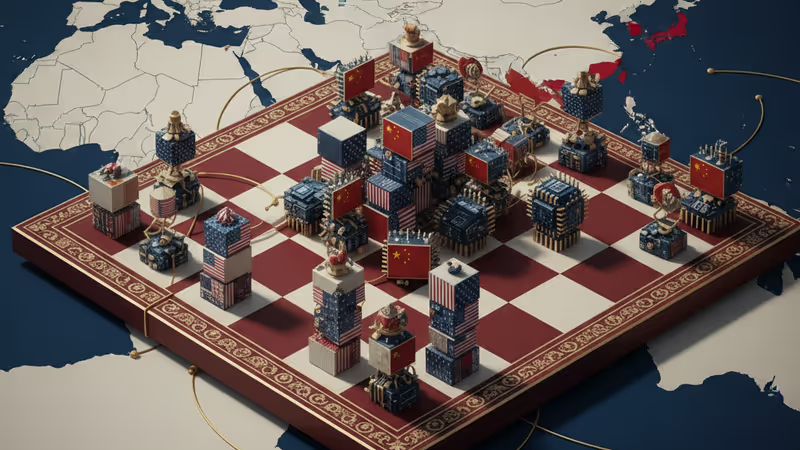
It's Not a New Cold War—It's a U.S.-China Chess Game
The latest Trump administration National Security Strategy reframes the U.S.-China relationship as an economic rivalry, not a new Cold War. Deep economic interdependence and domestic political constraints on both sides prevent a full-scale decoupling.
The `keyword:Donald Trump` administration's latest National Security Strategy document is turning heads for how it talks—and doesn't talk—about `keyword:China`. As `keyword:CNN` noted, "Gone are the sweeping declarations about `keyword:China` being `keyword:America`’s most consequential geopolitical challenge." Instead, the new strategy emphasizes the U.S.-China economic rivalry above all else. This shift fundamentally challenges the popular framing of the relationship as a second Cold War.
Fragmentation, Not Decoupling
The original Cold War was a contest between the communist `keyword:Soviet Union` and the capitalist, democratic `keyword:United States`. Their blocs were largely insulated from each other, with minimal flows of goods, finance, and technology. That's not the case today. The world's economic landscape is defined by global value chains, where production happens in multiple stages across several countries. This deep integration means a full 'decoupling' is incredibly costly.
What is observable is a degree of fragmentation. Recent research by Harvard economist Gita Gopinath shows a decline in trade between political blocs relative to flows within them. But this is far from the near-total separation of the Cold War. Unlike the U.S.-Soviet rivalry between distinct economic systems, both the `keyword:U.S.` and `keyword:Chinese` economies rely on private capital, international trade, and technology transfers, creating inter-dependencies that are hard to sever.
Mutual Dependence and Domestic Constraints
The `keyword:U.S.` acts as a provider of services, tech, and investment, while `keyword:China` remains the world's factory. This interdependence creates constraints. For `keyword:China`, facing an aging population and weakening domestic demand, export-led growth is critical for domestic political stability. Its merchandise exports to the `keyword:U.S.` stood at around `stat:$525 billion` in `stat:2024`, representing about `stat:15%` of its total.
The `keyword:U.S.`, in turn, benefits from cheaper imports that help keep consumer prices in check. With inflation a central political concern, especially heading into the `stat:2026` midterm elections, the scope for aggressive trade confrontation is limited. An estimate from the Federal Reserve Bank of St. Louis suggests that tariff hikes during the three-month period of `stat:June-August 2025` added around `stat:0.5 percentage points` to headline inflation.
The Other Players on the Board
`keyword:Russia`, while no longer a global pole like the Soviet Union, remains a military heavyweight. Its economy's reliance on energy exports means it operates largely outside the economic logic that constrains both Washington and Beijing. Meanwhile, `keyword:India`'s young, large population positions it as a major future market. Its ability to translate this demographic potential into production strength will depend on its integration with Asian value chains.
Today's U.S.-China competition is better understood as a pragmatic and transactional game of chess. Unlike the ideologically-driven conflict of the 20th century, this rivalry is shaped by domestic economic needs, leaving it more open to negotiation and adjustment. While strategic tensions will persist, the structural conditions for a full-fledged Cold War are simply absent.
본 콘텐츠는 AI가 원문 기사를 기반으로 요약 및 분석한 것입니다. 정확성을 위해 노력하지만 오류가 있을 수 있으며, 원문 확인을 권장합니다.
관련 기사

멕시코 해군 소속 소형 항공기가 미국 텍사스 해안에 접근하던 중 추락해 어린이 환자 등 최소 5명이 사망했다. 사고 원인은 현재 조사 중이다.

대한민국 국회가 여당 주도로 윤석열 전 대통령의 계엄 시도 관련 내란 사건을 다룰 특별재판부 설치 법안을 통과시켰다. 야당은 필리버스터로 강력히 반발하며 사법부 장악 시도라고 비판했다.

시리아 정부군과 쿠르드 주도 SDF가 알레포에서 교전을 중단하기로 합의했다. 터키 외무장관 방문 중 발생한 이번 충돌로 최소 2명의 민간인이 사망했다.

중국 온라인에서 마지막 왕조인 청나라에 역사적 책임을 묻는 '1644 사관'이 확산하며 당국의 비판과 사회적 논쟁을 촉발하고 있다. 이 현상의 배경과 의미를 분석한다.