
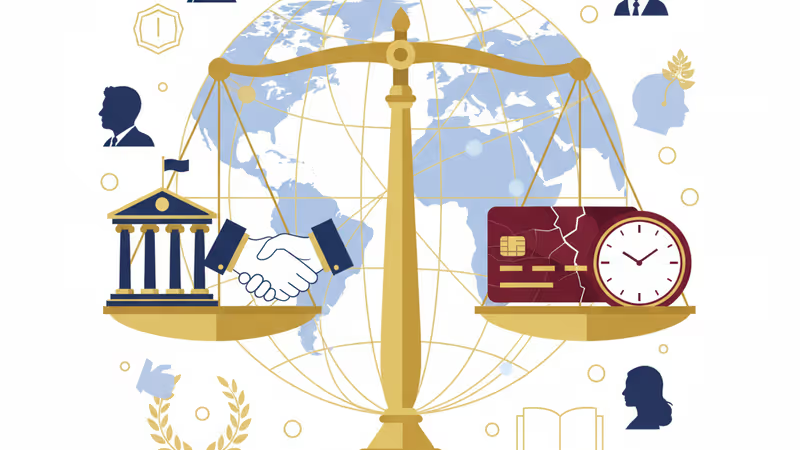
Biden's Medical Debt Erasure: A Political Masterstroke or a Credit Risk Time Bomb?
President Biden's plan to ban medical debt from credit reports is a major pre-election move. PRISM analyzes its impact on fintech, lending, and global business.
The Lede: Why This Matters to You
President Biden's proposal to scrub medical debt from U.S. credit reports is more than a healthcare policy tweak; it's a fundamental rewiring of credit risk assessment in the world's largest consumer economy. For global executives, investors, and technologists, this isn't just a domestic U.S. issue. It's a pre-election gambit that will create new winners and losers in finance and healthcare, accelerate the race for alternative data in lending, and force a re-evaluation of the American consumer's financial health.
Why It Matters: The Second-Order Effects
The immediate goal is to boost credit scores for millions of Americans. But the ripple effects extend far beyond individual households, creating both opportunities and significant new risks across key sectors:
- Financial Services & Fintech: Lenders are about to lose a key, albeit controversial, data point. This will force a scramble to update risk models. While potentially causing a short-term credit tightening or higher rates as institutions recalibrate, it simultaneously creates a massive opening for AI-driven fintech firms specializing in alternative credit scoring (e.g., cash-flow analysis, rental history). The era of relying solely on traditional credit bureaus is being actively disrupted by policy.
- Healthcare Industry: The threat of a damaged credit score has long been a powerful tool for medical collections agencies. Removing this leverage could fundamentally alter the economics of healthcare revenue cycle management. Providers may face increased difficulty in collecting on patient balances, potentially forcing them to demand more upfront payments or push for new financing arrangements at the point of care.
- Global Investment: International firms invested in U.S. consumer credit, from mortgage-backed securities to credit card debt, must now account for this shift. The American consumer may appear healthier on paper, but the underlying risk associated with unmanageable healthcare costs hasn't vanished—it has merely been rendered invisible in standard credit files.
The Analysis: Politics, Precedent, and Global Context
This policy is a calculated political move in a high-stakes election year. Medical debt is a uniquely American crisis that cuts across partisan lines, making it a potent issue for the Biden campaign to champion consumer protection. It builds on previous, voluntary steps by the major credit bureaus (Equifax, Experian, TransUnion) to minimize the impact of medical collections, but a federal mandate represents a significant escalation.
From a global perspective, this action underscores the profound divergence between the U.S. healthcare system and those of other developed nations. Countries with universal or single-payer systems do not face a medical debt crisis on this scale. The Biden proposal is a uniquely American solution to a uniquely American problem: instead of addressing the root cause—exorbitant healthcare costs—it aims to mitigate the financial symptoms through the credit system. This presents a fascinating case study in policy patching, where the financial infrastructure is used to soften the failures of the healthcare infrastructure.
The counter-argument from the lending industry is not trivial. They contend that more data, not less, leads to more accurate and fairly priced credit. By removing a valid indicator of financial distress, they argue, lenders may be forced to price risk more broadly, potentially raising costs for everyone to cover unpredictable defaults.
PRISM Insight: The Alt-Data Arms Race Accelerates
The primary technological consequence of this policy will be the turbocharging of the alternative data industry. With a key traditional data source being deprecated by federal rule, the value proposition of AI-powered risk modeling platforms has skyrocketed. Expect a surge in venture capital funding and M&A activity for fintech companies that can provide lenders with a more holistic view of a borrower's financial life. The vacuum created by this policy is the single biggest market opportunity for alternative credit scoring in a decade. Lenders who fail to integrate these new data sources and models will be flying blind into a riskier lending environment.
PRISM's Take: A Populist Cure That Masks The Disease
President Biden's proposal is a politically astute and empathetic policy that will provide tangible relief to millions of Americans. As an election-year strategy, it is powerful. However, it is a painkiller, not a cure. The policy expertly shifts the perceived risk from the individual to the lending system without solving the underlying disease: a healthcare system that generates unpayable bills in the first place.
By obscuring a key risk indicator, the rule doesn't eliminate the risk itself; it merely hides it from plain sight. The critical question for the U.S. economy is whether this leads to a more resilient consumer base or a credit bubble built on incomplete information. For the rest of the world, it's a stark reminder that in the U.S., even healthcare is ultimately a financial product, with its consequences rippling through every corner of the economy.
관련 기사

대만이 중국의 기습 공격에 대비해 분산형 지휘체계로 전환합니다. 우크라이나 전쟁의 교훈이 대만 해협의 지정학적 구도를 어떻게 바꾸는지 분석합니다.

미국의 시리아 IS 보복 공습은 단순한 군사 작전을 넘어, 트럼프 행정부와 시리아 신정부의 새로운 협력 관계를 알리는 지정학적 변곡점입니다.

트럼프 행정부가 브라운대 총기난사 사건을 계기로 다양성 비자 추첨 프로그램을 전격 중단했습니다. 이 결정의 지정학적 파장과 미국의 미래에 미칠 영향을 심층 분석합니다.

2025년 말, 우크라이나 전쟁은 교착 상태에 빠졌습니다. 서방의 장기 지원과 푸틴의 강경 발언 속에서 종전 협상의 핵심 쟁점과 지정학적 함의를 분석합니다.