

Beyond the Tariffs: Why the US-China EV Spat Redraws the Global Tech Map
New US tariffs on Chinese EVs are more than a trade dispute. It's a strategic move to contain China's tech dominance, redrawing global supply chains.
The Lede: This Isn't About Cars, It's About Control
The White House's recent decision to impose a 100% tariff on Chinese-made electric vehicles (EVs) is far more than a protectionist trade spat. For the busy executive, this is a clear signal that the era of intertwined global supply chains is being systematically dismantled in favor of strategic, geopolitically-aligned economic blocs. This isn't about saving a few auto jobs; it's a decisive move in the long-term struggle for technological supremacy, supply chain security, and control over the critical industries of the 21st century. Your company's global footprint, sourcing strategy, and market access are now on the front lines of this new reality.
Why It Matters: The Ripple Effects of Economic Decoupling
The immediate impact is blocking a potential flood of low-cost Chinese EVs from the US market. But the second-order effects are where the real story lies. This action sets a powerful precedent that will force other major economic powers, particularly the European Union, to make a difficult choice: align with the US containment strategy or risk their own domestic industries being hollowed out by state-subsidized Chinese competition. This escalates the global economic fragmentation:
- Supply Chain Bifurcation: Companies will accelerate the costly process of creating separate, resilient supply chains for China and Western markets, a trend often called “friend-shoring.” This creates redundancy but also introduces new inefficiencies and risks.
- The EU's Dilemma: Brussels is caught between a rock and a hard place. German automakers are heavily dependent on the Chinese market, yet the EU faces the same threat of being overwhelmed by Chinese EV imports. Expect intense internal debate followed by their own version of tariffs, further fracturing the global auto market.
- Critical Minerals Race: The focus on EVs and batteries intensifies the geopolitical competition for control over lithium, cobalt, and nickel. Nations will increasingly use trade policy and strategic alliances to secure these resources, making the raw materials market a new theater of conflict.
The Analysis: A Playbook Decades in the Making
This is not a spontaneous policy decision; it's the culmination of years of escalating techno-nationalism. From a US perspective, this is an attempt to avoid a repeat of the solar panel industry, where massive Chinese state subsidies in the 2010s effectively decimated Western manufacturing. Washington views China's industrial policy, including initiatives like "Made in China 2025," as a direct challenge aimed at dominating future high-tech sectors through means that defy free-market principles.
From Beijing's viewpoint, these tariffs are a blatant act of protectionism designed to contain China's legitimate economic and technological rise. Chinese officials argue their competitive advantage in EVs stems from genuine innovation, massive domestic market scale, and smart industrial planning, not simply unfair subsidies. They will likely retaliate, not necessarily with symmetrical tariffs, but through more subtle means like regulatory hurdles for US firms in China or restrictions on the export of key materials like graphite, a critical component in EV batteries.
This dynamic creates a tit-for-tat escalatory cycle. The battlefield has moved beyond simple trade deficits to encompass the foundational technologies of the future: semiconductors, AI, and now, the entire green-tech ecosystem.
PRISM Insight: The Real Target is Data and Software
While the tariff headlines focus on steel and batteries, the underlying strategic anxiety is about data and control. A modern EV is a sophisticated, connected computer on wheels, constantly collecting data on its surroundings, its driver's habits, and critical infrastructure. The national security concern in Washington is that a dominant Chinese presence in the US auto market would create an unprecedented network for data collection and, potentially, foreign influence or disruption. The battle for the auto industry is a proxy for the battle over who writes the rules for the Internet of Things and the data-driven economies of tomorrow.
PRISM's Take: The Age of Geopolitical Business Strategy is Here
The era of treating geopolitical risk as a secondary concern for global business is definitively over. The US tariff action solidifies the shift from a world governed by WTO-style economic efficiency to one defined by great power competition and national security. For leaders, this means strategic planning must now embed geopolitical analysis at its core. The most efficient supply chain is no longer the best; the most resilient and politically palatable one is. Market expansion is no longer a purely economic calculation but a complex assessment of political alignment and regulatory risk. This is the new operating system for global commerce, and companies that fail to adapt will find themselves on the wrong side of history's new dividing lines.
관련 기사

미국 '교육 주지사' 모델의 선구자 짐 헌트의 타계. 그의 유산이 어떻게 노스캐롤라이나를 첨단 기술 허브로 바꾸고 미국 정치에 영향을 미쳤는지 심층 분석합니다.

정치 풍자 만평은 단순한 그림이 아닙니다. AI와 소셜미디어 시대, 여론을 움직이는 강력한 무기로서의 역할과 미래를 심층 분석합니다.
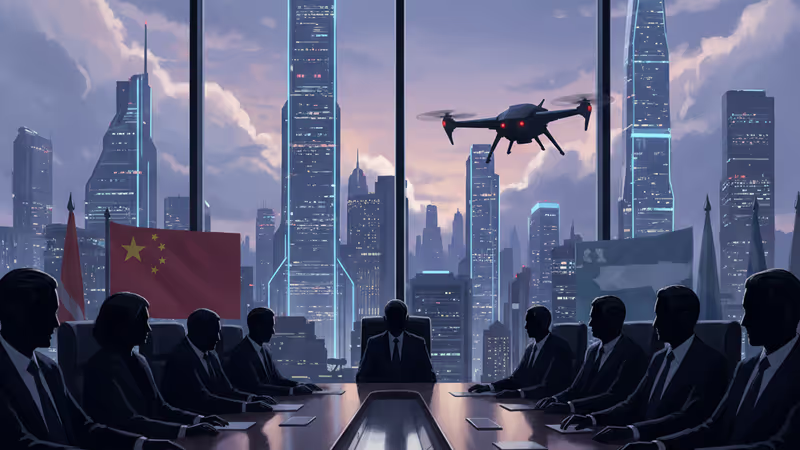
중국의 '저고도 경제' 야망이 8000m 불법 드론 비행으로 시험대에 올랐다. 기술 발전과 항공 안전 규제 사이의 충돌이 글로벌 드론 산업에 미칠 영향을 심층 분석한다.

일본은행의 금리 인상과 중앙아시아 외교는 단순한 뉴스가 아니다. 방위비 증강, 우주 개발 경쟁 속에서 일본의 지정학적 대전환을 심층 분석한다.