
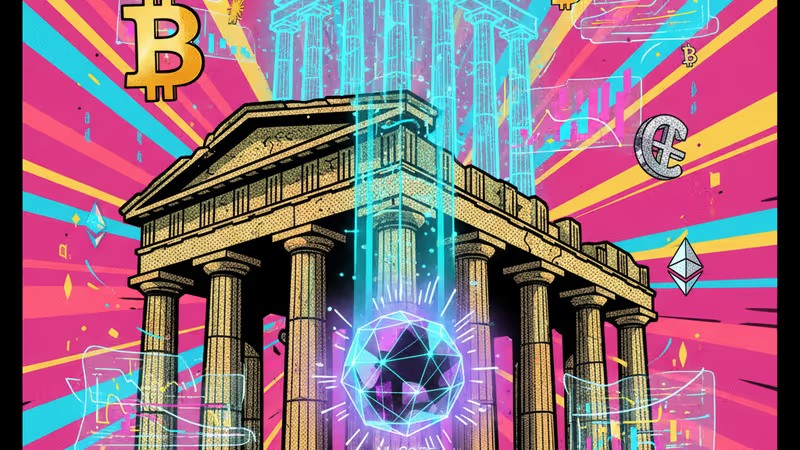
Beyond the Ruin: How AI is Resurrecting Lost Worlds for a New Economy
A photographer's viral project isn't just art. It's the start of a new 'Digital Restoration' economy, using AI to reshape real estate, tourism, and media.
The Lede: This Isn't Art, It's an Economic Signal
An Italian photographer's viral project, which uses AI to visually 'restore' abandoned buildings, is more than a compelling art experiment. For the busy executive, this is a critical signal. It marks the birth of 'Digital Restoration'—a new category of generative media where AI acts as a time machine, creating high-fidelity reconstructions of the past. This isn't just about creating pretty pictures; it’s a proof-of-concept for a new economy built on computational nostalgia, with immediate applications in real estate, media, tourism, and cultural preservation.
Why It Matters: The Second-Order Effects
The ability to instantly visualize 'what was' or 'what could be' moves from a specialized, expensive service to an accessible tool. This has massive downstream implications:
- Real Estate & Architecture: Developers can now generate photorealistic 'before' and 'after' scenarios for historical restoration projects in seconds, not weeks. This will dramatically accelerate client buy-in and project financing.
- Tourism & Culture: Imagine museum exhibits or city guides where visitors can point their phone at a ruin and see it in its prime. This technology allows for the creation of immersive, interactive historical experiences at a fraction of the traditional cost of CGI.
- Entertainment & Media: Film and game production studios can leverage this for rapid environmental concepting, pre-visualization, and creating historically accurate digital sets, slashing pre-production costs and timelines.
The Analysis: From Photographer to Prompt Engineer
Photographer Eleonora Costi's work highlights a fundamental shift in the creator economy. The value is no longer solely in the difficult act of capturing the present (the 'proof-of-work' in traveling to remote ruins). The new, defensible value is in the curation of a unique dataset (her years of original photos) and the artistic skill to direct the AI to a desired outcome (the 'proof-of-imagination').
This is a new creative workflow where the artist acts as a director and the AI is the world's most knowledgeable, instantaneous scenic designer. It democratizes historical visualization, moving it from the hands of niche VFX studios to individual creators. The competitive landscape is no longer just about the best lens, but the most insightful prompt and the most compelling narrative bridge between the real and the imagined.
PRISM Insight: Investing in the 'Digital Restoration' Stack
The core investment opportunity isn't just in the artists, but in the enabling technology—the 'Digital Restoration' stack. This project was likely created with general-purpose tools like Midjourney or Stable Diffusion. However, we predict the emergence of specialized platforms trained on architectural and historical data.
Think of a 'Getty Images for Lost Worlds,' a service providing AI-generated assets of historical locations in their prime. The most valuable assets in this new ecosystem are proprietary, high-quality image datasets of specific domains—like Costi's collection of ruins. Companies that can acquire and build specialized models on such unique data will own the market in creating digital heritage on demand. This is the new frontier of synthetic data, applied to culture and history.
PRISM's Take: The Future of Memory is Computational
This trend represents a profound shift from passive documentation to active, imaginative reconstruction. The line between historian, photographer, and technologist is irrevocably blurring. The key takeaway is that the raw data of our world—in this case, photos of decay—is the fuel for AI to not only show us what is, but to build a tangible, visual connection to what was lost.
This isn't about replacing reality or erasing history; it's about augmenting it. We are witnessing the fusion of human exploration with machine imagination. The future of preserving our past lies not just in protecting physical ruins, but in computationally resurrecting their stories for a new generation.
관련 기사

독재자들의 편집증적인 식사 규칙이 어떻게 현대의 블록체인 푸드 트래킹과 AI 식품 분석 기술의 필요성을 예고했는지 알아보세요.
제프리 엡스타인 자택에서 발견된 트럼프 콘돔의 의미를 분석합니다. 단순 가십을 넘어 밈 정치와 권력의 상징이 된 사건의 이면을 파헤칩니다.
양떼가 살인사건을 수사한다? 황당한 영화 '양떼 탐정'을 통해 할리우드의 최신 IP 전략과 CGI 기술 트렌드를 심층 분석합니다.
프랑스 2800만 명 연구 결과, 코로나 백신이 모든 원인을 포함한 전체 사망률을 25% 감소시키는 것으로 나타났습니다. 단순 바이러스 예방을 넘어선 백신의 놀라운 효과를 분석합니다.