
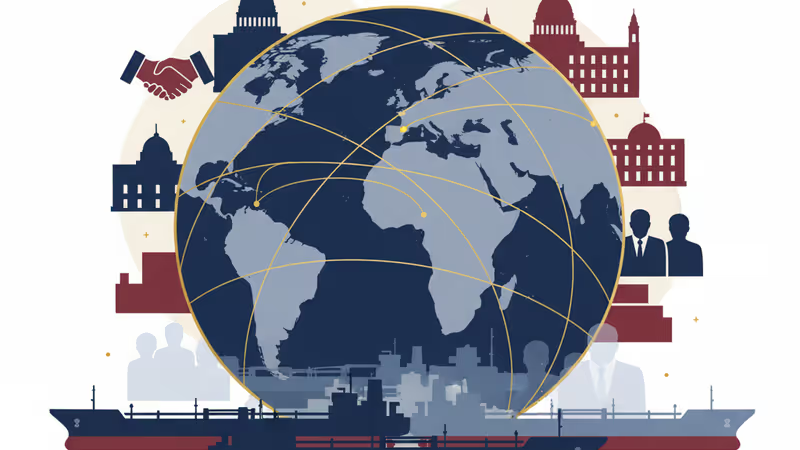
Beyond the Barrel: Trump's Tanker Ban Weaponizes Maritime Data, Forging a Global 'Shadow Fleet'
US ban on Venezuela tankers is more than a sanction. It's weaponizing maritime data, creating a 'shadow fleet' & impacting global supply chains. Analysis here.
The Lede: A New Digital Iron Curtain on the High Seas
Washington's latest move against Venezuela is far more than another line item in a long-running sanctions regime. By banning specific oil tankers from global transit, the White House has shifted its strategy from targeting a nation's cargo to blacklisting the physical assets of global trade. For business leaders and investors, this isn't just about oil prices; it's the weaponization of maritime logistics itself. A digital iron curtain is descending on the high seas, forcing a choice between compliance and exclusion, and redrawing the map of global supply chains in real-time.
Why It Matters: The Ripple Effect Beyond Caracas
The immediate goal is to choke off the final revenue streams for the Venezuelan government. But the second-order effects are far more significant for the global economy:
- A Two-Tiered Shipping Market: This order creates a permanent "pariah" class of vessels. Any tanker that has serviced Venezuela becomes toxic, facing bans from major ports, denied insurance from syndicates like Lloyd's of London, and de-listed by flag states like Panama and Liberia. This bifurcates the global tanker fleet into compliant and non-compliant assets, increasing costs and complexity for everyone.
- Insurance and Finance Under Fire: The compliance burden on maritime insurers, banks, and commodity traders has just been magnified exponentially. They must now track not just the cargo, but the entire history of the vessel itself, creating significant operational risk and likely increasing insurance premiums across the board.
- Energy Market Volatility: While Venezuela's output is a fraction of its former glory, removing its barrels from the transparent market and forcing them into the shadows adds a new layer of uncertainty and a risk premium to global oil prices. It also tightens the market for heavy crude, impacting specific refiners in Asia.
The Analysis: An Escalation in a Long Geopolitical Chess Match
This policy is a direct evolution of tactics used against Iran and North Korea, but its application to an entire class of globally-trading vessels marks a significant escalation. For years, sanctioned states have relied on a growing "shadow fleet"—aging tankers with opaque ownership structures, often engaging in ship-to-ship transfers with their transponders off to hide their activity. This US move is a direct assault on that network.
The geopolitical chessboard is now in motion. China, a primary buyer of sanctioned oil, and Russia, a key geopolitical ally to Caracas, will view this as an unacceptable extraterritorial overreach. They will likely accelerate efforts to build a parallel maritime ecosystem—complete with their own insurance, financing, and certification—to counter US dominance over global trade chokepoints. This deepens the trend of geopolitical fragmentation, forcing other major shipping and trading nations, from Greece to Singapore, into a difficult strategic position.
PRISM Insight: The New Battlefield is Maritime Surveillance Tech
Enforcement of this ban is a high-tech endeavor, transforming maritime intelligence from a niche industry into a critical tool of statecraft. The US and its allies will rely on a sophisticated mesh of technologies:
- Satellite Intelligence: Commercial satellite firms providing Automatic Identification System (AIS) tracking data are the front line. AI algorithms will be used to detect suspicious behavior, like vessels going "dark" near Venezuelan waters.
- Synthetic Aperture Radar (SAR): When transponders are off, SAR satellites can still detect the steel hulls of ships, exposing illicit ship-to-ship transfers even at night or through cloud cover.
- Predictive Analytics: Fintech and regtech platforms will be crucial for mapping complex corporate ownership structures to identify the true beneficiaries of a vessel's operations.
This creates a cat-and-mouse game. The shadow fleet will respond with more sophisticated GPS spoofing, identity laundering, and operational tactics to evade detection. For investors, the growth area is clear: companies specializing in next-generation maritime domain awareness are now essential components of the national and economic security apparatus.
PRISM's Take: A High-Stakes Bet on Logistical Strangulation
The White House is betting it can make the logistical and financial cost of dealing with Venezuela prohibitively high for any actor in the global system. While this strategy may succeed in further isolating Caracas, it simultaneously accelerates the splintering of the globalized trade framework we've known for 30 years. The long-term consequence will be a less efficient, more expensive, and more politically fragmented maritime system. For global corporations and investors, the era of assuming frictionless maritime transit is over. Mapping and mitigating geopolitical risk within your supply chain is no longer a theoretical exercise; it is now an urgent and permanent cost of doing business.
관련 기사

노르웨이의 친환경 풍력발전이 원주민 사미족의 삶을 위협합니다. 기후 대응과 인권이 충돌하는 '녹색 전환의 딜레마'와 ESG 리스크를 심층 분석합니다.

미군의 태평양 해상 선박 타격으로 사망자가 100명을 넘어섰습니다. 마약 소탕을 명분으로 내세운 이 작전이 베네수엘라를 겨냥한 지정학적 압박이자 국제법을 위협하는 위험한 선례가 되는 이유를 심층 분석합니다.

EU가 900억 유로 규모의 우크라이나 지원안에 합의했습니다. 러시아 동결자산 대신 공동부채를 택한 결정의 지정학적, 경제적 함의를 심층 분석합니다.

EU가 우크라이나에 900억 유로 대출을 결정했습니다. 러시아 동결 자산 활용이 무산된 배경과 지정학적 셈법, 글로벌 금융 시장에 미칠 영향을 심층 분석합니다.