

Germany's Record €87 Billion Trade Deficit With China Sparks Protectionism Fears
Germany's trade deficit with China is set to hit a record €87 billion in 2025, fueled by weak German exports, strong EV competition, and a corporate 'in China, for China' strategy, raising fears of a protectionist turn.
Germany’s trade deficit with China is on track to hit a record €87 billion (US$102 billion) in 2025, a dramatic widening driven by shrinking demand for German goods and fierce competition in the electric vehicle sector. According to analysts, the growing imbalance is fueling concerns of a political and protectionist backlash in Berlin.
A forecast released last week by Germany Trade and Invest (GTAI), an economic development agency, projects that China's exports to Germany will rise by 7.2% this year to reach €168 billion. Meanwhile, Germany’s exports to China are expected to fall by 10% to just €81 billion. Holger Goerg of the Kiel Institute for the World Economy noted that reversing this trend will be difficult in the short term.
The Engine Stalls: Auto Industry Woes Deepen the Divide
At the heart of the issue is the eroding competitiveness of Germany's famed industrial base. The GTAI report forecasts that the country's vaunted automotive industry is set to see its global exports decline by 3.2% this year. It's a slump driven significantly by Chinese EV makers, who are aggressively challenging legacy German brands not only in their home market but across emerging Asia.
This trend is a key driver of the trade gap. A Deutsche Bank report from October stated that Germany’s auto exports to China fell by roughly 5% year-on-year during the first seven months of 2025, directly contributing to the widening deficit.
'In China, for China': A Strategy That Curbs Exports
Adding to the imbalance is a strategic shift by German industrial giants themselves. Companies like Volkswagen are increasingly localizing their production under an “in China, for China” mantra, a strategy encouraged by Beijing. This effectively substitutes goods once exported from Germany with products made locally in China.
As a result, German foreign direct investment in China is now driven less by new capital and more by the reinvested earnings of established players expanding their local operations, Goerg observed.
This record deficit isn't just an economic statistic; it's a political flashpoint. It will intensify the debate within Germany's government between pro-engagement industrial interests and hawkish factions demanding a tougher stance on Beijing, potentially accelerating a push for new EU-level trade defenses.
본 콘텐츠는 AI가 원문 기사를 기반으로 요약 및 분석한 것입니다. 정확성을 위해 노력하지만 오류가 있을 수 있으며, 원문 확인을 권장합니다.
관련 기사

일본 정부가 122조 엔 규모의 사상 최대 예산안을 조율하는 가운데, 1인당 GDP 순위는 24위로 하락했다. 고령화 대응과 엔저 현상이라는 두 가지 과제를 동시에 마주한 일본 경제의 현주소를 분석한다.

더불어민주당 김병기 원내대표가 대한항공으로부터 약 160만원 상당의 호텔 숙박을 제공받은 사실이 보도되자 공식 사과했다. 야당은 청탁금지법 위반 가능성을 제기하며 공세를 펴고 있다.

베테랑 공화당 전략가 마크 쇼트가 NPR 인터뷰에서 당의 현주소와 차세대 리더십을 논했다. 2026년 중간선거와 2028년 대선을 앞두고 공화당의 미래 방향성을 가늠해본다.
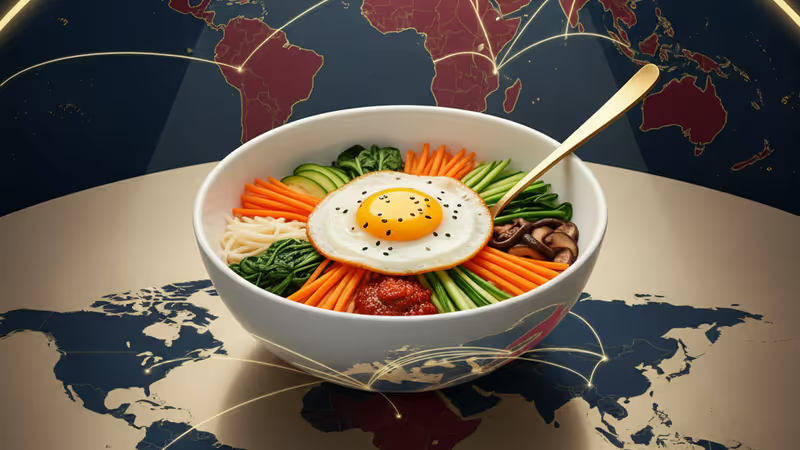
한국 정부가 K-컬처의 세계적 인기를 기반으로 2030년까지 연간 식품 수출액 210억 달러 달성을 목표로 하는 종합 전략을 발표했다. 맞춤형 수출 품목, 인재 양성, 문화 연계 등을 통해 K-푸드를 국가 전략 산업으로 육성할 계획이다.