
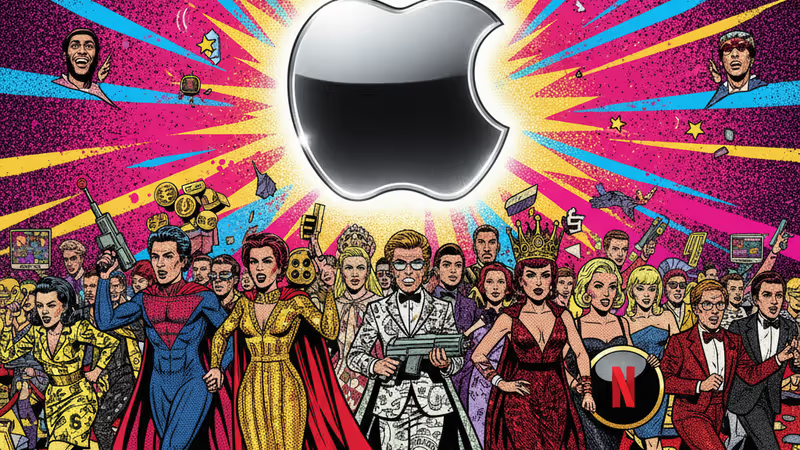
Apple's New Hollywood Playbook: Weaponizing A-Listers to Win the Streaming Wars
Apple TV+ is weaponizing A-list talent and prestige films not just to win subscribers, but to fortify its entire trillion-dollar tech ecosystem.
The Lede: Beyond the Queue
While rivals focus on subscriber counts, Apple is executing a calculated, long-term assault on the prestige entertainment market. Its upcoming film slate—featuring A-listers like Brad Pitt, Matthew McConaughey, and Denzel Washington, helmed by acclaimed directors Joseph Kosinski, Paul Greengrass, and Spike Lee—is not merely content. It's a strategic deployment of cultural capital designed to fortify its trillion-dollar ecosystem, making Apple TV+ a critical component of brand loyalty, not just a line item in your streaming budget.
Why It Matters: The Great Streaming Bifurcation
This signals a fundamental split in the streaming landscape. The market is bifurcating into two distinct models:
- The Content Supermarket (Netflix, Amazon): A volume play focused on having something for everyone, all the time. Success is measured by engagement hours and minimizing churn through sheer quantity.
- The Digital Boutique (Apple): A curation play focused on prestige, quality, and cultural impact. Success is measured by brand association, critical acclaim, and its halo effect on the broader hardware and services ecosystem.
Apple's strategy forces competitors to confront an uncomfortable question: can a 'supermarket' model sustain premium pricing and brand loyalty when a 'boutique' offers consistent, award-caliber exclusives? This is a direct challenge to the established streaming economy, shifting the battleground from quantity to perceived quality.
The Analysis: From 'CODA' to Content Citadel
Apple's 2022 Best Picture Oscar for CODA was not a lucky shot; it was proof of concept. The company learned it could bypass the decades-long process of building a studio reputation by attracting top-tier talent with two things rivals struggle to offer simultaneously: near-unlimited budgets (subsidized by iPhone profits) and the promise of creative prestige, including theatrical releases and robust awards campaigns.
Look at the new slate. Joseph Kosinski, fresh off the massive success of Top Gun: Maverick, brings blockbuster credibility with F1. Paul Greengrass (The Bourne Ultimatum) and Spike Lee (Do the Right Thing) lend gravitas and auteur-driven appeal. This isn't about filling content gaps; it's about building a modern-day equivalent of a classic Hollywood studio—like MGM in its prime—where the brand itself becomes a seal of quality.
While Netflix is navigating the complexities of ad-supported tiers and password-sharing crackdowns, Apple is playing a different game. It doesn't need Apple TV+ to be profitable on its own. It needs it to be another indispensable reason to buy an iPhone, subscribe to Apple One, and perhaps one day, view content on a Vision Pro. Each potential Oscar nomination is marketing for the entire Apple ecosystem.
PRISM Insight: The ROI of Cultural Capital
The investment thesis here transcends media P&L. Apple is investing in cultural assets, not just content licenses. The return on investment (ROI) for a film like The Lost Bus isn't measured solely by streams, but by its contribution to Apple's brand as a purveyor of premium, human-centric stories. This soft power is invaluable.
Technologically, this strategy integrates seamlessly with its hardware ambitions. Expect Apple to leverage its high-end filmmaking collaborations to push the technical envelope, creating showcase content optimized for its devices. Imagine an F1 movie with spatial audio exclusive features for AirPods Max or an immersive viewing mode designed for the Vision Pro. The content becomes a Trojan horse for hardware upgrades, creating a powerful, self-reinforcing flywheel that no pure-play streamer can replicate.
PRISM's Take: Building a Moat with Celluloid
Apple is not participating in the streaming wars; it is fundamentally altering the terms of engagement. While competitors fight a war of attrition over monthly fees, Apple is building a cultural moat. Its strategy is to make "Apple Original Films" synonymous with excellence, turning its streaming service from a simple utility into a status symbol. This isn't about beating Netflix at the volume game. It's about creating a new, more defensible position where brand, prestige, and ecosystem integration are the ultimate weapons. In this arena, Apple is competing only with itself.
관련 기사

프랑스 2800만 명 연구 결과, 코로나 백신이 모든 원인을 포함한 전체 사망률을 25% 감소시키는 것으로 나타났습니다. 단순 바이러스 예방을 넘어선 백신의 놀라운 효과를 분석합니다.

SNS 속 완벽한 케이크와 웃픈 실패작. 이 밈 현상은 단순한 유머를 넘어, 디지털 시대의 기대치 인플레이션과 정신 건강에 대한 중요한 질문을 던집니다.

사소해 보이는 디자인 실패가 브랜드 충성도를 파괴하고 기업의 미래를 위협합니다. 자동차 터치스크린부터 떼기 힘든 스티커까지, UX 재앙의 진짜 의미를 분석합니다.

대퇴사 시대, '남의 직장' 사진 열풍은 단순한 구경거리가 아닙니다. 일의 경험화, 직업의 콘텐츠화라는 미래 트렌드를 분석합니다.