

America's 'Weather Brain' on the Chopping Block: The Geopolitical Fallout of a Climate Lab Breakup
The White House plan to dismantle a key climate research center isn't just bureaucracy. It's a strategic move that could cede weather prediction leadership to rivals.
The Lede: Why This Matters Beyond the Forecast
The White House's plan to dismantle a premier federal weather and climate research center in Colorado is far more than an administrative shuffle. For leaders in business and government, this represents the potential degradation of a core strategic asset: data supremacy. The systems that predict hurricane paths, crop yields, and energy demand are not just public services; they are foundational infrastructure for a multi-trillion-dollar global economy. Disrupting the nerve center of this system introduces a critical, and perhaps irreversible, risk into global markets and national security planning.
Why It Matters: The Cascade of Second-Order Effects
Losing even a fraction of forecasting accuracy has massive downstream consequences. This move isn't just about whether to bring an umbrella; it's about systemic risk that ripples through critical sectors:
- Global Commerce & Supply Chains: Aviation, shipping, and logistics companies depend on precise long-range forecasts to optimize routes, save fuel, and ensure safety. Degraded modeling introduces costly inefficiencies and new layers of operational risk.
- Agriculture & Food Security: Predicting droughts, floods, and freezes is essential for managing global food supplies. A less reliable forecast directly impacts crop insurance, commodities trading, and ultimately, food prices and stability.
- National Security: The Department of Defense and intelligence agencies rely on US-owned and operated weather models for everything from naval deployments and flight missions to predicting conditions in geopolitical hotspots. Ceding capability in this area is a direct threat to operational superiority.
- The Insurance Industry: The $1.4 trillion insurance and reinsurance market uses sophisticated climate models to price risk for everything from coastal real estate to infrastructure projects. Undermining the public data these models are built upon creates catastrophic uncertainty.
The Analysis: A Retreat in the Global Data Race
Historically, the United States has been the world's leader in atmospheric science, treating its data and modeling as a global public good. This leadership, anchored by integrated research centers like the one in Colorado, has been a significant source of soft power and a strategic advantage. However, this move occurs in a fiercely competitive global landscape.
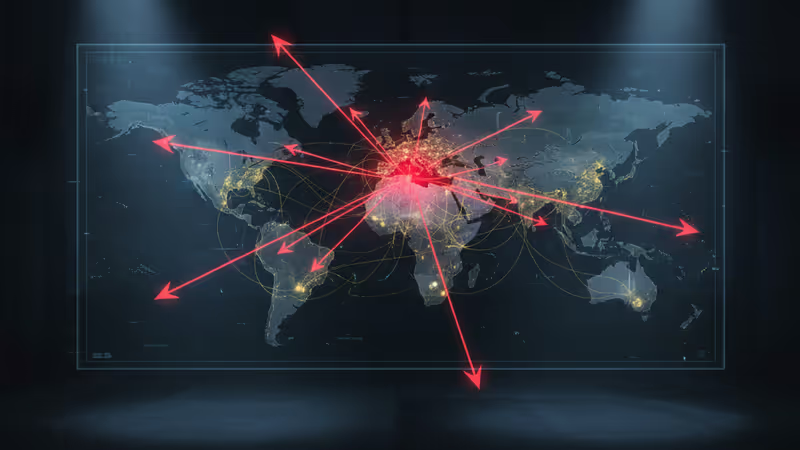
The European Centre for Medium-Range Weather Forecasts (ECMWF) already consistently outperforms the primary American model (GFS) in key metrics. Meanwhile, China has declared its ambition to achieve global leadership in meteorological science by 2035, investing billions in supercomputing, satellite constellations, and AI research to achieve it. Proponents of the breakup may argue for efficiency or streamlining bureaucracy, but experts see it as dismantling the very collaborative, multi-disciplinary structure that fosters innovation. In this context, the White House plan looks less like a reorganization and more like a unilateral disarmament in a global technology race where the prize is predictive power.
PRISM Insight: The AI Weather War and Sovereign Data Risk
The next frontier in forecasting is AI. Models from Google’s DeepMind (GraphCast) and NVIDIA (FourCastNet) are already demonstrating the ability to generate faster, and in some cases more accurate, predictions than traditional physics-based systems. However, these AI models are only as good as the decades of high-quality, trusted historical data they are trained on.
The Colorado research center is a critical steward and generator of this foundational data. Breaking it up risks fracturing datasets, interrupting long-term climate records, and degrading the very 'digital crude' needed to fuel America's competitiveness in the AI weather war. For private sector companies that build services atop government data, this introduces a new category of sovereign data risk—the danger that their foundational data supply could be compromised by domestic political decisions, not just foreign actors.
PRISM's Take: A Self-Inflicted Strategic Wound
Viewing this decision through a geopolitical and technological lens, the plan to break up a key climate research hub is a profound strategic error. It prioritizes perceived short-term administrative neatness over the long-term preservation of a vital national and economic security asset. In an era where predictive analytics and data dominance define power, deliberately degrading one of the world's most sophisticated data engines is a self-inflicted wound. It creates a capability vacuum that strategic competitors like China are fully prepared and funded to fill, potentially leaving the US and its allies dependent on foreign-owned systems for critical environmental intelligence.
관련 기사
엡스타인 파일 공개가 2024년 미국 대선을 앞두고 빌 클린턴을 겨냥한 정치적 무기로 변질되고 있습니다. 사법의 무기화 현상과 글로벌 파장을 심층 분석합니다.

중국산 부품이 러시아의 킬러 드론을 어떻게 강화하고 있는가? 이는 단순한 무기 거래를 넘어, 지정학과 미래 전쟁의 패러다임을 바꾸는 새로운 '드론 동맹'의 부상이다.

미국이 사우디에 대한 공격용 무기 판매 금지를 해제했습니다. 중동의 힘의 균형, 미-중 경쟁, 그리고 방산 기술 시장에 미칠 파장을 심층 분석합니다.

미 법무부의 엡스타인 파일 공개가 투명성 논란을 지폈습니다. 단순 요약이 아닌, 편집된 진실 뒤에 숨은 정치적, 사법적 함의를 심층 분석합니다.