
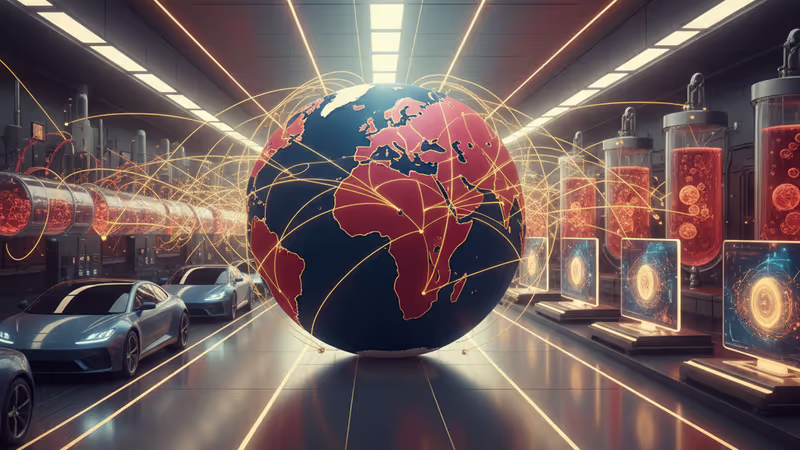
China Unplugs a Decade of EV Subsidies, Pivoting to the Next Tech Frontier
China has dropped electric vehicles (EVs) from its list of strategic industries for the first time in a decade, signaling a major policy shift. What does this mean for the global market, and what lessons can the U.S. learn from China's industrial playbook?
After a decade of relentless state-led investment that made it the world's undisputed electric vehicle (EV) leader, China has made a stunning policy pivot. In its 15th Five-Year Plan (2026-2030), Beijing omitted EVs from its official list of strategic industries for the first time in ten years. The move signals that China's leadership believes the industry has graduated from its hyper-accelerated development phase and is ready to face market forces, a transition that holds critical lessons for the U.S. and its allies.
Venture-Capital Statecraft and Its Side Effects
China's EV dominance was built on a strategy best described as venture-capital statecraft. From 2009 to 2023, the government poured an astonishing $230 billion into the sector through subsidies, tax breaks, and cheap credit. This happened even when demand was negligible; in 2009, total EV sales in China were just 500 units. The bet paid off. By 2024, China's EV production hit 12.4 million units, accounting for 70% of global output.
However, this supply-side push created severe economic distortions. The strategy led to what Beijing now calls “involution”—a state of hyper-competition, overcapacity, and deflation. China's EV production capacity is now three times its domestic demand. As of August 2025, only three EV makers—BYD, Li Auto, and Aito—are profitable. This imbalance is economy-wide: nearly a quarter of all industrial firms are losing money, the highest share since 2001, as investment consistently outpaces consumption.
The Export Release Valve and the New Blueprint
So far, China has managed these pressures through a crucial 'release valve': exports. With domestic demand weak, overseas markets have absorbed the massive overcapacity. China's record $992 billion trade surplus in 2024 was a key driver of its 5% GDP growth. In markets like Brazil, Mexico, and Thailand, Chinese models account for over 80% of EV imports. Some local officials even resorted to inflating economic data by exporting “zero-mileage” cars as 'used' to foreign markets at a discount.
With the EV industry now considered mature, Beijing is applying the same playbook to a new set of frontiers. The new strategic industries list is a guide to the future: quantum technology, bio-manufacturing, hydrogen and fusion energy, 6G communications, embodied intelligence, and brain-computer interfaces. These sectors are now slated to receive the same preferential financing and state support that built China's EV empire.
China's experience offers a clear, if costly, blueprint for scaling new industries. For U.S. policymakers, the lesson is twofold. First, industrial policy must balance supply-side incentives with demand-creation measures like public procurement and tax credits to avoid creating domestic overcapacity. Second, strategic coordination with allies on R&D, market access, and targeted protectionism is crucial to effectively compete with China's state-driven model.
본 콘텐츠는 AI가 원문 기사를 기반으로 요약 및 분석한 것입니다. 정확성을 위해 노력하지만 오류가 있을 수 있으며, 원문 확인을 권장합니다.
관련 기사

멕시코 해군 소속 소형 항공기가 미국 텍사스 해안에 접근하던 중 추락해 어린이 환자 등 최소 5명이 사망했다. 사고 원인은 현재 조사 중이다.
대한민국 국회가 여당 주도로 윤석열 전 대통령의 계엄 시도 관련 내란 사건을 다룰 특별재판부 설치 법안을 통과시켰다. 야당은 필리버스터로 강력히 반발하며 사법부 장악 시도라고 비판했다.

시리아 정부군과 쿠르드 주도 SDF가 알레포에서 교전을 중단하기로 합의했다. 터키 외무장관 방문 중 발생한 이번 충돌로 최소 2명의 민간인이 사망했다.
중국 온라인에서 마지막 왕조인 청나라에 역사적 책임을 묻는 '1644 사관'이 확산하며 당국의 비판과 사회적 논쟁을 촉발하고 있다. 이 현상의 배경과 의미를 분석한다.