

After Assad: Trump’s 'Vengeance' Strike Forges a New, Fragile US-Syria Alliance
Analysis: US retaliatory strikes in Syria signal a new era. We break down the geopolitical shift, the fragile US-Syria alliance, and what it means for global security.
The Lede: Beyond Retaliation
A series of US airstrikes in Syria, framed by the White House as “vengeance,” is far more than a simple retaliatory act. For global executives and strategists, this is the first major stress test of the post-Assad geopolitical landscape. The operation, conducted with the explicit support of Syria's new government, signals a dramatic realignment in the Middle East. It establishes a new, transactional US foreign policy doctrine of swift retribution and redefines the rules of engagement with non-state actors, directly impacting regional stability, energy security, and defense sector outlooks.
Why It Matters: A New Doctrine and a New Partner
This event marks a pivotal moment with three critical second-order effects:
- The Birth of a Transactional Alliance: The overt cooperation between Washington and the new Damascus government, formed after Bashar al-Assad's fall in 2024, is a seismic shift. The new Syrian regime gains much-needed international legitimacy and a powerful security partner. The US secures a local force to prosecute its counter-terrorism goals without a costly large-scale troop deployment. This is a fragile, symbiotic relationship born of necessity.
- Foreign Policy as Public Declaration: Secretary of Defense Pete Hegseth's statement, “This is not the beginning of a war — it is a declaration of vengeance,” is carefully crafted policy. It’s a signal to adversaries worldwide that attacks on American personnel will be met with disproportionate force, not protracted conflict. This “retribution doctrine” aims to re-establish deterrence through overwhelming, targeted force.
- Regional Power Vacuum Reshuffle: With the Assad regime gone, Russia and Iran have lost their primary client state in the Levant. This US-backed operation further sidelines their influence. Neighboring powers like Turkey, Israel, and the Gulf states are now recalculating their strategies in a Syria that is, for the first time in decades, aligning with Washington.
The Analysis: From Proxy War to Precarious Partnership
For over a decade, Syria was a complex theater of proxy warfare where the US and the Assad regime, backed by Russia and Iran, had conflicting objectives. Fighting ISIS was often secondary to a larger geopolitical chess match. The fall of Assad in 2024 wiped the board clean, creating a power vacuum that ISIS immediately sought to exploit.
President Trump's decision to strike with the new government's blessing transforms the dynamic from adversarial to allied. This move is a textbook example of a pragmatic, post-ideological foreign policy. However, this partnership is fraught with risk. The new Syrian government is still consolidating power and faces internal threats. Its long-term strategic interests may not always align with Washington's. The US is betting that the mutual threat of an ISIS resurgence is enough to hold the alliance together. History, particularly in this region, suggests such alliances of convenience are inherently unstable.
The international reaction will be fragmented. European allies, while supportive of counter-ISIS operations, may be wary of the Trump administration's aggressive “vengeance” rhetoric. Russia and China will likely condemn the strikes as a violation of sovereignty, even with the new Syrian government's approval, viewing it as a move by the US to cement its influence in a post-Assad Middle East.
PRISM Insight: The Tech of Targeted Vengeance
The operation's name, “Hawkeye Strike,” is telling. It points to a heavy reliance on advanced Intelligence, Surveillance, and Reconnaissance (ISR) platforms—likely a combination of satellites, high-altitude drones, and AI-driven pattern analysis to identify and track dozens of targets across a wide area. This represents the maturation of remote warfare. The key technological trend is not just precision munitions, but the data fusion and AI-powered targeting that enables a rapid, wide-scale “vengeance” operation to be planned and executed in days. This creates a feedback loop: increased regional instability drives demand for advanced ISR and precision strike technologies, benefiting a specific sub-sector of the defense industry.
PRISM's Take: A High-Stakes Bet on a New Syria
Operation Hawkeye Strike is a powerful statement, but its true significance lies in the strategic bet the US is placing on Syria's nascent government. The Trump administration is leveraging a tactical military necessity—retaliating against ISIS—to achieve a much larger strategic goal: embedding a pro-US anchor in the heart of the Levant and locking Russia and Iran out.
The success of this entire doctrine hinges on one critical variable: the stability and reliability of its new partner in Damascus. If the new government can consolidate power and remain a dependable ally, the US will have successfully reshaped the Middle East at a minimal cost. If, however, the government fractures or turns against US interests, Washington will find itself in a familiar nightmare: facing a resurgent terrorist threat in a failed state, with even fewer options than before. This operation isn't an end; it's the beginning of a precarious and consequential new chapter for US policy in the region.
관련 기사
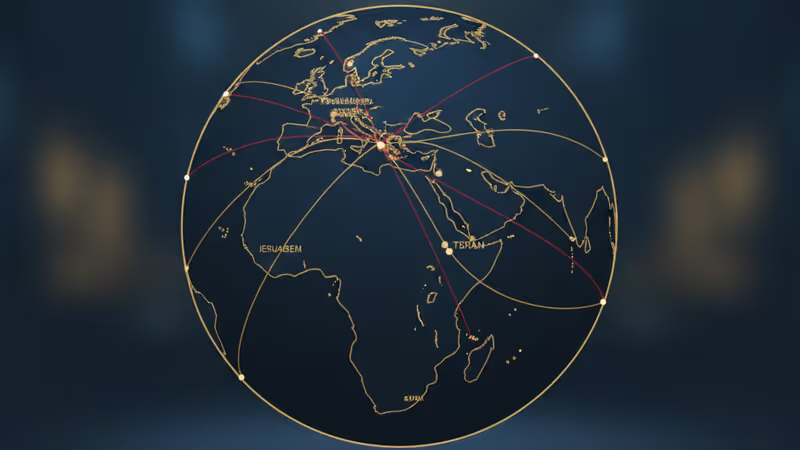
트럼프 행정부의 시리아 IS 보복 공습을 심층 분석합니다. 단순한 군사 행동을 넘어 '미국 우선주의'의 딜레마와 중동 지정학에 미친 영향을 파헤칩니다.

과거 전쟁의 기억은 미래 분쟁에 대한 위험한 착각을 만듭니다. 미중 갈등은 우리가 상상하는 것과 전혀 다른 하이브리드 전쟁이 될 것입니다.
미국 ICE 구금 시설 사망자가 20년래 최고치를 기록했습니다. 트럼프 행정부의 강경 이민 정책이 낳은 인도주의적 위기와 그 지정학적 함의를 심층 분석합니다.

트럼프 재선 1년, 일론 머스크의 DOGE와 행정명령을 통해 연방정부가 해체되고 있습니다. 미국의 행정부 재편이 글로벌 지정학에 미치는 영향을 분석합니다.