
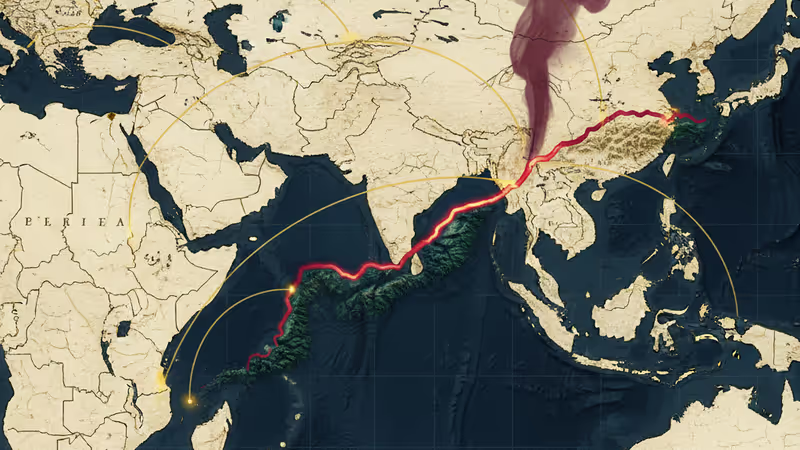
A Line on a Map: Why Cambodia and Thailand Are Back at War
In December 2025, the Cambodia-Thailand border conflict has reignited, shattering a recent peace deal. Explore the 100-year-old dispute rooted in a French colonial map, the 1962 ICJ ruling, and why diplomacy failed.
A peace deal hailed just two months ago has collapsed into heavy fighting. In December 2025, hostilities between Cambodia and Thailand erupted anew along their disputed border, displacing over 750,000 people and shattering a U.S.-brokered accord. The conflict's origins lie not in recent tensions, but in a century-old map drawn by French colonial cartographers.
The recent flare-up began in July 2025 with firefights across the border. A U.S.-mediated ceasefire on July 28 briefly paused the violence. Working with ASEAN, President Donald Trump then helped broker the Kuala Lumpur Peace Accord on October 26, which aimed to turn the fragile truce into a long-term de-escalation framework. Both countries agreed to a phased withdrawal of heavy weaponry.
But the accord never attempted to confront the territorial dispute at the center of the conflict. In retrospect, its failure was probably inevitable.
---
## Timeline: From Peace Accord to Open Conflict
* **July 28, 2025:** After initial firefights erupt, the United States mediates a ceasefire.
* **October 26, 2025:** The Kuala Lumpur Peace Accord is signed in Malaysia, witnessed by U.S. President Donald Trump and Malaysian Prime Minister Anwar Ibrahim.
* **Early November 2025:** Several Thai soldiers are injured by a landmine. Bangkok claims it was newly planted by Cambodia and suspends its obligations under the peace deal. Phnom Penh denies the claim.
* **December 7, 2025:** Following a new incident, the two sides exchange heavy fire once again, effectively rendering the peace framework defunct.
---
## callout-info: Background: The Colonial Seed
The dispute dates to the early 20th century, when Cambodia was part of French Indochina. France, seeking to secure its colonial borders, and Siam (modern-day Thailand), struggling to preserve its independence, negotiated a new boundary. A 1904 treaty established the "watershed principle"—the crest of the Dangrek Mountains—as the natural dividing line. However, the critical work of surveying and map-making was left to a joint Franco-Siamese commission, which was dominated by French technical officers.
This commission produced a series of maps, including the one now known as the Annex I Map. This map covered the Preah Vihear temple, an 11th-century Angkorian ruin. Had the watershed principle been strictly applied, the temple would have been on the Siamese side. The French-drawn map, however, placed it in Cambodia.
Crucially, when Siamese officials received the map around 1908, they lodged no formal protest. In international law, a state's silence in the face of such a delineation can be interpreted as tacit acceptance, or acquiescence. For decades, the map was used without objection in official documents and even school classrooms.
Everything changed after Cambodia gained independence in 1953. With the colonial framework gone, Bangkok reopened the border question, arguing the map violated the 1904 treaty's watershed principle. In 1954, Thai troops occupied the temple.
In 1959, Cambodia took the case to the International Court of Justice (ICJ). In its landmark 1962 ruling, the ICJ found that Thailand had accepted the Annex I Map for half a century through its actions and silence. Its late-stage objection could not override decades of acquiescence. The court held that Preah Vihear temple belonged to Cambodia.
Yet, the ICJ's ruling never adjudicated the entire 817-kilometer frontier. It left large stretches of land, including other ancient temples like Ta Moan Thom, Ta Moan Tauch, and Ta Krabei, undefined and vulnerable to competing claims. These areas are the flashpoints of the 2025 conflict.
Thailand argues that the treaty-mandated watershed line places these other sites on its side and that other French maps lack binding force without clear joint approval. Cambodia counters that all the maps were produced under treaty authority and implicitly accepted by Siam over time, a pattern of behavior the ICJ itself recognized.
## PRISM Insight: Colonial Legacies and the Limits of Diplomacy
The Cambodia-Thailand conflict is a textbook case of how ambiguous colonial-era legacies can erupt into 21st-century violence. It highlights a classic international law dilemma: which holds more weight, the text of a treaty (the watershed principle) or subsequent state practice (the acceptance of a map)? The rapid collapse of the October peace accord also demonstrates the limits of third-party mediation, such as that led by the Trump administration, when it fails to confront the core territorial dispute. A map, this conflict shows, is never just a map; it's a battleground for history, sovereignty, and national identity.
本コンテンツはAIが原文記事を基に要約・分析したものです。正確性に努めていますが、誤りがある可能性があります。原文の確認をお勧めします。
関連記事

タイとカンボジアが、死者41人、避難民100万人近くを出している国境紛争の終結に向け、12月24日に協議を再開する。トランプ前大統領が仲介した停戦が崩壊した背景と、国際社会の動きを解説。
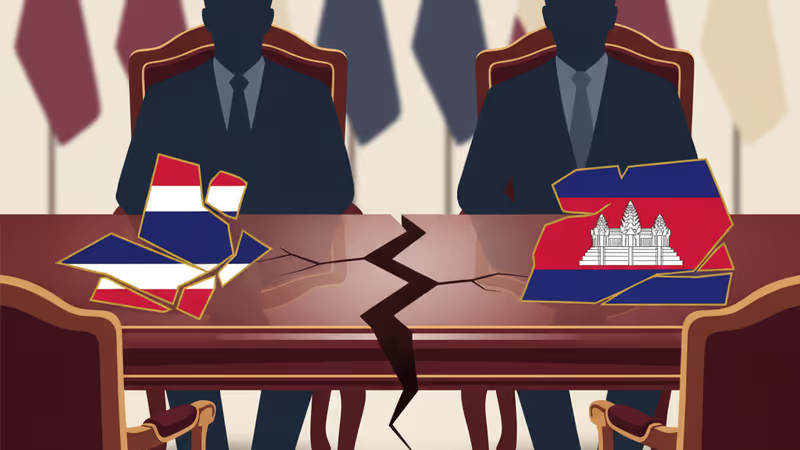
12月22日にクアラルンプールで開かれたASEAN特別外相会合で、タイとカンボジアは即時停戦に合意できなかった。両国は水曜日に協議を再開する予定で、外交努力が続いている。
ASEANの外交努力の最中、タイとカンボジア国境で新たな戦闘が発生。死者は40人を超え、避難民は100万人近くに。両国の非難の応酬と国際社会の対応を詳報します。
ASEANがタイ・カンボジア国境紛争で緊急外相会議を開催。死者40人、避難民75万人超の事態に対し、タイは国内事情を背景に強硬姿勢を維持。国際社会の仲介は難航が予想される。