
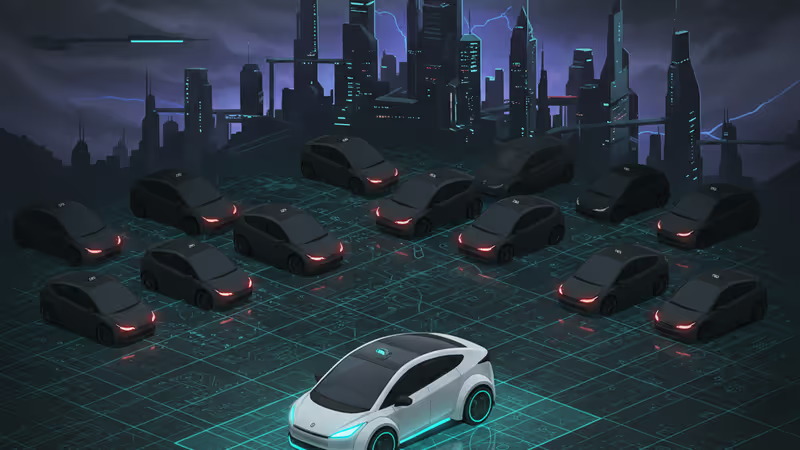
Waymo's $110B Gambit: Why Alphabet is Doubling Down to End the Robotaxi Wars
Waymo's potential $15B funding at a $110B valuation isn't just growth. It's Alphabet's strategic move to end the robotaxi wars and dominate the future of transport.
The Lede: The Endgame Begins
Waymo's reported discussions to raise over $15 billion at a staggering $110 billion valuation is far more than just another funding round. This is Alphabet's strategic power play, signaling the end of the decade-long R&D phase for autonomous vehicles and the beginning of a brutal, capital-intensive war for market dominance. For investors, executives, and urban planners, this move is a clear signal: the theoretical future of transportation is now a real-world land grab, and Waymo intends to be the last one standing.
Why It Matters: Building an Unbreachable Moat
A $15 billion war chest isn't just for buying more Jaguar I-PACEs. It's for creating an unassailable competitive advantage that latecomers will find impossible to overcome. This capital injection is designed to build a three-tiered moat:
- Regulatory Capture: The biggest hurdle for AVs is no longer just technology, but city-by-city, state-by-state regulatory approval. This funding fuels the legal and lobbying efforts required to navigate a complex patchwork of jurisdictions, creating a bureaucratic barrier to entry for less-funded rivals.
- Technological Escape Velocity: While Waymo is the current leader, the race is far from over. This capital will be poured into advancing its AI driver, sensor technology, and operational efficiency, aiming to keep its tech stack at least one generation ahead of competitors like Zoox, Motional, and a struggling Tesla FSD.
- Market Saturation & Network Effects: By rapidly launching in over a dozen new cities, Waymo aims to achieve critical mass. Once a significant portion of a city's population relies on Waymo, its brand recognition, data advantage, and operational efficiency create powerful network effects, starving competitors of oxygen before they can even launch.
The Analysis: Capital, Crisis, and Competing Philosophies
From Moonshot to Juggernaut: Unlocking Alphabet's Hidden Value
For over a decade, Waymo (formerly the Google Self-Driving Car Project) has been a quintessential Alphabet "Other Bet"—a futuristic, capital-incinerating moonshot. This proposed $110 billion valuation, a 144% leap from its 2024 valuation, marks its graduation. CEO Sundar Pichai's projection of "meaningful" financial contributions by 2027 is now being priced in by the market. This move forces investors to re-evaluate Alphabet not just as an advertising giant, but as a future leader in physical world logistics and transportation—a far more capital-intensive, but potentially massive, new line of business.
The Post-Cruise Power Vacuum: Waymo's Strategic Acceleration
The timing of this funding push is no coincidence. The dramatic collapse of GM's Cruise unit, following a major safety incident, created a power vacuum and a crisis of public trust. While Cruise stumbled, Waymo's methodical, safety-first approach—often criticized as slow—has been vindicated. This new capital is a clear move to aggressively seize the market share, political goodwill, and rider confidence that Cruise abandoned. Waymo is pressing its advantage while its primary US competitor is on the ropes.
A Tale of Two Strategies: Waymo's Method vs. Tesla's Marketing
This valuation serves as a powerful market endorsement of Waymo's strategy over Tesla's. Waymo employs a Level 4, geo-fenced approach with redundant sensors (including LiDAR) and a deliberate, city-by-city rollout. In contrast, Tesla's camera-only "Full Self-Driving" is a Level 2 driver-assist system sold as a consumer beta program. While Tesla has mastered marketing, institutional investors are signaling with their wallets that true, unattended robotaxi services require Waymo's more conservative, capital-heavy, and technologically robust approach. One sells a promise; the other is delivering a service.
PRISM Insight: The "Android of Autonomy" Play
The analysis that matters is not whether Waymo can run a better taxi service than Uber, but whether it can become the underlying operating system for autonomous movement. This $15 billion fundraise is about more than just rides; it's about building the platform that could power logistics, delivery, trucking, and even personal vehicles in the next decade.
Think of it as the "Android of Autonomy." Google gave Android away to handset makers to win the mobile OS war against Apple. Waymo's endgame may be similar: perfect the Waymo Driver (the AI, sensors, and HD maps) and license it to automakers and logistics fleets globally. This transforms the business model from a low-margin taxi operator to a high-margin, scalable technology licensor. The $110 billion valuation is not just for the current robotaxi service, but for the potential to own the foundational software layer for a multi-trillion dollar industry.
PRISM's Take
This is the inflection point where autonomous driving shifts from a science experiment to a geopolitical asset. Waymo's planned capital raise is a clear declaration that it is playing to win, not just to participate. By securing a dominant position in the US and making its first international move into London, Waymo is forcing the hands of global automakers and tech giants. The question is no longer *if* a company can achieve Level 4 autonomy at scale, but who can afford the colossal price of admission to compete with Alphabet's focused, decade-long head start. For now, the answer appears to be almost no one.
関連記事

韓国が150兆ウォン規模の公的成長ファンドを設立。AI、半導体、バッテリーに重点投資する国家戦略を分析し、投資家や業界への影響を読み解きます。
新型の円盤型衛星「DiskSat」が打ち上げ。20年にわたり標準だったCubeSatを超える存在となるか?宇宙産業の新たなパラダイムシフトを専門家が分析します。

AIデータセンターの需要爆発により、PC用メモリとSSDの価格が記録的に高騰。自作PCユーザーとゲーマーが直面する新たな現実と、専門家による対策を解説します。
YouTubeが200万登録のAI偽映画予告編チャンネルを閉鎖。AIコンテンツの許容範囲と「欺瞞」の境界線がどこにあるのか、プラットフォームの新たな姿勢を専門家が分析します。