
UPS Scrambles as Trump's 'De Minimis' Repeal Triggers Pre-Holiday Shipping Chaos
The repeal of the U.S. 'de minimis' trade rule by President Trump has caused a logistical crisis for UPS, leading to lost packages, unexpected tariffs, and a chaotic holiday season.
A sudden reversal of a nearly decade-old U.S. trade policy has thrown international shipping into disarray, leaving logistics giant UPS struggling to clear a massive backlog of packages. With the holiday season at its peak, consumers are facing lost shipments, destroyed goods, and unexpected tariff bills, a direct fallout from the Trump administration's decision to end the 'de minimis' rule.
The chaos stems from an executive order President Donald Trump signed in August 2025, suspending the trade exemption that had, since 2016, allowed goods valued at $800 or less to enter the U.S. free of tariffs and taxes. The rule's popularity had surged with e-commerce; according to U.S. Customs and Border Protection (CBP), de minimis shipments rocketed from 139 million in 2015 to over one billion in 2023. Its termination has buried imports under a new mountain of paperwork and duties.
The de minimis rule was a trade provision that exempted low-value shipments from customs duties and taxes. In the U.S., the threshold was set at $800, a level that significantly fueled the growth of international online shopping.
While all carriers are affected, UPS appears to be weathering the storm more poorly than its rivals. "Over the last few months, we’ve been seeing a lot of UPS shipments, in particular, becoming stuck and being lost or disposed of," said Matthew Wasserbach, a brokerage manager for Express Customs Clearance in New York, a firm helping importers navigate the new rules. "Their whole business model changed once the de minimis was ended. And they just didn’t have the capacity to do the clearance."
The operational failure has had severe consequences for businesses. Tezumi Tea, an online seller of Japanese tea, lost roughly $13,000 worth of matcha (about 150kg) that was stuck in the UPS backlog. "The loss had a severe effect on a number of our cafe customers," said co-founder Ryan Snowden. The company has since stopped using UPS for its Japanese imports, switching to DHL and FedEx.
The tracking says on multiple instances that UPS attempted to contact the sender (me), but this is false... It is absolutely disgraceful that my package was mishandled – clothes and children’s toys were destroyed at the hands of UPS.
In addition to lost goods, consumers are now being hit with surprise fees at their doorstep. Without the de minimis shield, the recipient of an international package is now considered the importer, responsible for any duties owed. "You might order something you find a bargain abroad... and you might be in for a rude awakening once that thing arrives at your door," said David Bieri, an associate professor at Virginia Tech.
Professor Bieri suggests UPS's decision to dispose of some uncleared packages may be a cold calculation. "All these additional rules and regulations impose additional pressure on already relatively tight margins," he noted, adding that it might be a sign UPS believes it's in "a sufficiently strong monopolistic position that they can do such horrible practice." While competitors like FedEx claim they actively work to return or resubmit shipments, the system-wide strain is undeniable. For now, with Christmas just days away, a resolution seems unlikely. "As for solving this problem before Christmas," Wasserbach told Al Jazeera, "I don’t think that that’s gonna happen."
本コンテンツはAIが原文記事を基に要約・分析したものです。正確性に努めていますが、誤りがある可能性があります。原文の確認をお勧めします。
関連記事
米国の「デミニミス」800ドル免税措置が廃止され、国際輸送大手UPSで大規模な荷物の遅延や廃棄が発生。年末商戦への影響と、消費者や企業が直面する混乱の実態を専門家が解説します。
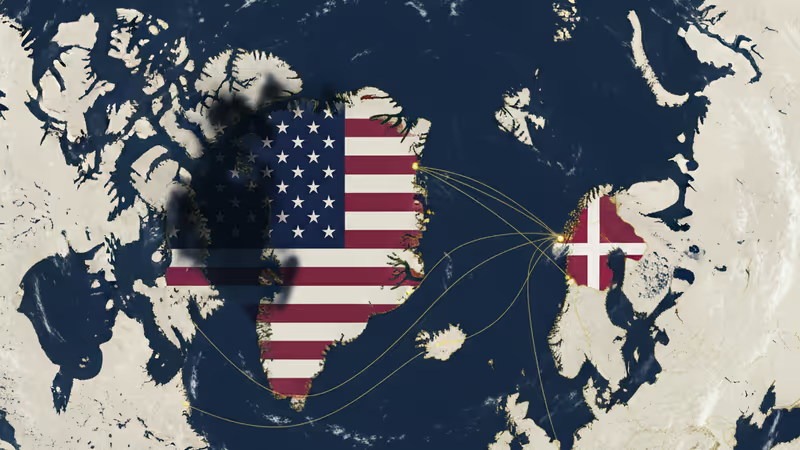
米トランプ大統領がグリーンランド買収のため特使を任命し、「国家安全保障に不可欠」と発言。デンマークとグリーンランドは「主権侵害」と強く反発し、EUもデンマーク支持を表明。北極圏をめぐる地政学的緊張が高まっています。

中南米15カ国がジャーナリスト保護と偽情報対策を目的とした「サンティアゴ宣言」に署名。5000万ドルの基金を設立する一方、ブラジルなどは国家主権を理由に不参加を表明し、域内の意見対立も浮き彫りになりました。
中国国営の再利用可能ロケット「長征12号A」が初打ち上げでブースター回収に失敗。今月2度目の失敗となり、スペースXなどが先行する米国との技術格差が浮き彫りになった。