
Ukraine's $1,000 Drones Are Slaying Russian Missiles, Rewriting the Rules of Air Power
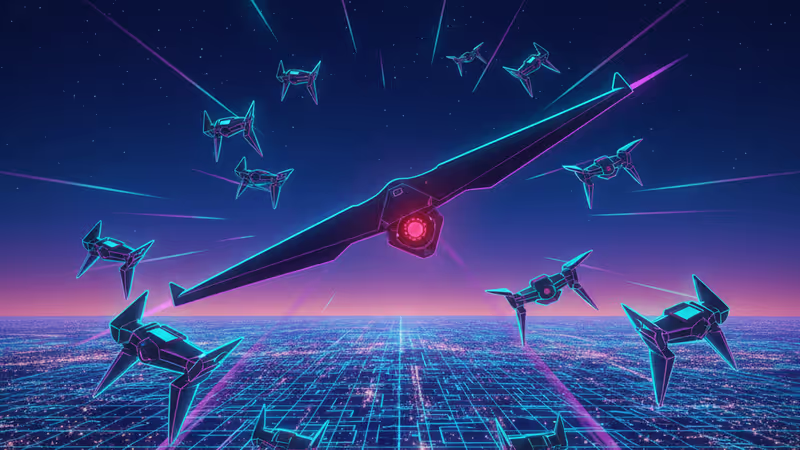
Ukraine is deploying inexpensive interceptor drones, some costing just $1,000, to counter Russian aerial attacks. This strategy is rewriting the economics of air defense and shaping the future of warfare.
Ukraine is rapidly deploying fleets of inexpensive interceptor drones to counter Russia's sophisticated aerial attacks, fundamentally altering modern air defense strategy. These homegrown systems are neutralizing high-altitude suicide drones at a fraction of the cost of conventional missiles, providing a critical shield for the nation's cities and energy infrastructure.
According to reports from the Associated Press, these systems have progressed from prototype to mass production within months in 2025. Field technicians are now seen swiftly assembling the equipment, a sign of Kyiv's strategic shift toward affordable, mass-produced defensive weapons that can be replaced far more easily than their expensive counterparts.
The New Economics of War
The economic advantage is proving decisive. Interceptors like the Sting, produced by the volunteer-driven startup Wild Hornets, and the new Bullet from General Cherry, can cost as little as $1,000. Pilots operate them with viewing displays or first-person-view (FPV) goggles, accelerating rapidly to collide with enemy drones.
They're targeting Russian drones, predominantly the Iranian-designed Shahed, which cost anywhere from $10,000 to $300,000 each. "We are inflicting serious economic damage," said Andrii Lavrenovych, a strategic council member at General Cherry.
A High-Stakes Innovation Race
This defensive shift is part of an ongoing innovation battle. Russia has been developing numerous variants of its triangle-winged Shahed aircraft, equipping them with jammers, cameras, and even turbojet engines to fly faster and higher. A Ukrainian unit commander, known only by the call sign "Loi," stated, "The enemy does not sleep, and neither do we."
However, defense analysts caution that these interceptors aren't a panacea. Federico Borsari, an analyst at the Center for European Policy Analysis, calls them a "cornerstone of modern counter-unmanned aerial systems" but warns, "It would be a mistake to see them as a silver bullet." Their effectiveness, he explains, hinges on a wider ecosystem of sensors, rapid command and control systems, and skilled operators.
本コンテンツはAIが原文記事を基に要約・分析したものです。正確性に努めていますが、誤りがある可能性があります。原文の確認をお勧めします。
関連記事
ウクライナが開発した1機1000ドルの迎撃ドローンが、ロシアの高価な自爆ドローンを撃墜しています。コスト効率で防空戦略を覆す、現代の非対称戦の最前線を解説します。

【2025年最新】米国の携帯「使い放題」プランは本当に無制限?T-Mobile、Verizon、AT&Tの料金、通信速度、特典を徹底比較。あなたに最適なプランを見つけます。

CBSが編集長の判断で放送中止した「60ミニッツ」の特集がインターネット上に流出。エルサルバドルの刑務所での虐待を告発する内容で、メディアの編集権と情報統制を巡る議論が巻き起こっています。

サムスンが2026年に世界初となる6K解像度の裸眼3Dゲーミングモニター「Odyssey 3D G90XH」を発売。32インチ、165Hz、視線追跡技術を搭載し、新たなゲーム体験を提供します。
ウクライナが開発した1機1000ドルの迎撃ドローンが、ロシアの高価な自爆ドローンを撃墜しています。コスト効率で防空戦略を覆す、現代の非対称戦の最前線を解説します。
【2025年最新】米国の携帯「使い放題」プランは本当に無制限?T-Mobile、Verizon、AT&Tの料金、通信速度、特典を徹底比較。あなたに最適なプランを見つけます。
CBSが編集長の判断で放送中止した「60ミニッツ」の特集がインターネット上に流出。エルサルバドルの刑務所での虐待を告発する内容で、メディアの編集権と情報統制を巡る議論が巻き起こっています。
サムスンが2026年に世界初となる6K解像度の裸眼3Dゲーミングモニター「Odyssey 3D G90XH」を発売。32インチ、165Hz、視線追跡技術を搭載し、新たなゲーム体験を提供します。