
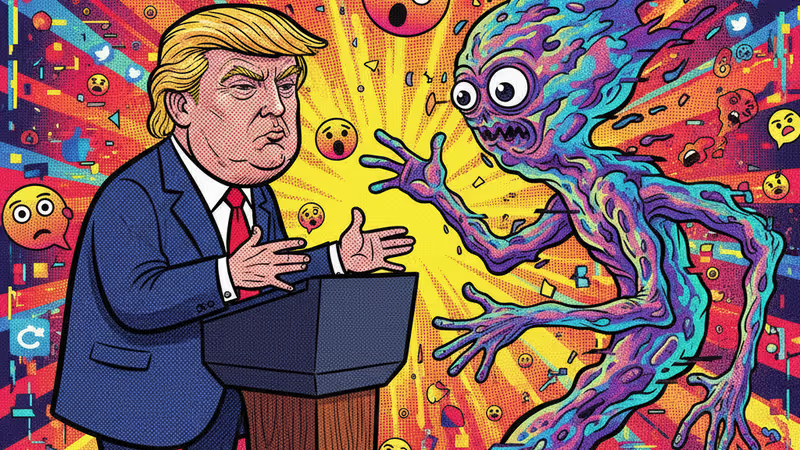
Trump's 'Turbo Cancer' Czar: The Appointment That Sent the Internet Into Meltdown
Trump's appointment of 'turbo cancer' theorist Dr. Harvey Risch to lead the President's Cancer Panel has sparked a global internet firestorm. Here's why.
Why Is Everyone Talking About This Appointment?
It’s the story that feels like a political thriller, a medical drama, and a dark comedy all rolled into one. In a move that ricocheted across the internet, President Donald Trump has reportedly appointed Dr. Harvey Risch—an epidemiologist known for promoting unproven COVID treatments and speculating on vaccine-linked 'turbo cancer'—to chair the highly influential President's Cancer Panel. The internet's collective jaw is on the floor, and we're here to unpack why.
The Story: From Fringe Theories to Federal Power
So, what exactly happened? Dr. Harvey Risch, a professor emeritus from Yale, has been a controversial figure since the pandemic. He championed treatments like hydroxychloroquine and ivermectin against mainstream scientific consensus and, more recently, gave air to the unsubstantiated theory of 'turbo cancers' allegedly caused by mRNA vaccines. This is a claim the National Cancer Institute explicitly refutes.
Now, he's been tapped to lead the President's Cancer Panel, a body that monitors and advises the White House on the entire National Cancer Program. This isn't some minor advisory role; it's a position that helps shape the direction of the nation's fight against cancer. The appointment, made without a formal White House announcement, has medical experts and online commentators alike in an uproar, fearing it will inject pseudoscience into the heart of federal health policy.
The Best Reactions: Outrage, Satire, and Disbelief
As soon as the news broke, the internet did what it does best: react with a potent mix of horror, gallows humor, and biting satire. We've curated the takes that capture the mood perfectly.
The Scientific Community's Cry for Help
Many doctors and researchers expressed sheer terror at the implications for patient safety and scientific integrity. The sentiment was clear: this is a disaster.
- "A man who pushed 'turbo cancer' conspiracies is now overseeing the National Cancer Program. This is like putting a flat-earther in charge of NASA. We are in uncharted territory for public health."
- "As a surgical oncologist, I spend my life relying on rigorous, evidence-based research. To see it potentially guided by conspiracy theories is not just insulting, it's dangerous. Patients will pay the price."
The Dark Humor Brigade
For many, the only way to process the absurdity was through satire. The memes practically made themselves.
- One popular post simply showed a photo of a horse with the caption: "Heading to my first oncology appointment under the new Cancer Panel chair. Wish me luck."
- Another user quipped: "Excited for the new national cancer strategy: a balanced breakfast of hydroxychloroquine, ivermectin, and thoughts and prayers."
The Political Strategists
Seasoned political commentators saw this as a calculated move, not a random blunder.
- "Make no mistake: this isn't about health. This is about rewarding loyalty and signaling to the anti-science base. It’s a culture war appointment, and cancer patients are the cannon fodder."
- "Appointing Risch, RFK Jr., and Dr. Oz is the trifecta. It's a systematic effort to dismantle trust in mainstream medicine and replace it with a politically-aligned 'alternative' health ecosystem."
Cultural Context: Why This Hit a Global Nerve
This isn't just an American political story; it's a global cultural moment. The COVID-19 pandemic created deep fissures worldwide in the public's trust in scientific institutions. Risch's appointment taps directly into that raw nerve. For one side, it's a terrifying validation of their worst fears: that expertise is being replaced by political ideology. For the other, it's a triumphant moment, seen as a legitimate challenge to a 'medical establishment' they no longer trust.
The story's virality stems from this perfect storm. Cancer is a universal fear, and the idea of its treatment being politicized resonates from London to Tokyo. It perfectly encapsulates the post-2020 internet culture, where scientific debate is no longer confined to peer-reviewed journals but is fought out with memes, viral threads, and political appointments.
PRISM Insight: The Weaponization of Doubt
Beyond the immediate shock, this appointment signifies a crucial strategic shift in the governance of science. This is the weaponization of doubt as a tool of statecraft. For decades, the model was to fund and follow scientific consensus. The new model appears to be to install figures who actively undermine that consensus from within the system itself.
By placing a proponent of 'turbo cancer' theories at the head of a national cancer panel, the administration achieves two goals. First, it legitimizes fringe theories, giving them a federal seal of approval that will be amplified by allied media. Second, it paralyzes the institution itself. How can the National Cancer Institute effectively communicate public health guidance when the panel overseeing it is chaired by someone who contradicts its most basic findings?
This isn't about one man's controversial views. It's an architectural change to how science and government interact. The goal is to create a parallel information ecosystem where 'alternative facts' carry the same weight as peer-reviewed evidence, fundamentally eroding the public's ability to make informed health decisions. The consequences won't be measured in political polls, but in public health outcomes for years to come.
関連記事
史上初のTikTokアワードは、カオスと熱狂の中に新時代の文化の形を示した。クリエイターエコノミーとメディアの未来を専門家が分析します。
90年代に物議を醸した『窒息人形』ジバジャバー。なぜこの玩具は当時許されたのか?現代のウェルネス文化との比較から、時代の変化と未来のトレンドを読み解きます。
3番目の恒星間天体3I/ATLASは宇宙船ではなかった。しかしその正体は、太陽系より古い可能性を秘めた『タイムカプセル』。オウムアムアの謎を解く鍵とは?
Redditで話題!現役医師たちが明かす、私たちが軽視しがちな健康習慣とは?予防医療とテクノロジーの未来を、独自の視点で深掘り分析します。