
The 'Wicked' Playbook: Jon M. Chu’s Masterclass on Hacking Hollywood’s AI Anxiety
Wicked director Jon M. Chu's success reveals a new playbook for Hollywood, blending Silicon Valley marketing with a powerful defense of human creativity against AI.
The Lede
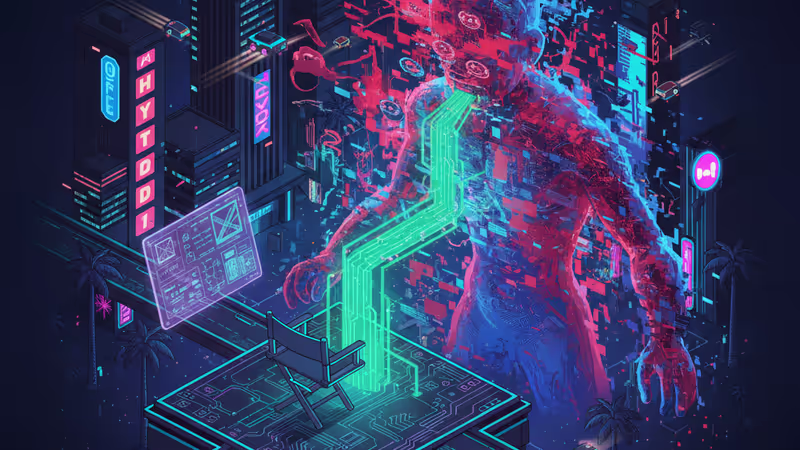
While Hollywood grapples with an existential crisis over generative AI, 'Wicked' director Jon M. Chu is quietly writing the playbook for its future. The staggering box office success of the franchise isn't just a win for musicals; it's a strategic masterclass in a new model of filmmaking. Chu is pioneering the role of the 'Director as System Architect'—a leader who wields Silicon Valley's growth-hacking and community-building tactics not to replace human creativity, but to amplify it on a global scale.
Why It Matters
Chu's approach signals a critical shift in how cultural blockbusters are made and marketed. In an era of content saturation and fractured audiences, simply making a good film is no longer enough. The 'Wicked' phenomenon demonstrates that the new competitive advantage lies in orchestrating a multi-year cultural event, meticulously engineered to dominate the conversation online and off. This model has profound implications for studios:
- The End of Fire-and-Forget Marketing: The traditional three-month marketing blitz is obsolete. Chu's five-year journey with 'Wicked' involved a sustained, always-on campaign that built community and anticipation, treating the audience like early adopters of a tech product, not passive consumers.
- Redefining the Director's Skillset: The next generation of successful directors will need to be as fluent in network effects and viral mechanics as they are in cinematography and narrative structure.
- Humanity as the Ultimate Differentiator: By publicly championing the “irreplaceable” human moments AI could never create, Chu is turning a technological threat into a core value proposition, reassuring both creative talent and audiences that artistry remains at the center of the spectacle.
The Analysis
Hollywood's Tech-Anxiety Loop
Hollywood has a long history of fearing new technology, from the advent of sound to the rise of streaming. The current panic over AI, however, cuts deeper, threatening the very essence of creative ideation. The industry is bifurcating into two camps: the purists who reject AI entirely, and the executives who see it as a ruthless efficiency tool to cut costs on writers and artists. Chu is carving out a vital third path: AI-Assisted, Human-Led Creation.
From 'Crazy Rich Asians' to Oz
This isn't Chu's first rodeo. The runaway success of 'Crazy Rich Asians' was not an accident; it was the prototype. Chu and his team transformed that film from a romantic comedy into a global cultural movement for representation. They applied the same principles to 'Wicked', understanding that the film's core asset wasn't just the songs or the story, but the pre-existing, passionate community around the IP. He didn't just market a movie; he serviced a fandom, using social media not as a megaphone, but as a conversational tool to build a groundswell of organic momentum long before the premiere.
This approach treats a film launch less like a premiere and more like a Series C funding round for a cultural idea. The goal is to achieve 'escape velocity,' where user-generated content and online discourse carry the marketing message far more effectively than paid ads ever could.
PRISM Insight
The key investment trend emerging from the 'Wicked' model is the rise of the "IP Ecosystem Orchestrator." Studios should re-evaluate talent not just on past box office performance, but on their ability to build and engage digital communities. The future of studio value lies in empowering creatives like Chu who can transform a single intellectual property into a multi-platform, revenue-generating universe. The tech to watch isn't just generative AI for VFX, but predictive analytics for audience sentiment, community management platforms, and tools that enable 'Augmented Creativity'—using AI for grunt work like pre-visualization or versioning, freeing up human creators to focus on the core emotional narrative that technology cannot replicate.
PRISM's Take
Jon M. Chu's success with 'Wicked' is more than a story about a great film; it's a critical lesson in modern power. He has demonstrated that in an age defined by algorithms, the most potent force is still a deeply human story, amplified by a masterful understanding of the networks that connect us. While others see AI as a threat to be feared or a cost to be cut, Chu frames it as a tool that, when properly subordinated to a creative vision, only serves to highlight what makes us irreplaceable. The future of Hollywood doesn't belong to the machines; it belongs to the system architects who know how to command them.
関連記事
映画『Wicked』の成功の裏には何が?ジョン・M・チュウ監督が語る、AI時代のヒット作の作り方。テクノロジーと人間の創造性が融合する未来を分析します。

韓国が150兆ウォン規模の公的成長ファンドを設立。AI、半導体、バッテリーに重点投資する国家戦略を分析し、投資家や業界への影響を読み解きます。
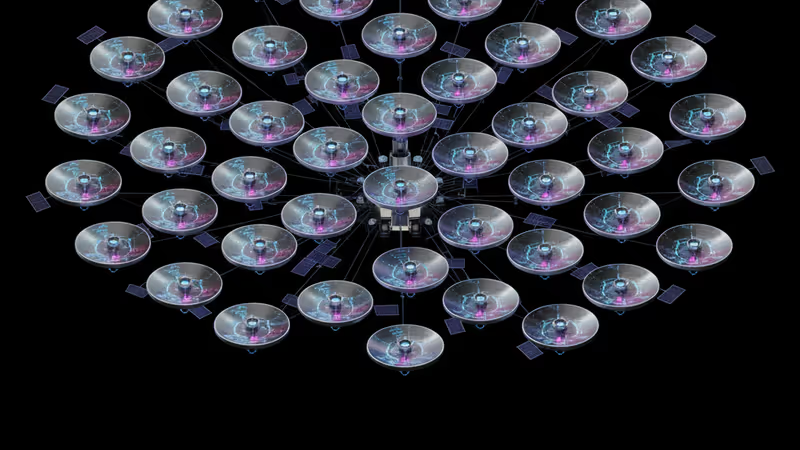
新型の円盤型衛星「DiskSat」が打ち上げ。20年にわたり標準だったCubeSatを超える存在となるか?宇宙産業の新たなパラダイムシフトを専門家が分析します。
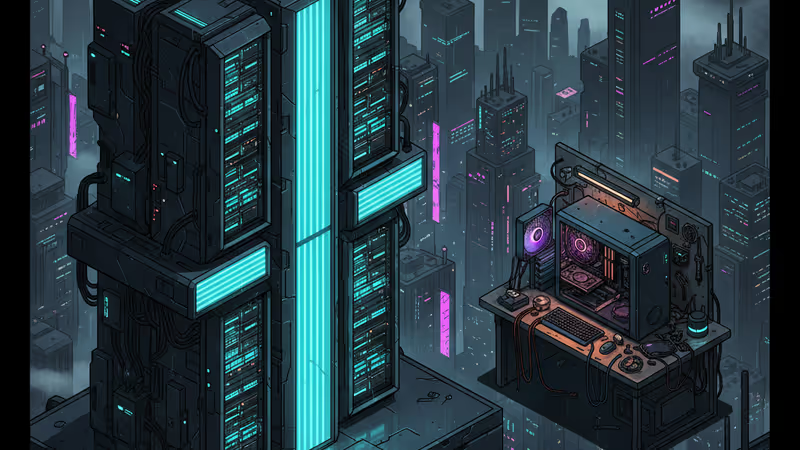
AIデータセンターの需要爆発により、PC用メモリとSSDの価格が記録的に高騰。自作PCユーザーとゲーマーが直面する新たな現実と、専門家による対策を解説します。