

The Weaponization of Everything: How the Ukraine War Forged a New Era of Economic Statecraft
The Ukraine war isn't just a military conflict; it's a paradigm shift in economic statecraft. Analyze the long-term impact on global supply chains and finance.
The Lede: Why This Is Not Just a Regional Conflict
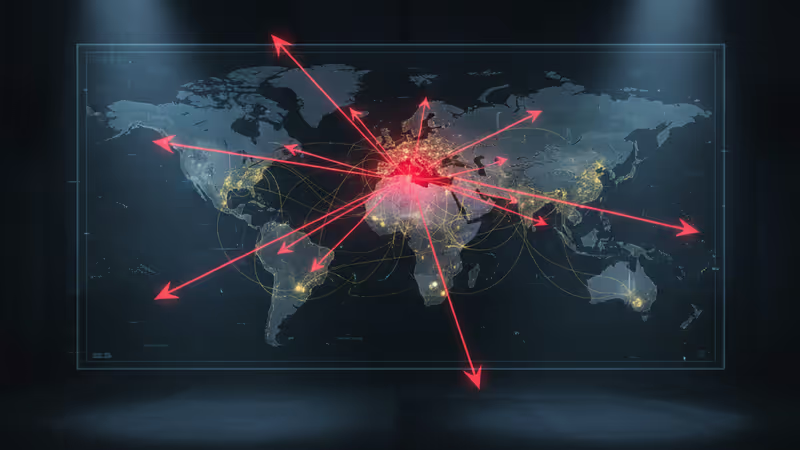
The war in Ukraine is more than a military confrontation; it is the largest live-fire stress test of 21st-century economic warfare. For global executives, the key takeaway is stark: the foundational assumptions of post-Cold War globalization have been shattered. We have entered a new era where supply chains, financial networks, and technology access are no longer just commercial concerns—they are instruments of state power. Understanding this paradigm shift is critical for navigating the increased volatility and risk now embedded in the global economy.
Why It Matters: The Second-Order Effects Are Reshaping Industries
The immediate impacts of the conflict—energy price shocks and grain shortages—were just the first tremors. The second-order effects are now reconfiguring the strategic landscape for multiple sectors:
- Energy Transition as National Security: Europe's frantic pivot away from Russian gas has fused climate policy with national security. This isn't just about renewables; it's about creating resilient, independent energy systems, accelerating investment in LNG terminals, next-gen nuclear, and hydrogen infrastructure.
- The Dollar's Dominance Questioned: The unprecedented freezing of Russia's central bank assets and its exclusion from SWIFT sent a powerful signal globally. While effective, it has spurred nations, particularly China, to accelerate efforts to de-dollarize trade and develop alternative financial systems, potentially fragmenting the global financial order long-term.
- From 'Just-in-Time' to 'Just-in-Case': The era of hyper-efficient, cost-optimized supply chains is over. Geopolitical alignment is now a primary sourcing criterion, giving rise to "friend-shoring." This strategic decoupling creates redundancy and resilience but introduces inflationary pressures and operational complexity.
The Analysis: A New Cold War, Fought Through Integrated Economies
Unlike the original Cold War, which featured two largely separate economic blocs, today's conflict is being waged between deeply intertwined economies. This makes the weaponization of economic interdependence far more potent and unpredictable. The West, led by the United States, is testing the limits of its financial and technological dominance as a tool of coercion. The goal is not just to punish Russia, but to deter other potential adversaries, most notably China, by demonstrating the costs of challenging the established order.
Simultaneously, we see the rise of a counter-bloc. Russia has pivoted its energy exports to Asia, strengthening ties with China and India. Many nations in the "Global South" have refused to align with Western sanctions, choosing a multi-polar path that prioritizes their own economic and strategic interests. This dynamic reveals the waning of unilateral influence and the emergence of a more fragmented world where middle powers wield significant leverage by playing competing blocs against each other. The lesson for Beijing, watching closely with Taiwan in mind, is the critical need to build economic and technological self-sufficiency to withstand similar pressure.
PRISM Insight: The Tech Trenches of the New Geopolitical Era
This conflict is a catalyst for specific technology sectors now viewed through a national security lens. Investors and strategists should monitor the following accelerations:
- Defense & Autonomy: The effectiveness of low-cost drones, sophisticated cyber defenses, and commercial satellite intelligence (like Starlink) has rewritten the modern military playbook, driving massive investment into autonomous systems and secure communications.
- Financial Technology (Fintech): The push for SWIFT alternatives will accelerate the development of Central Bank Digital Currencies (CBDCs). Nations see CBDCs not just as a monetary tool, but as a potential way to conduct international trade outside the direct oversight of the US financial system.
- Resource & Supply Chain Tech: Technology that enhances resource independence is now a strategic priority. This includes AI-driven mineral exploration, advanced materials science, and sophisticated recycling technologies designed to create circular economies and reduce reliance on geopolitically unstable sources.
PRISM's Take: Welcome to the Era of Fractured Globalization
The assumption that economic logic would always triumph over geopolitics is now defunct. We are in an era of Fractured Globalization, characterized by the formation of competing economic, technological, and financial blocs. For business leaders, geopolitical risk is no longer a peripheral concern managed by a specialized department; it is a core operational variable. Building resilience, ensuring supply chain diversity beyond simple cost analysis, and maintaining a deep understanding of the geopolitical landscape are now essential for survival. In a world where everything can be weaponized, every commercial dependency is a potential vulnerability.
関連記事
エプスタイン関連文書の公開は、単なるスキャンダル暴露ではない。トランプ陣営がクリントン氏の写真をどう利用し、2024年大統領選の情報戦を仕掛けているのかを深く分析する。

ロシアのドローン戦略を支える中国の役割を分析。ウクライナ戦争が示す新たな「テクノ地政学」の脅威と、それが世界の安全保障に与える影響を解説します。

米国の対中AI半導体規制強化を深掘り分析。地政学的影響、サプライチェーンの分断、そして「技術の鉄のカーテン」がもたらす未来とは。

米司法省がエプスタイン関連文書を公開。しかし期待された新事実はなく、政治的配慮の憶測を呼ぶ。透明性と司法の信頼性が問われる事態を深掘り分析。