
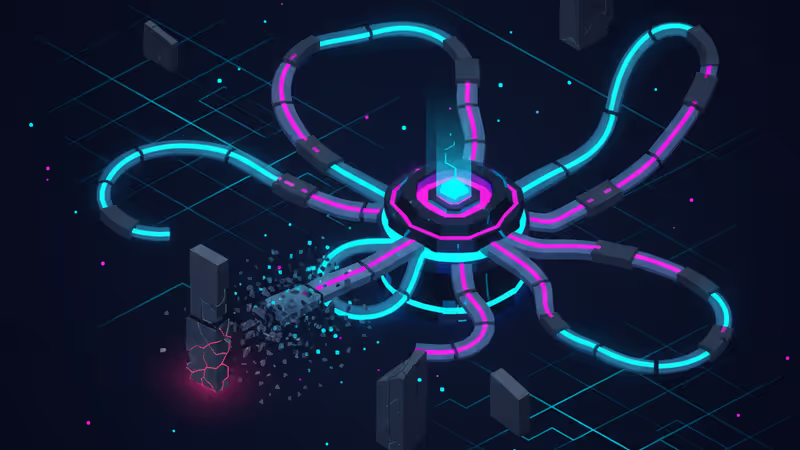
The End of the Netflix Homepage: How Aggregators Are Hijacking the Streaming Wars
Streaming aggregators are more than just guides. They represent a strategic power shift, turning giants like Netflix into mere utilities. Here's why it matters.
The Executive Briefing
The consumer annoyance of endlessly scrolling through Netflix is a symptom of a much larger strategic disruption. The rise of third-party streaming aggregators like JustWatch and Reelgood isn't a niche consumer trend; it's the emergence of a new power broker in the media ecosystem. These platforms are systematically dismantling the "walled garden" strategy of major streaming services, shifting user loyalty from the content provider to the content guide. For executives in media, tech, and advertising, this represents a fundamental threat to customer ownership and a critical battle for the starting point of all content consumption.
Why It Matters: The Great Unbundling of the Interface
The core business model of services like Netflix, Disney+, and Max relies on controlling the user experience entirely within their proprietary app. This is where they surface originals, guide discovery, and reinforce brand loyalty. Aggregators shatter this model with significant second-order effects:
- Commoditization of Platforms: When a user starts their search on JustWatch, Netflix becomes just another content source, on par with Tubi or Paramount+. The brand's premium interface and discovery algorithm are bypassed, reducing the service to a mere "content pipe."
- The Data Goldmine: Aggregators are building a cross-platform dataset of unprecedented value. They don't just know what a Netflix user watches on Netflix; they know what that user wants to watch across every service, including titles their current subscriptions don't cover. This is predictive churn data and content acquisition intelligence on a silver platter.
- Erosion of Stickiness: The "endless scroll" is a feature, not a bug, for streamers—it's designed to keep you inside their ecosystem. By providing an efficient, universal search, aggregators reduce friction and make it easier for users to "dip in" to a service for one show and then leave, increasing the likelihood of subscription cycling.
The Analysis: The TV Guide 2.0 and the Platform Wars
This isn't a novel concept but a digital re-imagining of a legacy media linchpin: the TV Guide. In the broadcast era, the guide held immense power by controlling the primary discovery interface. Today, the battle is more complex. We're witnessing a multi-front war for the "universal guide" position.
On one side are the independent, platform-agnostic players like JustWatch and Reelgood. Their strength is their neutrality. They serve the user, not a specific content agenda.
On the other side are the vertically-integrated giants. Apple TV, Google TV, and Amazon's Fire TV are all aggressively positioning their own operating systems as the de facto aggregator. Their advantage is being the native, default interface on the hardware itself. However, they often face challenges in getting complete buy-in from competitors (Netflix has famously been selective about its integration with Apple's TV app, for example), creating an opening for the neutral third parties.
PRISM Insight: The Next M&A Target Isn't a Studio, It's a Map
The strategic imperative is shifting from owning the most content to owning the best map to all content. This points to a new direction for investment and technology:
- The API-fication of Content: In this new landscape, the value lies in having a discoverable catalog. Streamers that resist integration with these super-guiders risk becoming invisible. The future is one where content libraries are accessed via API, and the primary competition happens at the discovery layer.
- Acquisition Targets: A company like JustWatch, with its global user base and rich, cross-platform intent data, is an incredibly attractive acquisition target. A hardware player like Samsung or a telco giant could acquire it to instantly create a powerful, data-rich discovery engine for their own smart TV platforms, leapfrogging competitors.
- The AI-Powered Sommelier: The ultimate evolution of this trend is a hyper-personalized, AI-driven discovery agent. This agent will not only know what's on every service but will know your mood, your viewing history across platforms, and who you're watching with to recommend the perfect piece of content, brokering the transaction on your behalf. The company that builds this "AI sommelier" will effectively own the future of video consumption.
PRISM's Take: The Interface is the New Battlefield
The era of battling for subscribers with exclusive content alone is closing. Welcome to Streaming Wars 2.0, where the fight is for the user's starting point. The streaming giants have spent a decade and hundreds of billions of dollars building magnificent, content-rich walled gardens. They've now discovered that consumers are tired of visiting each one individually and are outsourcing the navigation to third-party mapmakers.
For platforms like Netflix, the choice is stark: either build a universal discovery tool so compelling that it becomes the default for users, or risk being relegated to a utility—a powerful and important one, but a utility nonetheless, whose fate is increasingly decided by a layer of software that sits above them.
関連記事
Netflixがアバター企業Ready Player Meを買収。これはゲーム機能強化に留まらない。エンタメ帝国の次なる一手、メタバース経済圏構築への野心的な戦略を解説。
Netflixがポッドキャストのビデオ化でYouTubeに対抗。ユーザーの可処分時間を巡るメディア戦争の新局面を専門家が分析。業界への影響と今後の展望とは。

Netflixがアバター企業Ready Player Meを買収。これは単なるゲーム強化ではない。ユーザーを繋ぎ止める「Netflixメタバース」構築への戦略的布石を専門家が解説。
NetflixやDisney+の膨大な作品にうんざりしていませんか?JustWatch等のアグリゲーターが視聴体験を変革。業界への影響と未来を専門家が分析します。