
‘Doomsday Glacier’ Is Tearing Itself Apart, New Study Shows Startling Feedback Loop
A new study reveals Antarctica's 'Doomsday Glacier' is caught in a self-destructive feedback loop. Cracks are accelerating its flow, which in turn creates more cracks, speeding its path to collapse.
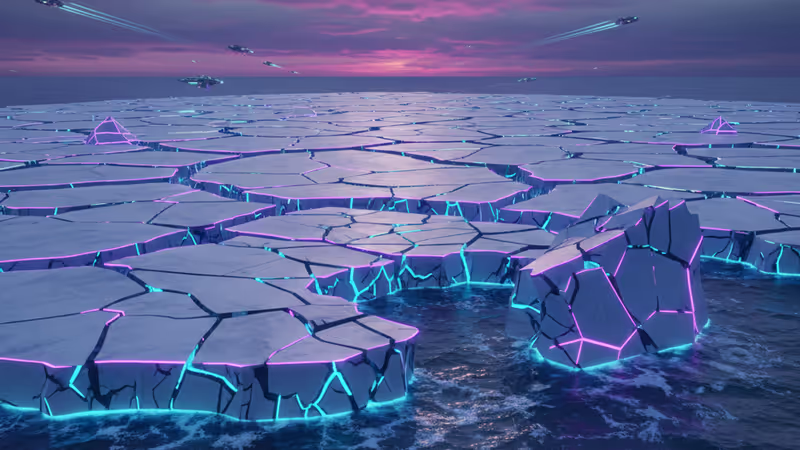
Antarctica's Thwaites Glacier, known as the “Doomsday Glacier” and one of the biggest unknowns in predicting global sea-level rise, is caught in a dangerous feedback loop, actively accelerating its own collapse. A new study from the International Thwaites Glacier Collaboration (ITGC) presents a detailed, alarming record of how the glacier's crucial eastern ice shelf is tearing itself apart from the inside out.
Researchers analyzing two decades of observational data (2002-2022) discovered that as cracks riddle the ice, the glacier's flow speeds up. This acceleration, in turn, generates even more cracks, creating a vicious cycle. According to the study, this process has effectively severed the ice shelf's connection to a stabilizing undersea ridge, transforming it from an anchor into a point of weakness.
A System Under Stress: The Damage in Numbers - **Total Crack Length**: Increased from ~**165 km** in 2002 to ~**336 km** in 2021. - **Ice Structure Change**: Instead of a few long cracks, the shelf is now fractured by numerous smaller ones, doubling the total fissure length and indicating widespread structural decay. - **Collapse Propagation**: During the winter of 2020, structural damage was observed propagating upstream at a rate of approximately **55 kilometers per year**.
The study reveals the weakening happened in distinct phases. First, long cracks grew along the direction of ice flow. Then, a swarm of shorter, cross-flow cracks emerged, shattering the shelf's integrity. GPS devices placed on the ice between 2020 and 2022 directly recorded this feedback loop in action, confirming that weakening in one area rapidly destabilizes the ice far upstream.
The researchers warn this pattern could be a playbook for how other Antarctic ice shelves collapse. The complete disintegration of Thwaites holds enough ice to raise global sea levels by about 65 centimeters (over 2 feet). This new evidence of a self-reinforcing collapse suggests that existing timelines for its demise may be too conservative.
PRISM Insight: The Thwaites Glacier is a real-time demonstration of a climate tipping point moving from theory to observation. This feedback loop shows how Earth's systems can shift into a state of non-linear, accelerated change, outpacing the linear projections of older climate models. It's a critical warning that the consequences of climate change may not only be severe but could also arrive far more suddenly than anticipated, challenging our infrastructure and economic stability.
本コンテンツはAIが原文記事を基に要約・分析したものです。正確性に努めていますが、誤りがある可能性があります。原文の確認をお勧めします。
関連記事

通常249.99ドルのMicrosoft Visio Professional 2021が、期間限定で9.97ドルに。サブスクリプション不要の永久ライセンスで、高度な図表作成ツールをお得に手に入れましょう。

ソニーのノイズキャンセリングヘッドホンWH-1000XM5が、AmazonとBest Buyで再び248ドルの最安値を記録。定価から38%オフ。最新のXM6モデルと比較し、なぜ今XM5が賢い選択なのかを解説します。

アルファベット傘下のウェイモが、京都市で完全無人ロボタクシーサービスを2026年4月に開始。同社初の米国外での大規模展開で、100台のジャガーI-PACEを投入。技術的な挑戦と今後の展望を解説します。
写真共有アプリRetroのチームが開発した新アプリ「Splat」は、AIを使ってどんな写真も子供向けの塗り絵に変えます。価格、使い方、そしてAIが日常を豊かにする未来について解説します。