
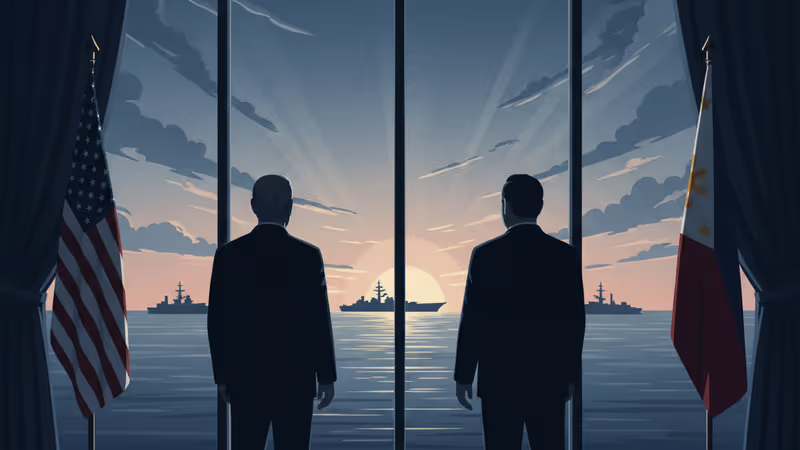
South China Sea Flashpoint: Why America's 'Ironclad' Vow to Manila Changes Everything
The US has drawn a red line in the South China Sea. Our analysis breaks down the global supply chain, tech, and investment risks of this geopolitical standoff.
The Lede: A Red Line in the World's Most Critical Waterway
For global executives, the escalating tension in the South China Sea is no longer a distant geopolitical chess match. Recent US declarations, framing its defense treaty with the Philippines as "ironclad," have transformed a regional dispute into a direct test of American credibility against Chinese expansionism. This isn't just about naval vessels; it's about the stability of global trade, the security of digital infrastructure, and the operational risks for every multinational corporation reliant on Asia. A miscalculation here could trigger a global economic shockwave far exceeding recent conflicts.
Why It Matters: The Second-Order Effects
The strategic implications of this standoff radiate outward, impacting critical sectors far beyond defense:
- Global Supply Chains: Over one-third of global maritime shipping, valued at over $3.4 trillion annually, transits the South China Sea. Increased militarization, gray-zone harassment, and the risk of conflict create a massive potential disruption for logistics, manufacturing, and retail worldwide.
- Digital Infrastructure at Risk: A vast network of subsea internet cables, the literal backbone of the global digital economy, lies on the floor of the South China Sea. These are vulnerable assets in any conflict, threatening everything from financial transactions to cloud computing.
- The Taiwan Nexus: This flashpoint is inextricably linked to the security of Taiwan. A failure by the US to act decisively in defense of the Philippines would severely undermine its security guarantees to Taipei, potentially emboldening Beijing and dramatically increasing risk for the global semiconductor industry.
The Analysis: From Strategic Ambiguity to Integrated Deterrence
A Deliberate Shift in US Policy
For decades, the precise conditions under which the 1951 US-Philippines Mutual Defense Treaty (MDT) would be invoked were intentionally vague. This "strategic ambiguity" is now dead. The Biden administration, building on a shift that began under its predecessor, has explicitly and repeatedly stated that an armed attack on Philippine public vessels, aircraft, or armed forces—including its coast guard—in the South China Sea would trigger a US military response. This is a deliberate message to Beijing, designed to close loopholes China has exploited through its use of coast guard and maritime militia forces in so-called "gray-zone" operations that stop just short of war.
China's Calculus: Testing the Red Line
Beijing views the South China Sea, through its expansive "nine-dash line" claim, as a core sovereign interest and a vital component of its national security. It perceives the strengthened US-Philippine alliance as part of a broader American containment strategy. By using non-military vessels to harass and intimidate, China aims to test the limits of the MDT, sow doubt among US allies about Washington's reliability, and gradually normalize its control over the waterway without provoking a full-scale military confrontation. Every water cannon blast and collision is a calculated probe of American resolve.
The Rise of 'Minilateralism'
This is not a purely bilateral issue. The US is orchestrating a wider network of security partnerships to create a collective counterweight to China. The burgeoning trilateral cooperation between the US, Japan, and the Philippines, alongside broader pacts like the Quad (US, Japan, Australia, India) and AUKUS (Australia, UK, US), represents a strategic shift toward flexible, overlapping alliances. These "minilateral" groupings are creating a latticework of deterrence across the Indo-Pacific, making it more complex and costly for China to act aggressively against any single nation.
PRISM Insight: Tech and Investment Implications
The heightened tension is a powerful catalyst for specific technology sectors and a driver of strategic economic shifts. Investors and corporate strategists should monitor three key areas:
- Defense Tech Acceleration: Funding and deployment will surge for technologies enabling maritime domain awareness. This includes AI-driven intelligence, surveillance, and reconnaissance (ISR) platforms, constellations of commercial and military satellites, autonomous underwater and surface drones (UUVs/USVs), and secure, resilient communication networks.
- Supply Chain De-Risking Becomes Mandatory: This standoff serves as a final warning for companies overexposed to East Asian supply chains. Expect an acceleration of "friend-shoring" and "near-shoring" initiatives, boosting investment in manufacturing and logistics infrastructure in Mexico, India, Vietnam, and other nations seen as less exposed to a potential conflict.
- The Geopolitical-Cyber Nexus: State-sponsored cyberattacks are a core component of modern geopolitical competition. Expect increased targeting of maritime logistics software, port authorities, and critical infrastructure in the Philippines and allied nations as a means of asymmetric warfare. Cybersecurity for operational technology (OT) is now a national security imperative.
PRISM's Take: The Credibility Trap
By drawing a clear red line, the United States has successfully raised the perceived cost of Chinese aggression, a classic deterrence strategy. However, it has also backed itself into a corner. The policy's success hinges entirely on its credibility. Any hesitation or perceived weakness in responding to a future Chinese provocation against the Philippines would be catastrophic, not only for the US-Philippines alliance but for the entire network of American alliances in the Indo-Pacific. Washington has made a high-stakes bet that clarity will deter conflict. The world now watches to see if Beijing will call the bluff. For businesses, the era of treating geopolitical risk as a secondary concern is definitively over; it is now a primary driver of corporate strategy and survival.
関連記事

米国のスーダン停戦要求は、単なる人道支援要請ではない。紅海の安定と大国の思惑が交錯する『代理戦争』の深層と、地政学リスクを専門家が分析。

2年以上の戦争を経てガザでクリスマスが再開。この小さな希望の光が、中東の脆弱な平和、コミュニティの再起力、そして地政学的な現実をどう映し出すのかを深く分析します。
有力な共和党員エリス・ステファニク氏の政界引退が意味するものとは?トランプ氏への忠誠戦略の限界と、共和党が直面する今後のアイデンティティの課題を深く分析します。

日本が中央アジアへ3兆円規模のビジネス目標を発表。これは単なる経済協力ではない。米中ロが競う地政学的要衝で、日本の資源安全保障と外交の新戦略を分析する。