
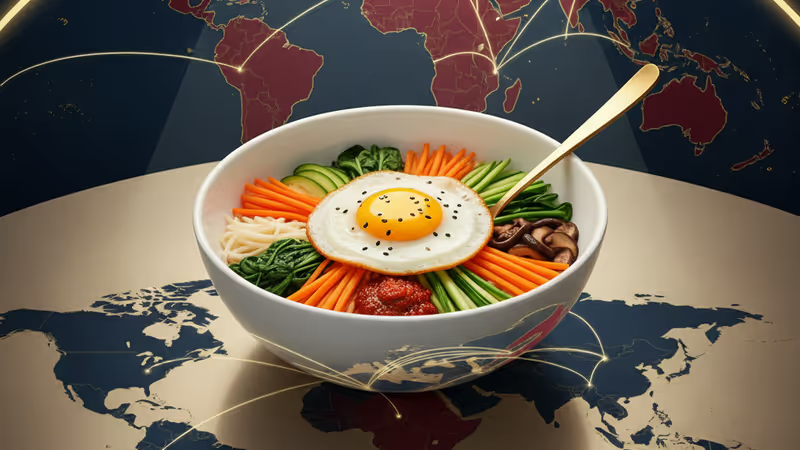
South Korea Sets $21 Billion Annual Food Export Target for 2030, Riding K-Culture Wave
South Korea's government has announced a comprehensive strategy to boost annual food exports to $21 billion by 2030, leveraging the global popularity of K-culture. The plan includes targeted product strategies, educational initiatives, and cultural integration.
Seoul,December 23– TheSouth Koreangovernment announced Tuesday it aims to achieve$21 billion in annual food exports by 2030, capitalizing on the soaring global popularity of Korean culture. The ambitious target was unveiled at a "K-food global vision declaration ceremony" by the Ministry of Agriculture, Food and Rural Affairs, which vowed to develop the sector into a strategic export industry.
The push comes as K-food exports are already on a strong trajectory. According to the ministry, exports from January to November this year reached a record high of$11 billion. The government now seeks to elevate Korean cuisine to the same level of global recognition as its tech and entertainment industries.
A Multi-Pronged Strategy for Global Palates
To achieve its goal, the ministry outlined five key strategies, including a market-specific approach. It plans to designate strategic items for different regions, such as barbecue sauce for theU.S., high-value health foods forJapan, and Halal-certified beef for the Middle East.
The government also plans to bolster infrastructure and training. A new culinary school focused on Korean cuisine will be established, alongside collaborations with prestigious institutions like the Culinary Institute of America and Le Cordon Bleu to open K-food classes. To support exporters, a one-stop support center will be created to navigate non-tariff trade barriers, and export vouchers for food companies will be doubled next year to40 billion won.
Weaving Food into Culture and Tourism
A central pillar of the strategy is the integration of food with cultural content and tourism. The ministry said it will create various cultural content centered on Korean cuisine and promote it through international cultural and sports festivals. It also aims to develop tourism programs with a culinary focus, hoping to turn foreign visitors into long-term advocates for K-food.
In a congratulatory message, PresidentYoon Suk Yeol stated that "the government will provide firm support to help K-food grow into a strategic export industry," according to the ministry.
This K-food initiative is a clear blueprint for converting cultural influence—soft power—into tangible economic returns. Seoul isn't just selling food; it's building a self-reinforcing ecosystem where K-dramas drive demand for kimchi, and tourism focused on cuisine boosts the nation's brand. If successful, this model could offer a valuable lesson for other nations seeking to monetize their own cultural appeal.
本コンテンツはAIが原文記事を基に要約・分析したものです。正確性に努めていますが、誤りがある可能性があります。原文の確認をお勧めします。
関連記事

中国の国営美術館で、職員が16世紀の絵画など文化財を不正に市場へ売却した疑惑が浮上。元館長が捜査対象となっており、「ルーブルの盗賊が間抜けに見える」と評される事件の背景と影響を解説します。

シリア北部の主要都市アレッポで、アサド政権の政府軍とクルド人主体の武装勢力「民主シリア軍(SDF)」との間で激しい武力衝突が発生。地域の勢力図に新たな緊張が走っています。

トランプ米大統領がグリーンランドを「国家安全保障に不可欠」と述べ、特使を任命。デンマークとグリーンランドは「他国を併合することはできない」と猛反発し、国際社会に波紋が広がっている。

シリアのアレッポでシリア軍とSDFが一時停戦。一方、ロシアはウクライナへのミサイル攻撃を激化させ、ベネズエラのマドゥロ大統領はトランプ氏に反論。世界各地で地政学的リスクが高まる現状を解説。