
South Korea Greenlights $1.6B Project for Reusable Methane Rocket, Targeting 2034 Completion
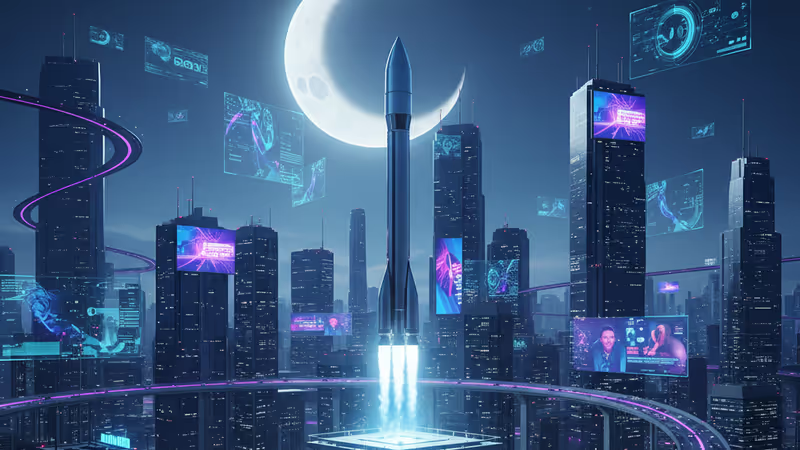
South Korea has approved a $1.6 billion project to build a reusable methane-powered rocket by 2034. The initiative, led by KASA, aims to support a 2032 lunar mission and establish the nation's competitive edge in the space industry.
South Korea's government has officially approved a 2.3 trillion-won (US$1.6 billion) project to develop a reusable space launch vehicle powered by a methane engine, targeting completion by 2034. The country's space agency, KASA, announced Monday that the plan was sanctioned by a government funding assessment committee.
At the core of the project is the development of a single 80-ton-thrust methane engine designed to power both the first and second stages of the next-generation rocket. According to the Korea AeroSpace Administration (KASA), this marks a strategic shift from an earlier plan that involved developing two different types of engines, signaling a push for greater efficiency and cost-effectiveness in the design.
The immediate goal is to support South Korea's planned lunar lander mission in 2032. The rocket will initially be used as a single-use launch vehicle for that mission, before the fully reusable system is expected to be completed two years later. KASA said the project's ultimate aim is to develop a competitive reusable launch vehicle in stages.
What's a Hopping Test?A low-altitude, vertical takeoff and vertical landing (VTVL) flight test. It's a critical step to validate the complex guidance and engine-throttling systems that allow a reusable rocket stage to fly back and land precisely on its own.
The development timeline includes a test firing of the engine scheduled for the end of 2031, followed by a crucial hopping test the following year. "The approval will help us implement the government's ambition for technology-led growth," said Yoon Young-bin, head of KASA. He added that the project, along with the lunar lander, "will open a new era of low-cost, reusable space launch vehicles."
This isn't just a new rocket; it's South Korea's official entry ticket into the global commercial space race dominated by players like SpaceX. The choice of a methane engine is a clear signal that KASA is aligning with the next-generation industry standard, which prioritizes reusability and cleaner propellants. By tying the rocket's development directly to a high-profile lunar mission, Seoul is creating a pragmatic roadmap with a clear deadline, turning a long-term tech ambition into a tangible national objective.
本コンテンツはAIが原文記事を基に要約・分析したものです。正確性に努めていますが、誤りがある可能性があります。原文の確認をお勧めします。
関連記事
韓国政府が、総額2.3兆ウォンを投じて2034年までにメタンエンジンを搭載した再利用型ロケットを開発するプロジェクトを承認。2032年の月着陸船ミッションを支援し、低コストの宇宙輸送時代を目指します。
日本のH3ロケットが測位衛星「みちびき5号」の軌道投入に失敗。文部科学省が発表。第2段エンジンの早期停止が原因と見られ、JAXAが調査を進めています。日本の宇宙開発計画への影響を解説します。

韓国EC大手クーパンで大規模な個人情報漏洩が発生後、1日あたりアクティブユーザー(DAU)が1400万人台に減少。事件の影響と消費者行動の変化、そして信頼失墜の長期的な代償を分析します。

オープンソースLLM界の「最大のダークホース」と称される中国のAIスタートアップDeepSeek。米中テック戦争における中国の秘密兵器として注目される同社の可能性と、地政学的な影響を解説します。