
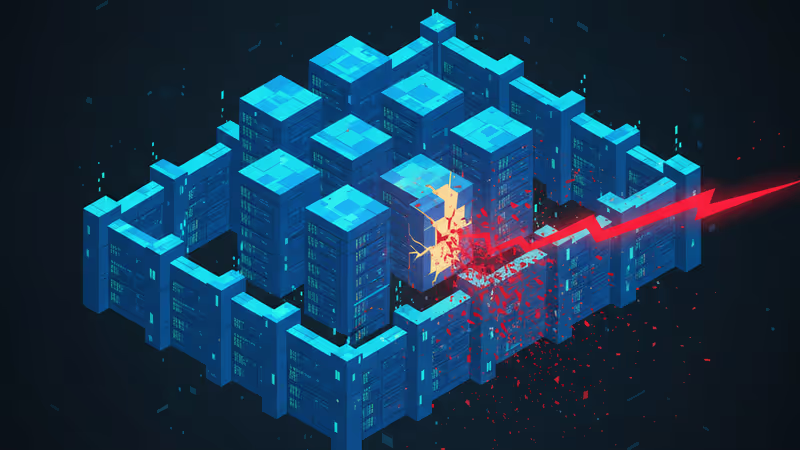
Russia's AWS Attack Signals a New Front in Cyber War: Your Own Misconfigurations
Analysis of Russia's multi-year cyberattack on AWS. The true threat isn't a flaw in the cloud, but the weaponization of customer misconfigurations.
The Lede: Why This Matters Now
A multi-year cyber campaign by Russia's elite Sandworm unit against Amazon Web Services (AWS) wasn't thwarted by some new, unbreakable Amazon shield. Instead, it thrived for years by exploiting the simplest of weaknesses: customer misconfigurations. For any leader running on the cloud, this is a blaring siren. The primary threat to your cloud infrastructure isn't a flaw in AWS, Azure, or Google Cloud; it's the operational hygiene of your own teams. This incident reframes the cyber war battleground from the cloud provider's fortress to your own digital backyard.
Why It Matters: The Shared Responsibility Model on Trial
This campaign is a brutal, real-world stress test of the cloud's foundational security principle: the Shared Responsibility Model. AWS secures the cloud; the customer secures everything *in* the cloud. Sandworm’s strategy demonstrates a profound understanding of this model, bypassing Amazon's hardened perimeter to weaponize the customer side of the equation. The second-order effects are significant:
- Critical Infrastructure is Exposed: The targeting of Western energy sectors isn't theoretical. It's a clear move by a nation-state to map, and potentially disrupt, critical infrastructure by leveraging the cloud supply chain.
- The Threat Surface is Redefined: The enemy isn't at the gate; they're looking for unlocked windows. The focus on 'low-hanging fruit' like misconfigured network edge devices means your attack surface is no longer a centralized data center but a sprawling, decentralized fleet of devices and settings managed by your teams.
- Security ROI is Flipped: For attackers, the return on investment for finding a single customer misconfiguration is now higher, and far less risky, than spending months trying to crack the cloud provider itself.
The Analysis: The Evolution of a Top-Tier Threat Actor
To understand the gravity, one must understand the attacker. Sandworm, an arm of Russia's GRU, is not a common cybercriminal. This is the group credited with the devastating NotPetya attacks and the blackouts in Ukraine. Their tactical pivot here is what's critical. Previously, a group like Sandworm might have focused on exploiting zero-day vulnerabilities in core software. Instead, they’ve shifted to a more scalable, persistent strategy: patiently scanning for and exploiting the inevitable human errors that occur in complex cloud environments.
This isn't a failure of AWS's technology. In fact, their Threat Intelligence team's ability to identify and attribute this long-term campaign is a testament to their capabilities. However, it highlights a competitive dynamic for all cloud providers. The best cloud platform isn't just the one with the most features, but the one that makes it easiest for customers not to fail. The future of cloud security competition will revolve around default-secure configurations, intuitive security dashboards, and proactive misconfiguration alerts.
PRISM Insight: The Mandate for Automated Governance
This incident is a massive validation for the entire Cloud Security Posture Management (CSPM) and Cloud-Native Application Protection Platform (CNAPP) market. The era of manual audits and periodic configuration checks is over. It’s simply not possible for human teams to keep pace with the scale of cloud deployments and the persistence of automated attackers.
Investment and enterprise adoption will accelerate in tools that provide continuous, automated monitoring of cloud configurations. Companies like Wiz, Orca Security, and Palo Alto Networks' Prisma Cloud are no longer 'nice-to-have' insurance policies; they are becoming a mandatory cost of doing business in the cloud. The key trend is shifting security left, embedding automated configuration checks directly into the development pipeline (DevSecOps) to prevent these 'low-hanging fruit' vulnerabilities from ever being deployed.
PRISM's Take: The Perimeter Has Moved Inside Your Head
The key takeaway from Amazon's disclosure is stark: the strategic high ground in cloud security has shifted. Nation-states are no longer just trying to breach the fortress; they are exploiting the operational tempo and complexity that leads to mistakes by the people inside. The new perimeter isn't a firewall; it's the discipline and tooling of your engineering and IT teams.
This is a C-suite issue, not an IT ticket. It requires a cultural commitment to security hygiene and investment in the automation platforms that can enforce it. For years, we've talked about a 'skills gap' in cybersecurity. Sandworm's campaign reveals the more dangerous threat: a 'configuration gap' that state-level adversaries are now driving a truck through.
関連記事
AWSがロシア国家による5年間のサイバー攻撃を公表。攻撃はクラウド本体ではなく、顧客側の設定ミスを標的としていた。地政学的リスクとクラウドセキュリティの新たな課題を解説。

OpenAIとAmazonが100億ドル規模の投資・チップ利用で協議。これは単なる資金調達ではなく、AIインフラの勢力図を塗り替える地殻変動の始まりを意味する。

Riot Gamesがチート対策でBIOS更新を要求。これは単なるアップデートではなく、PCゲーミングのセキュリティがハードウェアレベルに移行する新時代の幕開けです。

LG TVへのCopilot強制インストール騒動を深掘り。これは単なる迷惑アプリ問題ではない。スマートデバイスの所有権とAI覇権争いの最前線を解説します。