
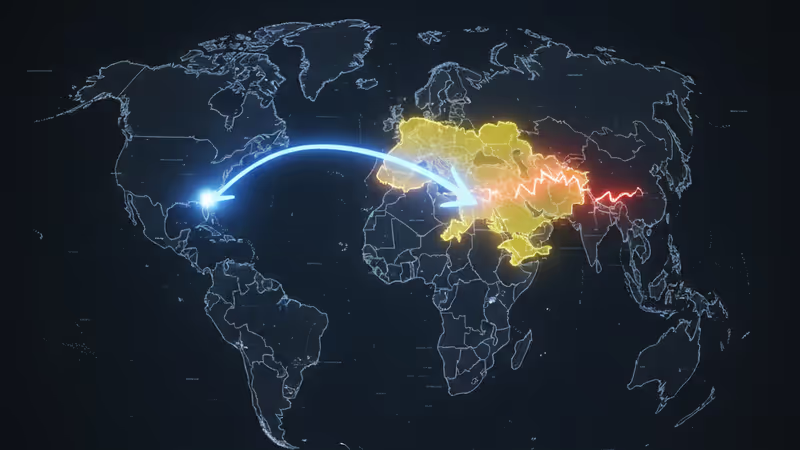
The Florida Gambit: Decoding the High-Stakes U.S. Plan to End the Ukraine War
Secret U.S.-led peace talks in Florida signal a major shift in the Ukraine war. PRISM analyzes the geopolitical calculus, tech's role, and what it means for global markets.
The Lede: Beyond the Battlefield
Secret negotiations in Florida, of all places, signal a seismic shift in the Ukraine conflict. While headlines focus on front-line attrition, the real action has moved to the backchannels. A Kremlin envoy’s carefully chosen word—"constructive"—is not a simple update; it's a calculated signal that the strategic calculus of all major powers is fundamentally changing. For global leaders and investors, ignoring this pivot from open warfare to high-stakes diplomacy is a critical error. The stability of energy markets, global supply chains, and the future of European security are now on the negotiating table.
Why It Matters: The Global Ripple Effect
A potential breakthrough, or even a protracted negotiation, carries immense second-order effects. The core issue is the transition from managing a hot war to defining a new, uneasy peace. A successful deal could unlock billions in reconstruction funds, stabilize global food and energy prices, and allow the West to pivot resources toward strategic competition with China. Failure, however, could trigger a dangerous escalation and shatter the already fragile Western consensus on supporting Ukraine. For corporations, this translates directly to strategic risk: defense sector contracts, energy futures, and supply chain resilience all hinge on the outcome of these talks.
The Analysis: A New Diplomatic Chessboard
This isn't a repeat of the failed Minsk or Istanbul talks. The context has radically evolved, driven by battlefield stalemate, economic exhaustion, and a looming U.S. presidential election. Each actor is navigating a complex set of pressures.
The U.S. Pre-Election Play
For the Biden administration, initiating these talks is a pragmatic move to de-risk the foreign policy landscape ahead of November. Securing even a temporary ceasefire would be framed as a major diplomatic victory. The choice of Florida, a politically charged U.S. state rather than a neutral European capital like Geneva, is a powerful domestic signal, potentially aimed at insulating the process from partisan attacks and acknowledging the realities of a potential shift in U.S. foreign policy.
Russia’s Calculated Optimism
The Kremlin's "constructive" language is a tool. It serves to project reasonableness to the Global South, create fissures within the Western alliance (particularly between hawkish Eastern European states and more pragmatic Western European powers), and test the U.S. administration's resolve. Moscow’s goal is clear: codify its territorial gains and secure sanctions relief, transforming battlefield realities into a permanent political settlement.
Ukraine and Europe at a Crossroads
For Kyiv, any negotiation is fraught with peril. The government must balance the stark reality of its military and economic limitations against the non-negotiable demand for sovereignty. Any deal perceived as capitulation would be politically untenable. European leaders, meanwhile, are watching with a mix of hope and trepidation. While desperate for an end to a costly war on their doorstep, they fear a U.S.-brokered deal that compromises Europe's long-term security architecture for the sake of Washington's short-term political calendar.
PRISM Insight: The Tech Stack of Modern Peacemaking
The "U.S.-proposed plan" is likely more than a paper document; it's a data-driven framework. We are witnessing the deployment of a new diplomatic tech stack:
- AI-Powered Scenario Modeling: Expect that U.S. negotiators are using advanced AI models to wargame countless scenarios, mapping out potential concessions, Russian red lines, and the economic impact of various ceasefire terms. This allows for a dynamic, rather than static, negotiating posture.
- Next-Gen Verification: A core component of any deal will be verification. This will rely less on human inspectors and more on a persistent, transparent network of commercial satellite imagery, AI-analyzed electronic signals, and open-source intelligence (OSINT) to monitor troop movements and ceasefire compliance in near real-time.
- Investment Implications: A credible peace process would immediately impact markets. Expect a rally in European equities, a drop in natural gas futures, and a strategic shift in defense spending from expendable munitions towards long-term ISR (Intelligence, Surveillance, Reconnaissance) and cyber defense platforms required to police a new European security order.
PRISM's Take: The Beginning of the Endgame
The fact that these talks are happening is more significant than any immediate outcome. It is a tacit admission by all sides that a total military victory is either impossible or too costly. The Kremlin’s positive spin is an invitation, but the price of entry will be steep. The central challenge for the U.S. is to craft a deal that provides Ukraine with ironclad, long-term security guarantees—something far more robust than the Budapest Memorandum—while offering Russia a tangible off-ramp. This is the first, cautious move in a long and treacherous endgame. The era of defining victory in terms of territory captured may be ending, replaced by a new, more complex era of defining it by the terms of the peace that follows.
関連記事

インドネシアの洪水被害からブリュッセルの農家デモ、香港の悲劇的な火災まで。世界が直面した天災、社会の緊張、そして文化的な営みを写真で振り返ります。

ボンダイビーチ銃撃事件から一週間、追悼式典でアルバニージー首相が国民の怒りに直面しました。反ユダヤ主義の台頭を背景に、オーストラリア社会の緊張と政府への信頼の揺らぎが浮き彫りになっています。

シドニーのボンダイビーチで15人が犠牲となった銃撃事件から1週間、オーストラリアは公式の「追悼の日」を迎えました。国全体が悲しみに包まれる中、犠牲者を悼む動きが広がっています。

南アフリカの最大都市ヨハネスブルグで銃乱射事件が発生。現地警察は容疑者の大規模な捜索を開始しました。事件の最新情報と、南アフリカが抱える治安問題の背景を解説します。