
Pregnancy on a Chip: Scientists Recreate Implantation in Lab, Unlocking Secrets of IVF Failure
Scientists have successfully recreated the first moments of human pregnancy on a lab chip, merging embryos with uterine organoids. This breakthrough could solve the mysteries of IVF failure and opens new ethical frontiers.
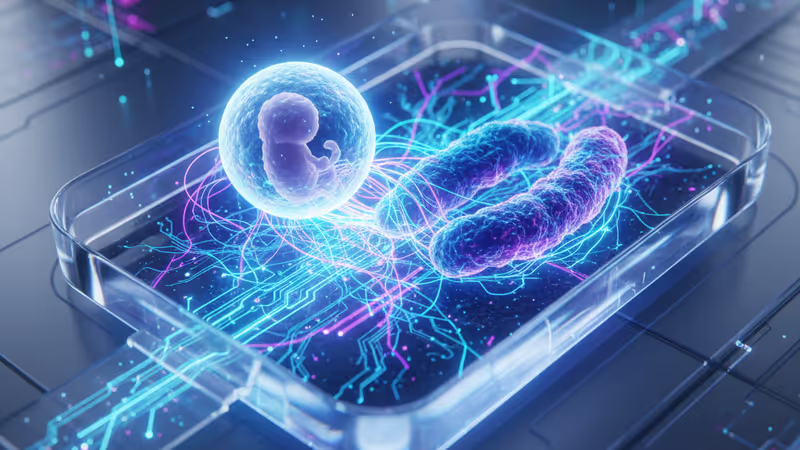
It’s the moment pregnancy officially begins: a ball-shaped embryo burrows into the uterine lining, forming the first tendrils of a future placenta. But this isn't happening inside a human body. It's unfolding on a microfluidic chip in a Beijing laboratory, giving scientists an unprecedented front-row seat to one of biology's most mysterious processes.
In a trio of papers published this week by Cell Press, research teams from China and a US-European collaboration report the most accurate lab-based models of early human pregnancy to date. By merging human embryos from IVF centers with 3D uterine organoids, they've successfully recreated implantation in vitro. This breakthrough could finally shed light on why IVF treatments so often fail and pave the way for new therapies.
Opening the 'Black Box' of Implantation
Until now, implantation has been a complete 'black box' because it occurs hidden deep within the uterus. "We’ve always hoped to understand human embryo implantation, but we have lacked a way to do so,” explains Hongmei Wang, a developmental biologist at the Beijing Institute for Stem Cell and Regenerative Medicine, who co-led one of the studies.
The solution, as described in all three papers, was to build a stand-in for the uterus. Scientists grew endometrial cells into organoids, which self-assemble into complex 3D structures that mimic the uterine lining. "You have an embryo and the endometrial organoid together," says Jun Wu of the University of Texas Southwestern Medical Center, a contributor to both Chinese reports. "That’s the overarching message of all three papers."
A New Frontier for IVF Treatment
Implantation failure is one of the biggest hurdles in IVF treatment. Many cycles fail simply because the embryo never attaches to the uterine wall. This new lab model offers a way to study—and potentially solve—that problem. "Considering that implantation is a barrier [to pregnancy], we have the potential to increase the success rate if we can model it in the laboratory," says Matteo Molè, a biologist at Stanford University involved in the European collaboration.
Commercial applications are already emerging. Startups like Simbryo Technologies in Houston plan to offer personalized IVF predictions. The idea is to take a biopsy from a patient's uterine lining, grow an organoid, and test if blastoids can implant. If they don't, it could signal that the patient's uterus isn't receptive, identifying the cause of infertility.
The Beijing team took it a step further, using their system for drug discovery. They created organoids from women who had experienced repeated IVF failures and screened 1,119 approved drugs. They found several chemicals had a positive effect, including avobenzone, a common sunscreen ingredient, which increased the implantation rate of blastoids from 5% to around 25% in these samples.
The Road to an Artificial Womb?
The current organoid system is still a simplified model, lacking crucial components like immune cells and a blood supply. The Beijing group is now working to add blood vessels and tiny pumps to their chip, creating a rudimentary circulation system. This raises the possibility of growing embryos in the lab longer than the ethically-mandated 14-day limit that all current experiments adhere to.
Some see this research as an early step toward ectogenesis—developing a baby entirely outside the body. However, researcher Jun Wu urges caution. "This technology is certainly related to ectogenesis," he says. "But I don’t think it’s anywhere near an artificial womb. That’s still science fiction."
This isn't just about infertility treatment; it's a fundamental shift from observing biology to engineering it. 'Life on a chip' moves beyond replacing animal models to create scalable platforms for drug discovery, personalized medicine, and fundamental research that was previously impossible. Biology is finally getting its own version of tech's rapid 'design-build-test-learn' cycle.
本コンテンツはAIが原文記事を基に要約・分析したものです。正確性に努めていますが、誤りがある可能性があります。原文の確認をお勧めします。
関連記事

アマゾンがAIアシスタント「Alexa+」の機能を大幅に拡張。2026年からエクスペディアやYelpなどと連携し、音声会話だけでホテルやサービスの予約が可能になります。AIアプリプラットフォーム化の最新動向と課題を解説。

一度は事業を閉鎖した起業家が、AIを武器に注文住宅設計市場に再挑戦。新会社「Drafted」は、わずか数分・数千ドルで住宅設計図を生成し、業界の民主化を目指す。そのビジネスモデルと可能性を解説。

ニューヨーク州で成立した画期的なAI安全法「RAISE法」に対し、テクノロジー企業らが大規模な広告キャンペーンを展開。その背景と影響を解説します。

クリスマスや年末年始のプレゼントがまだ決まらない?映画、ゲーム、学習、ウェルネスなど、カテゴリー別に厳選したデジタルギフトとサブスクリプションをご紹介。最後の瞬間に贈れる、心に残るプレゼントのアイデア集。
アマゾンがAIアシスタント「Alexa+」の機能を大幅に拡張。2026年からエクスペディアやYelpなどと連携し、音声会話だけでホテルやサービスの予約が可能になります。AIアプリプラットフォーム化の最新動向と課題を解説。
一度は事業を閉鎖した起業家が、AIを武器に注文住宅設計市場に再挑戦。新会社「Drafted」は、わずか数分・数千ドルで住宅設計図を生成し、業界の民主化を目指す。そのビジネスモデルと可能性を解説。
ニューヨーク州で成立した画期的なAI安全法「RAISE法」に対し、テクノロジー企業らが大規模な広告キャンペーンを展開。その背景と影響を解説します。
クリスマスや年末年始のプレゼントがまだ決まらない?映画、ゲーム、学習、ウェルネスなど、カテゴリー別に厳選したデジタルギフトとサブスクリプションをご紹介。最後の瞬間に贈れる、心に残るプレゼントのアイデア集。