
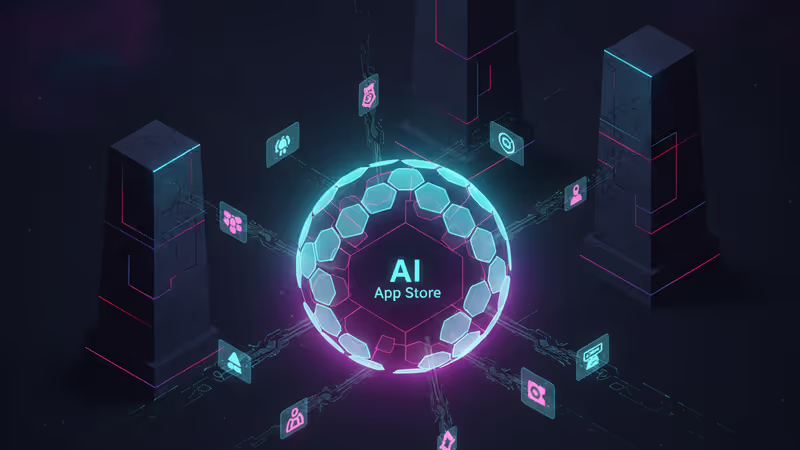
OpenAI's App Store Moment: Why ChatGPT's Directory Is a Declaration of War on Big Tech
OpenAI's new App Directory for ChatGPT isn't just a feature. It's a strategic move to build the next dominant computing platform, challenging Apple and Google.
The Lede: Beyond the Bot
OpenAI just launched an 'App Directory' and SDK for ChatGPT. A busy executive might dismiss this as a minor feature update. That would be a critical miscalculation. This isn't about adding functionality; it's about building an empire. OpenAI is executing a classic platform playbook, aiming to make ChatGPT the central operating system for the next era of computing. This move signals a direct challenge not just to other AI labs, but to the very foundations of Apple's App Store and Google's dominance in search and Android.
Why It Matters: The Birth of an Ecosystem
The significance of this launch lies in its second-order effects. By transforming a conversational tool into a development platform, OpenAI is catalyzing a new economy. The immediate impacts are clear:
- The App Store Flywheel: The release of an SDK and a centralized directory ignites a powerful flywheel. More developers build useful 'apps' (formerly 'connectors'), which attracts more users, which in turn incentivizes more developers. This is the exact strategy that cemented the dominance of the iPhone and Windows.
- Shift from 'Search' to 'Do': Google gave us answers. ChatGPT, as a platform, aims to execute tasks. This ecosystem will empower users to analyze a Google Sheet, book a flight, and draft a legal brief within a single, conversational interface. It's a fundamental paradigm shift from information retrieval to action completion.
- New Moats are Dug: The competitive moat in AI is shifting. While foundational model superiority is still key, it's becoming table stakes. The real, defensible moat will be the network effects of a thriving developer and user ecosystem. A user with ten indispensable AI apps integrated into their workflow will not easily switch to a rival chatbot, even if its underlying model is marginally better.
The Analysis: Echoes of 2008
We've seen this movie before. In 2008, Apple launched the App Store, transforming the iPhone from a sleek gadget into an indispensable life-hub. It unleashed a torrent of innovation and created multi-billion dollar industries that Apple couldn't have imagined on its own. Before that, Microsoft’s dominance was cemented not just by Windows, but by the rich ecosystem of software that developers built for it using its APIs.
OpenAI is meticulously following this script. The subtle rebranding of 'connectors' to 'apps' is a deliberate, strategic signal. A 'connector' is a technical pipe; an 'app' is a user-facing experience. OpenAI is telling the world it's no longer just in the business of providing an API; it's in the business of hosting an economy.
This puts immense pressure on competitors. Google is racing to integrate its AI, Gemini, across its product suite, but it's now also forced to defend its core platform businesses (Android, Chrome, Search) from a new kind of existential threat. Apple, the master of closed ecosystems, must now decide how to respond to a powerful, open-ended AI platform that could eventually siphon value away from its own App Store.
PRISM Insight: The 'Pick-and-Shovel' Gold Rush
The immediate investment implication isn't just in OpenAI or its direct competitors. The real gold rush will be in the 'pick-and-shovel' plays. A new class of companies will emerge providing the infrastructure, security, and tooling for developers to build, manage, and monetize these new ChatGPT apps. We will see the birth of 'AI-native' agencies, analytics platforms for conversational apps, and security firms specializing in protecting these new endpoints. For enterprise leaders, the question is no longer 'How do we use ChatGPT?' but 'How do we build on ChatGPT to create a competitive advantage?'
PRISM's Take: The OS for AI
OpenAI's App Directory is far more than a feature launch; it is the most aggressive and coherent attempt yet to build the dominant, general-purpose platform for the AI era. Sam Altman's vision is clear: to create the 'Windows' or 'iOS' for artificial intelligence, a central hub through which all other applications and services will eventually flow. The race for the best AI model is still raging, but OpenAI has just fundamentally changed the nature of the war. It's no longer just about who has the smartest brain; it's about who builds the most vibrant city around it.
関連記事
OpenAIの最新コーディングAI、GPT-5.2-Codexを徹底解説。長期的推論、大規模リファクタリング、サイバーセキュリティ能力が開発の未来をどう変えるか分析します。
取材拒否されたOpenAIのCEOをディープフェイクで再現。ドキュメンタリーが暴くAI倫理、デジタルアイデンティティの未来、そして人間とAIの新たな関係性。
OpenAIがChatGPTのApp Storeを開設。これは単なる新機能ではなく、AIがプラットフォーム化する「iPhoneモーメント」だ。その戦略的意味と業界への影響を深く分析します。

OpenAIの新画像AIは、写真編集を会話レベルにまで簡素化。これは技術競争だけでなく、「信頼」そのものを揺るがす時代の転換点です。その深層を分析します。