

OpenAI's App Store Moment: Why ChatGPT Just Became The New Internet
OpenAI's ChatGPT app store is more than a feature. It's a strategic move to build the next OS, igniting a new platform war and a developer gold rush.
The Lede: This Isn't a Feature, It's a Foundational Shift
OpenAI's announcement of an app submission process and in-product directory for ChatGPT isn't a minor product update—it's the most significant strategic move since the launch of ChatGPT itself. For the C-suite, this is the starting pistol for the next platform war. OpenAI is no longer building a product; it is methodically constructing a new operating system for the internet, with ChatGPT as its command line. The decision to open its gates to developers transforms the AI from a conversational tool into a dynamic, action-oriented ecosystem, signaling the dawn of the AI agent economy.
Why It Matters: The Second-Order Effects
The immediate impact is clear: enhanced functionality. But the strategic implications run far deeper, creating new markets and competitive battlegrounds.
- The Rise of the 'Intent Layer': ChatGPT is positioning itself as the universal interface for user intent. Instead of opening multiple apps to book a flight, find a hotel, and add it to your calendar, you will simply state your goal. The platform, via its integrated apps, will execute the entire workflow. This threatens to disintermediate countless services, including search engines and traditional app aggregators.
- A New Developer Gold Rush: Just as the iOS App Store created a multi-trillion dollar mobile economy, ChatGPT's app directory ignites a land grab for AI-native services. The first-mover advantage for developers who create indispensable 'chat-native' experiences—the Uber or Instagram of the AI era—is immense.
- From Prompt Engineering to Action Engineering: The core developer skill is shifting. The focus is no longer just on crafting the perfect text prompt but on building robust, reliable agents that can translate conversational requests into real-world API calls and actions. This requires a new class of tooling, security protocols, and validation frameworks.
The Analysis: Echoes of 2008, But Faster
The parallel to Apple's 2008 launch of the iPhone App Store is unavoidable, but the context is critically different. Apple had the hardware (iPhone) as a locked-down foundation. OpenAI's 'hardware' is its foundational model and its massive, engaged user base—a moat built on data and computational power.
This is a direct challenge to the established platform holders. Google, with its Android and Play Store, now faces an existential threat to its core search-and-discover business model. Microsoft, a key OpenAI partner, must navigate a complex relationship where its Copilot ecosystem competes with the very platform it heavily invests in. Apple's 'Siri + App Store' model, which has languished for years, now looks dangerously obsolete. OpenAI isn't just trying to win a category; it's attempting to redefine the entire field of human-computer interaction.
PRISM Insight: The 'Picks and Shovels' Investment Thesis
While everyone rushes to build the next breakout AI app, the most durable investment opportunities may lie in the enabling infrastructure. The 'picks and shovels' of this new gold rush will be in companies building:
- Agentic Tooling: Frameworks that help developers reliably connect language models to APIs and external data sources.
- AI Security & Trust: Solutions for verifying, securing, and monitoring the actions of third-party AI agents to prevent misuse and data breaches.
- Observability and Analytics: Platforms to track the performance, cost, and user behavior within these new conversational applications.
The value chain is being built in real-time, and the foundational layers will be immensely valuable.
PRISM's Take: The Gravitational Pull is Irresistible
OpenAI has made a calculated, audacious bet. By turning ChatGPT into a platform, it invites the world's developers to build its future, accelerating innovation at a pace it could never achieve alone. For developers, this presents a classic Faustian bargain: incredible distribution on a paradigm-shifting platform, but with the inherent risk of platform dependency and the ever-present threat of being 'Sherlocked' (where the platform owner copies a successful app's functionality into the core product).
Despite the risks, the gravitational pull of ChatGPT's user base and technological lead is too powerful to ignore. The race is no longer about building a better chatbot. It's about building the essential services that will define the next decade of digital interaction. The starting gun has fired.
関連記事

OpenAIの最新コーディングAI、GPT-5.2-Codexを徹底解説。長期的推論、大規模リファクタリング、サイバーセキュリティ能力が開発の未来をどう変えるか分析します。
取材拒否されたOpenAIのCEOをディープフェイクで再現。ドキュメンタリーが暴くAI倫理、デジタルアイデンティティの未来、そして人間とAIの新たな関係性。
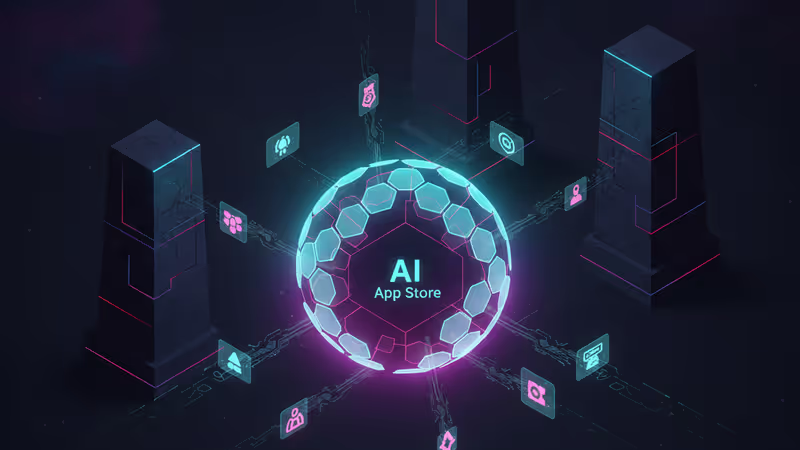
OpenAIがChatGPTのApp Storeを開設。これは単なる新機能ではなく、AIがプラットフォーム化する「iPhoneモーメント」だ。その戦略的意味と業界への影響を深く分析します。

OpenAIの新画像AIは、写真編集を会話レベルにまで簡素化。これは技術競争だけでなく、「信頼」そのものを揺るがす時代の転換点です。その深層を分析します。