
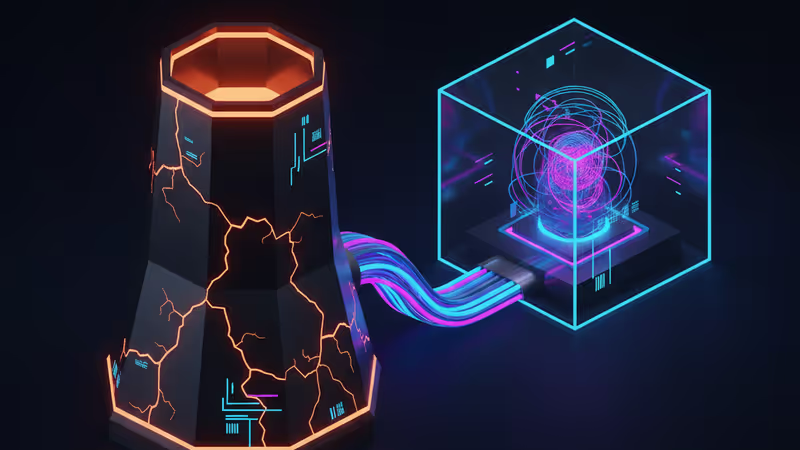
Nuclear's New Billion-Dollar Bet: Is This AI's Power Play or a Pre-Meltdown Bubble?
VCs are pouring billions into nuclear startups like Radiant to power the AI boom. PRISM analyzes if this is a strategic energy shift or a bubble on the brink of a shakeout.
The Trillion-Dollar Question
Radiant Nuclear just closed a $300 million funding round, valuing the microreactor startup at $1.8 billion. On its own, it’s a massive vote of confidence. But viewed in context—following nine-figure rounds for Last Energy, X-energy, and Aalo Atomics in mere weeks—it signals something far more significant. This isn't just another climate tech funding trend. This is Silicon Valley attempting to underwrite a solution to its own, self-created, existential crisis: AI's insatiable demand for power.
Why It Matters: The Symbiotic Bet
The success of the multi-trillion-dollar AI revolution is now directly tethered to the success of a nascent, high-risk, advanced nuclear sector. This is a symbiotic relationship of immense consequence. Without a new source of clean, reliable, baseload power, the exponential growth of data centers will physically and economically stall. Most analysis misses the second-order effect: a failure in the advanced nuclear sector won't just be a loss for climate tech VCs; it could become a systemic cap on the growth of the entire AI industry.
Conversely, the near-infinite capital and desperate demand from Big Tech provides the nuclear industry with something it hasn't had in 50 years: a well-funded, politically powerful, and highly motivated first customer. This changes the entire dynamic from a government-led science project to a market-driven imperative.
The Great Nuclear Filter of 2026
While the capital flows freely, a brutal reckoning is approaching. The current investment frenzy isn't just funding technology; it's funding a race against time. The industry faces three critical filters that will separate the future energy giants from expensive science experiments.
Filter 1: The Regulatory Gauntlet
Previous nuclear renaissances fizzled in the face of byzantine regulations and decade-long approval timelines. While programs exist to speed up approvals—like the one targeting a July 4, 2026 criticality deadline for several startups—navigating the Nuclear Regulatory Commission (NRC) remains a formidable challenge. A company's technology is only as good as its regulatory strategy. A single misstep here can be fatal.
Filter 2: The Manufacturing Valley of Death
As the source correctly notes, building a single, hand-crafted demonstration reactor is one thing. Mass-producing them at a cost that competes with alternatives is another entirely. Many of these startups predicate their entire business model on a factory-based approach, a feat the nuclear industry has historically failed to achieve. Crossing this chasm from bespoke prototype to assembly-line product is where most will likely stumble. It requires a completely different skillset than R&D.
Filter 3: The Hype-Cycle Headwind
The current AI-driven urgency provides a powerful tailwind. But if these startups fail to meet their ambitious mid-decade deadlines, investor patience will wear thin. The narrative could quickly shift from "essential AI infrastructure" back to "complex, delayed nuclear projects." The capital spigot could tighten just as companies need it most for scaling production, creating a dangerous trap for all but the clear frontrunners.
PRISM Insight: De-Risking the Atom
For investors, the key takeaway is that this is no longer a pure technology play. The underlying fission science is relatively understood. The real risk—and opportunity—lies in execution across three non-technical domains:
- Regulatory Arbitrage: Which teams have the deepest expertise and most credible strategy for navigating the NRC? Look for teams with former regulators and a clear, milestone-based plan for licensing. This is a moat as powerful as any patent.
- Supply Chain Mastery: Who can actually build a robust supply chain for specialized components like TRISO fuel and helium coolants at scale? A brilliant design with a non-existent supply chain is worthless.
- Customer Integration: Beyond press-release partnerships, like Radiant's with Equinix, which startups are deeply embedded with data center operators to design reactors that meet their specific operational needs for security, footprint, and power delivery?
We anticipate a wave of consolidation around 2027-2028. The few companies that successfully achieve criticality and demonstrate a clear path to manufacturing will likely acquire the intellectual property and talent from the dozens of competitors who falter, creating a handful of dominant, vertically-integrated players.
PRISM's Take
To call this a 'bubble' is to misunderstand the fundamental forces at play. This is a high-stakes, high-dispersion qualifying round, not a speculative frenzy. Unlike Web3, the demand is not hypothetical; the power gap for AI is real, measured in gigawatts, and growing daily. However, the probability of failure for any individual startup remains incredibly high.
The outcome will be binary. A few of these companies will succeed, becoming foundational energy providers for the 21st-century digital economy and generating venture returns of a scale rarely seen. The rest will become footnotes. The critical story for the next 24 months isn't just about who raises the most money, but who can navigate the unforgiving path from blueprint to baseload power before the AI industry's energy bill comes due.
関連記事
韓国が150兆ウォン規模の公的成長ファンドを設立。AI、半導体、バッテリーに重点投資する国家戦略を分析し、投資家や業界への影響を読み解きます。
新型の円盤型衛星「DiskSat」が打ち上げ。20年にわたり標準だったCubeSatを超える存在となるか?宇宙産業の新たなパラダイムシフトを専門家が分析します。
AIデータセンターの需要爆発により、PC用メモリとSSDの価格が記録的に高騰。自作PCユーザーとゲーマーが直面する新たな現実と、専門家による対策を解説します。

YouTubeが200万登録のAI偽映画予告編チャンネルを閉鎖。AIコンテンツの許容範囲と「欺瞞」の境界線がどこにあるのか、プラットフォームの新たな姿勢を専門家が分析します。