
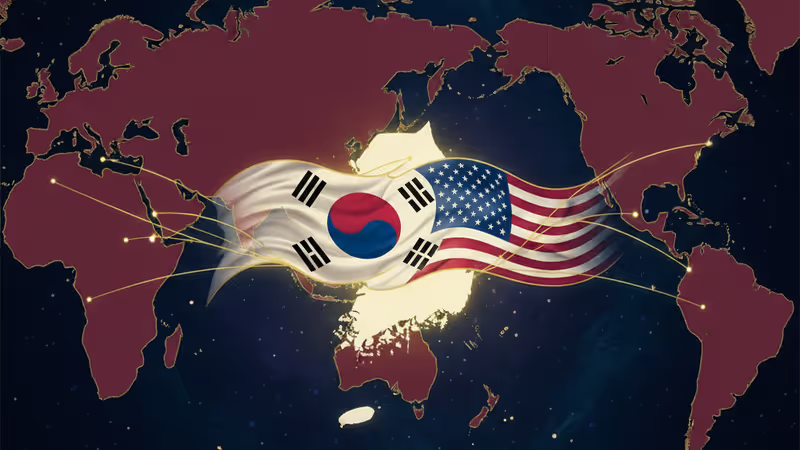
South Korea's Push for Military Autonomy Puts 70-Year U.S. Alliance at a Crossroads
As South Korea pursues greater military autonomy, including the OPCON transfer and nuclear submarines, the 70-year alliance with the U.S. is at a turning point. An analysis of the motives and future.
They're shaking hands, but the calculations under the table are complex. South Korea is accelerating its push for greater military autonomy—from seeking to retake wartime operational control (OPCON) from Washington to building its own nuclear-powered submarines. While the U.S. appears to be receptive, this shift in the decades-old alliance is being driven by a much larger geopolitical game: containing China.
Seoul's Drive for Self-Reliance
South Korean President Lee Jae Myung’s administration is aiming to retake wartime OPCON before his term ends in 2030. A transition would mean a South Korean general would lead the allies' combined forces during a conflict. In a sign of progress, Defense Minister Ahn Gyu-back and U.S. Defense Secretary Pete Hegseth agreed last month in Seoul to develop a roadmap to "expedite" the process, according to a Yonhap report.
This pursuit of autonomy extends beyond command structures. After bilateral missile guidelines were lifted in 2021, South Korea gained the ability to develop ballistic missiles with ranges greater than 800 kilometers. More recently, Seoul has been pushing to acquire nuclear-powered submarines, an effort that received backing from U.S. President Donald Trump during their summit in late October.
Washington's Strategic Calculus
The U.S. appears receptive because a stronger, more autonomous South Korea aligns with its broader strategy of countering China. Nam Chang-hee, a professor at Inha University, told Yonhap that Washington believes the benefits of bolstering its ally's capabilities to check China outweigh the risks of its increased autonomy. RAND Corp. senior defense analyst Bruce Bennett added that the U.S. government realizes that both the economic burden and control must be shared with its allies.
However, some observers argue that Trump's support is more transactional than strategic. His backing for the submarine project followed grueling trade negotiations where Seoul committed to investing US$350 billion in the U.S. The view on the ground is also more cautious. Gen. Xavier Brunson, commander of U.S. Forces Korea (USFK), has stressed that meeting the agreed-upon conditions for the OPCON transfer is more important than adhering to a specific timeline.
本コンテンツはAIが原文記事を基に要約・分析したものです。正確性に努めていますが、誤りがある可能性があります。原文の確認をお勧めします。
関連記事
韓国が長年の懸案である戦時作戦統制権(OPCON)の返還を求める中、米国はこれを容認する姿勢を見せている。米中対立を背景に、米韓同盟の力学はどう変化するのか、その深層を分析する。

韓国製造業の賃金が日本を27.8%、台湾を25.9%上回る一方、生産性の伸び悩みから国際競争力の低下が懸念されています。その背景と課題を分析します。

日本の国会で提起された「外国人犯罪率1.72倍」説。元刑事や記者の証言、東京地裁の裁判傍聴から、その実態と司法現場が抱える通訳不足などの課題を多角的に分析します。
ナイジェリア北東部の都市マイドゥグリのモスクで24日夜、爆発が発生し、礼拝中の信者少なくとも8人が死亡した模様。長年ボコ・ハラムなどの活動拠点となってきた地域で、治安への懸念が再燃している。
韓国が長年の懸案である戦時作戦統制権(OPCON)の返還を求める中、米国はこれを容認する姿勢を見せている。米中対立を背景に、米韓同盟の力学はどう変化するのか、その深層を分析する。
韓国製造業の賃金が日本を27.8%、台湾を25.9%上回る一方、生産性の伸び悩みから国際競争力の低下が懸念されています。その背景と課題を分析します。
日本の国会で提起された「外国人犯罪率1.72倍」説。元刑事や記者の証言、東京地裁の裁判傍聴から、その実態と司法現場が抱える通訳不足などの課題を多角的に分析します。
ナイジェリア北東部の都市マイドゥグリのモスクで24日夜、爆発が発生し、礼拝中の信者少なくとも8人が死亡した模様。長年ボコ・ハラムなどの活動拠点となってきた地域で、治安への懸念が再燃している。