
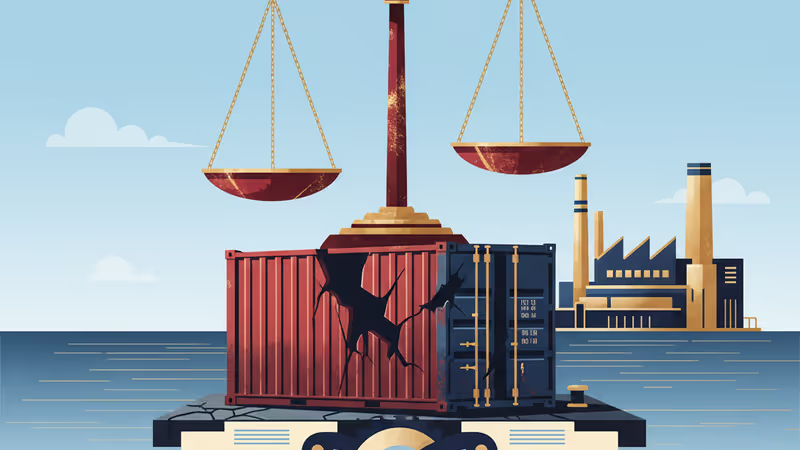
Trump's Blueprint for a Second Term: A 60% Tariff on China and a 'Ring Fence' Around the U.S. Economy
An in-depth analysis of the proposed second-term economic plan for Donald Trump, featuring a 60% tariff on Chinese goods and a 10% universal tariff, and its potential to trigger a global trade war and reshape the U.S. economy.
Advisors to former President Donald Trump have outlined a radical economic plan for a potential second term, proposing a universal 10% baseline tariff on all imports and a staggering 60% tariff on all goods from China. The proposal, intended to aggressively rebalance global trade and bolster U.S. manufacturing, has ignited a firestorm of debate, with critics warning it could trigger a global trade war and severely damage the American economy.
The plan was detailed in recent interviews by Robert Lighthizer, who served as U.S. Trade Representative, and Robert O'Brien, a former National Security Advisor. According to Lighthizer, the ultimate goal is to eliminate the nation's roughly $500 billion annual trade deficit. He argued for creating a "ring around the U.S. economy," using the 10% universal tariff as a starting point for negotiating better terms with trade partners.
1. Universal Baseline Tariff (10%): A flat tax on all goods imported into the U.S., regardless of origin. This would serve as leverage in trade negotiations. 2. Punitive China Tariff (60%+): A targeted, much higher tariff on all Chinese goods, aimed at forcing a dramatic rebalancing of trade with America's largest trade deficit partner.
Proponents frame the strategy as a matter of national security. "It's not just an economic issue; it's a national security issue," O'Brien stated, arguing that dependence on foreign supply chains has hollowed out America's industrial base. The advisors contend that the tariffs from Trump's first term were successful but insufficient to correct long-standing trade imbalances.
The plan was met with immediate and stark warnings from mainstream economists. Adam Posen, president of the Peterson Institute for International Economics, called the proposal a "prescription for a Great Depression." He argued that such tariffs would function as a massive tax on American consumers and businesses, disrupting global supply chains and sparking runaway inflation.
An analysis by the non-partisan Tax Foundation estimated that the plan would reduce long-run U.S. GDP by 1.1%, eliminate 825,000 full-time equivalent jobs, and lower wages.
This proposal is more than a trade policy; it's a fundamental challenge to the post-WWII global economic order. It signals a potential move away from the multilateralism of the WTO toward aggressive, power-based bilateralism. If implemented, global corporations would be forced into a costly and chaotic realignment of supply chains, while consumers would likely face higher prices. The plan underscores that the upcoming U.S. election is a critical inflection point for the future of the global economy.
本コンテンツはAIが原文記事を基に要約・分析したものです。正確性に努めていますが、誤りがある可能性があります。原文の確認をお勧めします。
関連記事

米国の有力保守系シンクタンク、ヘリテージ財団で職員十数人が集団離職。反ユダヤ主義などを唱える右派インフルエンサーの処遇を巡る内部の路線対立が表面化し、米保守運動全体の分裂を象徴している。
韓国の与党「共に民主党」が、これまで反対してきた「統一教会」疑惑に関する特別検察官の導入を電撃的に受け入れた。与野党間の政治的計算が交錯する中、世論の強い支持を背景に政界を揺るがす捜査が本格化する見通しだ。
ガザ地区で約2000年の歴史を持つ大オマリ・モスクが、続く紛争の中で廃墟と化しました。この文化遺産の破壊が意味するものと、紛争下における歴史的建造物保護の課題について解説します。
2025年の会期末を迎え、米連邦議会の立法実績は乏しく、引退議員が増加しています。複数の元議員が「議会は昏睡状態にある」と現状に深刻な懸念を表明し、問題は長年かけて形成されたものだと指摘しています。