

NASA Just Built Its Next Great Observatory. It’s Not Another Webb.
NASA's newly completed Roman Space Telescope isn't another Webb. It's a 'Big Data' observatory set to create a data tsunami and redefine astronomy.
The Lede: Beyond the Pretty Pictures
While the James Webb Space Telescope (JWST) captures the world's imagination with its stunning, deep-field images, NASA has quietly completed assembly of its next cosmic titan: the Nancy Grace Roman Space Telescope. On the surface, it’s another major observatory on track for a 2026 launch. For the informed executive, however, this isn't just 'Webb 2.0'. Roman represents a fundamental strategic pivot in cosmic discovery—from surgical strikes to wide-scale surveillance. It’s an instrument built not for the single perfect photo, but for a data deluge that will redefine astronomy and challenge our tech infrastructure.
Why It Matters: The Shift from Microscope to Panoramic Map
The completion of the Roman telescope isn't just a hardware milestone; it signals a new era of astronomical investigation. Where Hubble and Webb act as cosmic microscopes, peering deep into tiny patches of sky to study individual objects in exquisite detail, Roman is a panoramic camera. Its field of view is 100 times larger than Hubble's. This isn't an incremental improvement; it's a paradigm shift.
This wide-angle capability is purpose-built to tackle two of the most profound mysteries in science:
- Dark Energy: By mapping the distribution and distance of millions of galaxies over vast cosmic history, Roman will provide the statistical power to test theories about the mysterious force accelerating the expansion of the universe.
- Exoplanet Census: Instead of studying one alien world at a time, Roman will conduct a massive galactic survey, using microlensing to detect thousands of exoplanets. This will create the first robust statistical census of planetary systems, telling us how common worlds like Earth truly are.
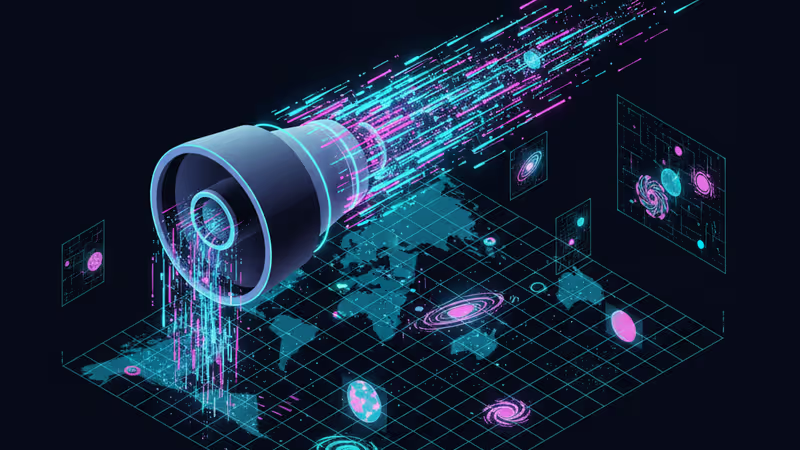
The second-order effect that most aren't considering is the data tsunami. Roman will generate petabytes of data, creating an unprecedented challenge and opportunity for AI, machine learning, and cloud computing firms tasked with parsing this cosmic firehose.
The Analysis: A New Pillar of Cosmic Observation
Hubble's Precision, Webb's Depth, Roman's Breadth
Understanding Roman requires placing it in context. For three decades, NASA's space observatories have followed a 'deep-and-narrow' philosophy. The Hubble Space Telescope gave us our sharpest views of the visible universe. The JWST pushed that frontier into the infrared, allowing us to see the universe's first galaxies. Both are fundamentally designed to zoom in.
Roman breaks this tradition. It's the third pillar in a strategic triad. If Hubble is the keen-eyed observer and Webb is the time-traveling archaeologist, Roman is the master cartographer. Its mission is to create the largest, deepest maps of the universe ever conceived. This systematic, 'Big Data' approach is less about the serendipitous discovery of a single strange object and more about building the foundational datasets that will allow scientists to understand the universe's fundamental rules at a statistical level.
The Coming Data Deluge
The true legacy of the Roman telescope may be measured in bytes as much as light-years. The sheer volume of high-resolution imagery it will produce is staggering and will dwarf the archives of its predecessors. This isn't just a problem for NASA's data centers; it's a catalyst for innovation.
Analyzing Roman's surveys will be impossible for humans alone. The mission is explicitly designed to be powered by algorithms and machine learning. Identifying faint gravitational lensing signals or classifying millions of galaxies will require automated systems on an unprecedented scale. This makes the Roman mission as much a landmark project for Big Data and AI as it is for astrophysics.
PRISM Insight: The Industrialization of Astronomy
The core insight here is the shift from artisanal to industrial-scale discovery. Previous great observatories enabled breathtaking, handcrafted discoveries by small teams. Roman is designed to fuel an entire industry of data-driven science. Its success won't be a single press-conference image, but a steady flow of cataloged data that powers thousands of scientific papers for a decade or more.
This has profound implications for the future of scientific research. It signals that the next great breakthroughs may not come from a lone genius staring at an image, but from a data scientist designing a better algorithm to sift through Roman's digital universe. For the tech sector, this means the tools being developed for market analysis and logistics are now becoming critical instruments for fundamental cosmic research. The demand for efficient data processing, storage, and AI analysis from scientific institutions is about to skyrocket.
PRISM's Take
The Nancy Grace Roman Space Telescope is the unsung workhorse set to define the next decade of cosmology. While JWST will continue to deliver awe-inspiring, emotionally resonant images of specific cosmic wonders, Roman will quietly build the statistical backbone needed to solve the universe's largest structural mysteries. It trades the immediate 'wow' factor for long-term, foundational understanding. This is a strategic and necessary evolution, recognizing that in the 21st century, the greatest discoveries lie hidden not in a single point of light, but in the patterns revealed across billions of them.
関連記事

民間宇宙飛行士ジャレッド・アイザックマン氏のNASA長官就任は単なる人事ではない。SpaceX主導の民間企業が宇宙開発の主導権を完全に掌握したことを示す地殻変動を分析。
民間宇宙飛行家J.アイザックマン氏がNASA新長官に。宇宙開発の商業化が加速する中、新時代のNASAが目指すものとその影響を専門家が徹底分析。
NASAのナンシー・グレース・ローマン宇宙望遠鏡が完成。JWSTの100倍の視野で暗黒エネルギーや系外惑星を探査。宇宙ビッグデータ時代の幕開けを専門家が分析。
NASAの次世代宇宙望遠鏡「ローマン」が完成。ハッブルの100倍の視野で、ダークマターや系外惑星の謎に挑む。宇宙探査とビッグデータの未来を解説します。