
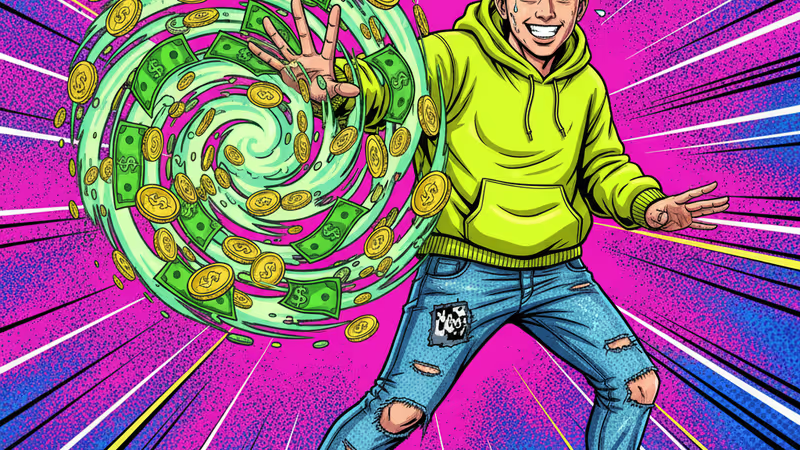
Money Literally Buys Superpowers in 'Cashero' — Why This Netflix K-Drama Is Your Next Obsession
Netflix's new K-drama 'Cashero' gives a hero superpowers based on how much cash he holds. Discover why this unique capitalist satire is already going viral.
It's the most 'late-stage capitalism' superhero ever conceived, and the internet is already losing its mind.
TL;DR: Netflix just dropped details on its new K-drama, “Cashero,” where an ordinary guy gets superpowers proportional to the amount of cash he's holding. This brilliantly absurd premise is a ready-made recipe for a global viral hit, tapping into universal anxieties about money and power.
The Story: A Superhero Powered by Cold, Hard Cash
In a world saturated with capes and cosmic powers, a new hero is emerging from the most unlikely of places: the ATM. Netflix’s upcoming series “Cashero,” based on a popular webtoon, centers on Kang Sang Ung (played by K-pop idol and acclaimed actor Lee Junho), a regular government employee whose life is turned upside down when he develops a bizarre ability: his physical strength is directly tied to the cash he possesses. Need to lift a car? You'd better have a few thousand dollars on hand. Down to your last dollar? You can barely lift a feather.
The concept alone is a stroke of genius, but the recent reveal of its villains has sent the hype into overdrive. Rising stars Lee Chae Min (“Hierarchy”) and Kang Han Na (“Start-Up”) are set to play a pair of power-hungry villainous siblings, instantly creating a classic dynamic of earned power versus inherited wealth and influence. The first stills have hit the internet, and the conversation is already electric.
The Best Reactions: The Internet Cashes In
While the show is still in production, its killer premise has already sparked a wave of hilarious and insightful reactions across social media. Here’s a curated look at what has everyone talking:
- The most common sentiment is pure astonishment at the concept's satirical brilliance: “A superhero whose power level depends on his bank account? This is the most relatable and depressing hero for our generation. I’m obsessed.”
- Many are already riffing on the comedic possibilities: “Imagine him in a huge fight, but his credit card gets declined mid-punch and he just goes limp. The meme potential is off the charts.”
- Viewers are connecting it to everyday financial struggles: “So when he’s broke before payday, is he just a normal dude? This is literally me trying to get through the last week of the month.”
- There's also genuine excitement for its potential as a sharp social commentary: “This is either going to be the smartest satire on capitalism since Parasite or the funniest show of the year. Either way, I am SEATED.”
Cultural Context: Why This Resonates Globally
“Cashero” isn't just a quirky idea; it's a perfect storm of cultural trends. South Korean creators have become masters of the capitalist critique, with global phenomena like Squid Game and Parasite finding massive audiences by exploring themes of debt, class struggle, and economic inequality. “Cashero” takes this a step further, turning the subtext into text by literally equating money with power.
Its brilliance lies in its simplicity. You don't need to understand complex lore or cultural nuances to get the joke. The phrase “money is power” is universal, making the show instantly accessible to a global audience. Furthermore, adapting wildly popular webtoons is a proven formula for Netflix, de-risking the project with a built-in fanbase and a story that has already been stress-tested for audience engagement.
PRISM Insight: Engineered for Meme-ification
Our take? “Cashero” represents the next evolution of content strategy: creating shows that are not just meant to be watched, but to be memed. The premise is a content-generating engine in itself.
1. Virality as a Feature, Not a Byproduct: The core concept is so simple and visual that it’s practically designed for viral clips, TikToks, and reaction GIFs. Every fight scene will double as a visual gag about personal finance. This organic, user-generated marketing is infinitely more powerful than a traditional ad campaign. Netflix isn't just launching a series; it's launching a thousand memes.
2. The Relatable Superhero: In an age of billionaire playboys in iron suits and god-like aliens, “Cashero” offers a hero for the rest of us. His power isn't derived from a spider bite or a super-soldier serum, but from his financial situation—a daily concern for billions. This grounds the fantastical in the painfully real, creating a character whose struggles feel more immediate and resonant than stopping an alien invasion. It's the perfect superhero for the gig economy generation, and it's why “Cashero” is poised to be not just a hit show, but a defining cultural conversation.
関連記事
アルゴリズムの語源はアラビア語。日常に隠されたアラブ文化の影響を解き明かし、AI時代の言語学習とビジネスチャンスを分析します。
結婚費用が高騰する中、ハネムーンの価値観が激変。単なる節約ではない、Z世代が求める『本物の贅沢』とは何か。その背景にある社会とテクノロジーのトレンドを分析します。
今日のWordleの答えは単なる5文字の単語ではありません。その裏にあるNYTのビジネス戦略と、デジタル時代の「習慣化」の重要性をPRISMが徹底分析します。
NYTの新作パズル『Strands』はなぜ人気なのか?その背後にあるメディアの巧妙なエンゲージメント戦略と、アテンションエコノミーの未来を専門家が分析します。