
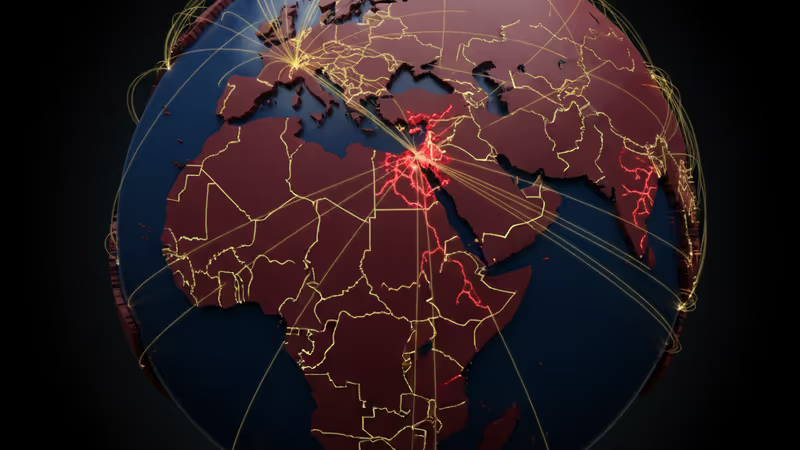
West Bank at the Brink: Why Localized Clashes Signal a Wider Geopolitical Unraveling
Recent violence in the West Bank and Gaza signals a dangerous new phase in the Israeli-Palestinian conflict, with significant geopolitical and investment risks.
The Lede: Beyond the Headlines
Reports of three Palestinian deaths in separate incidents in the West Bank and Gaza are more than tragic data points in a long-running conflict. For the C-suite, this pattern of escalating, decentralized violence signals the breakdown of the long-standing security paradigm in the region. The West Bank, once considered the 'managed' front compared to Gaza, is becoming a tinderbox. This shift indicates a new, more unpredictable phase of instability that threatens to unravel delicate regional alliances and creates significant, under-appreciated risk for global business and diplomacy.
Why It Matters: The Second-Order Effects
The immediate human cost is clear, but the strategic implications ripple outward, impacting global stability and investment climates:
- Geopolitical Volatility: This ground-level friction directly challenges the top-down narrative of the Abraham Accords, reminding global powers that the core Israeli-Palestinian conflict cannot be indefinitely bypassed. It strains US diplomatic capital and creates openings for rivals like Russia and China to expand their influence.
- Investor Risk: Heightened instability spooks markets. For companies with operations, supply chains, or investments in the broader Middle East, this signals a need to re-evaluate regional risk models. An escalation could impact energy transit routes and overall market sentiment.
- The Tech Battleground: These clashes turn the region into a complex arena for technology companies. Social media platforms face intense pressure over content moderation, while defense and surveillance tech firms navigate the ethical and political minefield of supplying conflict zones.
The Analysis: A System Under Stress
To understand the current danger, one must differentiate between the two Palestinian territories. Gaza, ruled by Hamas, is largely contained by an Israeli-Egyptian blockade, leading to predictable, albeit violent, cycles of escalation. The West Bank, however, is now the epicenter of a strategic shift. The Palestinian Authority (PA), the internationally recognized governing body, is experiencing a severe crisis of legitimacy and capability. Its inability to provide a political path forward or effective governance has created a power vacuum.
Into this vacuum, new, localized militant cells are emerging, particularly in northern West Bank cities like Jenin and Nablus. These groups are often more radical, less hierarchical, and not under the direct control of the traditional Fatah leadership. From the Israeli perspective, this necessitates frequent and aggressive military raids to preempt attacks, which in turn fuels Palestinian anger and the cycle of violence. The current Israeli government's policies, including accelerated settlement expansion, are viewed by much of the international community as an accelerant to this breakdown. The result is a fragile system where any single incident—like the recent deaths—has the potential to trigger a much wider conflagration.
PRISM Insight: The TikTok Insurgency & Asymmetric Tech
This is not a traditional conflict. It is a case study in modern, asymmetric warfare supercharged by technology. We are witnessing the rise of the 'TikTok Insurgency,' where platforms like TikTok and Telegram have become primary tools for recruitment, propaganda, and operational communication, bypassing traditional command structures entirely. This makes the violence more viral, harder to track, and more difficult for established authorities on either side to control.
Furthermore, the proliferation of low-cost commercial drones for surveillance and even rudimentary attacks by non-state actors is changing the tactical landscape. The conflict is increasingly a laboratory for cyber-disruption and information warfare, where a hack or a viral video can be as impactful as a physical confrontation.
PRISM's Take: Recalibrate Your Risk Model
The international community's focus on state-to-state normalization deals, while significant, has created a dangerous blind spot to the deteriorating reality on the ground. The assumption that the West Bank's security situation can be indefinitely 'managed' through coordination between the Israeli military and a weakened PA is now obsolete.
Leaders and investors must understand that the conflict is not static; it is entering a more chaotic and fragmented phase. The old playbooks for de-escalation are failing because the actors are changing. The primary risk is no longer just a large-scale, predictable war between Israel and Hamas. It is a sustained, low-grade, and highly unpredictable insurgency in the West Bank that could easily spiral, dragging in regional players and upending the fragile geopolitical order Washington has sought to build.
関連記事
インドネシアの洪水被害からブリュッセルの農家デモ、香港の悲劇的な火災まで。世界が直面した天災、社会の緊張、そして文化的な営みを写真で振り返ります。
ボンダイビーチ銃撃事件から一週間、追悼式典でアルバニージー首相が国民の怒りに直面しました。反ユダヤ主義の台頭を背景に、オーストラリア社会の緊張と政府への信頼の揺らぎが浮き彫りになっています。

シドニーのボンダイビーチで15人が犠牲となった銃撃事件から1週間、オーストラリアは公式の「追悼の日」を迎えました。国全体が悲しみに包まれる中、犠牲者を悼む動きが広がっています。

南アフリカの最大都市ヨハネスブルグで銃乱射事件が発生。現地警察は容疑者の大規模な捜索を開始しました。事件の最新情報と、南アフリカが抱える治安問題の背景を解説します。