
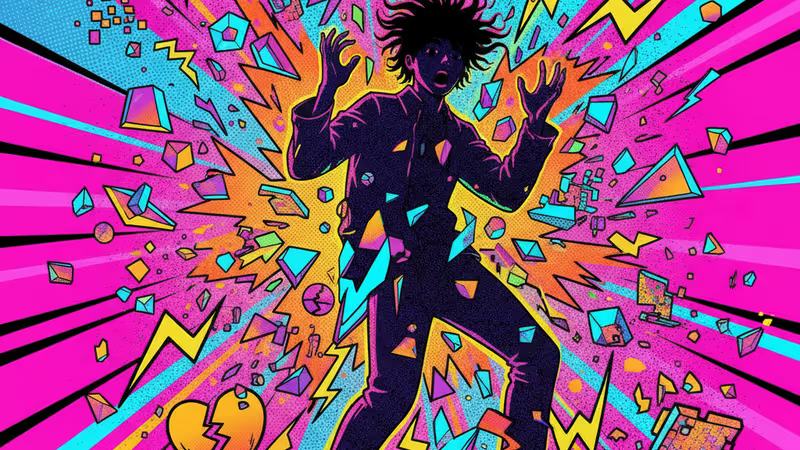
K-Pop's Year of Chaos: Why 2025's Scandal Storm Is More Than Just Drama
2025 was a year of unprecedented chaos for K-Pop. We analyze the major scandals and explain the deep cultural shifts they reveal about the industry's future.
The Great Unmasking of K-Pop
If 2025 felt like a year of non-stop whiplash for K-Pop fans, you're not wrong. From explosive corporate battles fought via CCTV footage to shocking criminal charges and deeply personal revelations, the industry's polished veneer didn't just crack—it shattered. This wasn't just a string of isolated incidents; it was a cultural reckoning played out in real-time on a global stage.
What we witnessed was the violent collision of a meticulously controlled star system with the unfiltered reality of the digital age. The result? A series of viral moments that force us to ask: what is K-Pop becoming, and can it survive its own success?
The Story: A Year of Broken Narratives
The relentless news cycle of 2025 can be understood not as random gossip, but as the collapse of several core myths that the K-Pop industry was built upon. Each scandal targeted a different pillar of the idol fantasy.
Pillar 1: The Myth of Industry Harmony
The simmering feud between industry titan HYBE and its subsidiary ADOR, helmed by the enigmatic Min Hee-jin, boiled over in the most 21st-century way possible: a leaked security video. The clip, which allegedly showed girl group ILLIT greeting their seniors NewJeans, was released to dispute claims of workplace bullying. It instantly became a public Rorschach test.
- The Spark: Allegations that NewJeans were being deliberately ignored by their juniors, ILLIT, on the orders of management.
- The Explosion: The release of ambiguous CCTV footage that, for many, failed to prove anything conclusively, instead exposing the intense surveillance and corporate maneuvering behind the scenes.
- Why People Cared: It peeled back the curtain on the manufactured "family" narrative of entertainment labels, revealing a cutthroat corporate battleground where idols are strategic assets.
Pillar 2: The Myth of the Infallible Idol
The moral purity expected of K-Pop idols has always been an impossible standard. In 2025, that standard was obliterated by a series of shocking allegations and admissions that ranged from the deeply disturbing to the reputationally catastrophic.
- The Crimes: Former NCT member Taeil's admission to aggravated rape charges sent a shockwave of genuine horror through the community, forcing a conversation far beyond typical fan disputes.
- The Allegations: The damning exposé from Kim Sae Ron’s aunt, accusing superstar Kim Soo Hyun of a relationship with the late actress when she was a minor, rocked the internet and irrevocably tainted a top-tier public image.
- The Transgressions: From THE BOYZ's Ju Haknyeon being dismissed for meeting a Japanese porn star to KISS OF LIFE and VERIVERY members being filmed in a private room, the line between private life and public brand became a warzone.
Pillar 3: The Myth of Asexuality & Total Availability
For decades, an idol's romantic life was the ultimate taboo. In 2025, that wall began to crumble, not through gentle announcements, but through unexpected leaks and bold confirmations.
- The Rumors & The Reality: While the alleged Jungkook (BTS) and Winter (aespa) pairing dominated social media gossip, it was the quieter, more concrete revelations that hit harder. 2PM’s Taecyeon's proposal was discovered via a photographer's Instagram, and Girls’ Generation’s Tiffany suddenly announced her impending marriage to actor Byun Yo Han.
- Why it Matters: These events challenge the parasocial contract where fans feel a sense of ownership over an idol's personal life. Each confirmed relationship is a step towards a more mature, Westernized model of celebrity, and not all fans are ready for it.
Best Reactions: The Internet Grapples with Reality
Across social media, the reactions were a mix of disillusionment, dark humor, and sharp analysis. The fan-as-detective and fan-as-commentator were in full force.
- On the ADOR/ILLIT CCTV footage: "This isn't about a ‘hello.’ This is about a multi-billion dollar company using a grainy video of young women to win a PR war. It’s dystopian."
- Responding to the wave of dating news: "First you complain they’re treated like robots, then you have a meltdown when you find out they have a human life? Pick a side!"
- On the more serious criminal allegations: "We need to stop using fandom logic to defend potential crimes. Some things are bigger than K-Pop."
- A viral take on the year's chaos: "Being a K-Pop fan in 2025 is like being an ER doctor. You just walk in every morning and ask, ‘Okay, what’s the catastrophe today?’"
- On the positive news of idols like JUST B's Bain coming out: "Amid all the toxicity, let's not forget the immense courage this takes. This is the real evolution the industry needs."
Cultural Context: The Parasocial Breakup
Why did this year feel so different? Because K-Pop is no longer a niche genre; it's a global cultural force. The standards and scrutiny of a worldwide audience are being applied to an industry model built for a more controlled, domestic market. This is a system under extreme pressure.
The core tension is the 'parasocial relationship'—the one-sided emotional investment fans have in idols. When an idol's real life (messy, complicated, sometimes criminal) shatters the carefully crafted persona, the resulting feeling for many fans is a genuine sense of betrayal or disillusionment. Social media acts as an accelerant, turning personal disappointment into global outrage within hours.
PRISM Insight: The Great Unbundling of the Idol
This isn't just a 'bad year for K-Pop.' We are witnessing the beginning of a fundamental industry shift—what we at PRISM are calling The Great Unbundling. For decades, the 'idol' was a bundled product: singer, dancer, actor, model, and flawless public figure, all controlled by a single corporate entity. 2025 is the year that bundle violently came apart.
The key takeaway is that the old model is no longer sustainable. The level of control required to maintain the 'perfect idol' myth is incompatible with global fame and the ever-present eye of social media. The industry is now at a crossroads:
- The Path of Control: Some companies will double down, implementing even stricter surveillance and media training, creating more sanitized but potentially less resonant artists.
- The Path of Authenticity: Others will move towards a model that allows for more individual expression and humanity. This path accepts that artists will make mistakes, have private lives, and hold controversial opinions. It's a riskier strategy but may build more resilient, long-term careers.
For fans and consumers of culture, the lesson is clear: the era of blissful ignorance is over. Understanding the corporate machinery behind the music is now part of the experience. The future of K-Pop will be shaped by which of these new models fans choose to reward with their attention and their money.
関連記事
史上初のTikTokアワードは、カオスと熱狂の中に新時代の文化の形を示した。クリエイターエコノミーとメディアの未来を専門家が分析します。
90年代に物議を醸した『窒息人形』ジバジャバー。なぜこの玩具は当時許されたのか?現代のウェルネス文化との比較から、時代の変化と未来のトレンドを読み解きます。
3番目の恒星間天体3I/ATLASは宇宙船ではなかった。しかしその正体は、太陽系より古い可能性を秘めた『タイムカプセル』。オウムアムアの謎を解く鍵とは?
Redditで話題!現役医師たちが明かす、私たちが軽視しがちな健康習慣とは?予防医療とテクノロジーの未来を、独自の視点で深掘り分析します。